
PAU Anglès 2019 · Setembre · Sèrie 5 · Part 3 · Listening comprehension
Enunciat
Text de l'enunciat (transcripció automàtica)
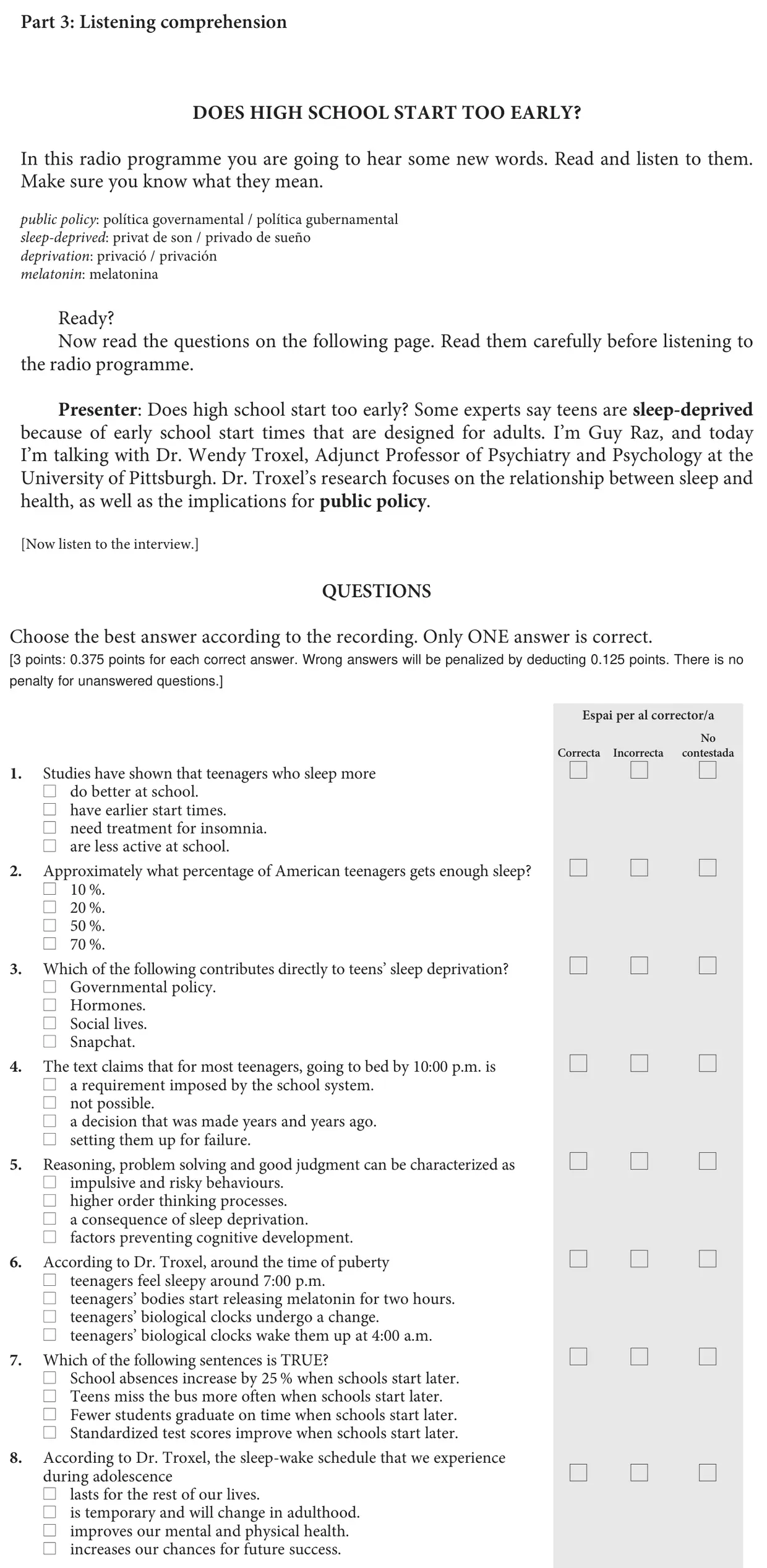
Part 3: Listening comprehension
DOES HIGH SCHOOL START TOO EARLY?
In this radio programme you are going to hear some new words. Read and listen to them.
Make sure you know what they mean.
public policy: política governamental / política gubernamental
sleep-deprived: privat de son / privado de sueño
deprivation: privació / privación
melatonin: melatonina
Ready?
Now read the questions on the following page. Read them carefully before listening to
the radio programme.
Presenter: Does high school start too early? Some experts say teens are sleep-deprived
because of early school start times that are designed for adults. I’m Guy Raz, and today
I’m talking with Dr. Wendy Troxel, Adjunct Professor of Psychiatry and Psychology at the
University of Pittsburgh. Dr. Troxel’s research focuses on the relationship between sleep and
health, as well as the implications for public policy.
[Now listen to the interview.]
QUESTIONS
Choose the best answer according to the recording. Only ONE answer is correct.
[3 points: 0.375 points for each correct answer. Wrong answers will be penalized by deducting 0.125 points. There is no
penalty for unanswered questions.]
1. Studies have shown that teenagers who sleep more
do better at school.
have earlier start times.
need treatment for insomnia.
are less active at school.
2. Approximately what percentage of American teenagers gets enough sleep?
10 %.
20 %.
50 %.
70 %.
3. Which of the following contributes directly to teens’ sleep deprivation?
Governmental policy.
Hormones.
Social lives.
Snapchat.
4. The text claims that for most teenagers, going to bed by 10:00 p.m. is
a requirement imposed by the school system.
not possible.
a decision that was made years and years ago.
setting them up for failure.
5. Reasoning, problem solving and good judgment can be characterized as
impulsive and risky behaviours.
higher order thinking processes.
a consequence of sleep deprivation.
factors preventing cognitive development.
6. According to Dr. Troxel, around the time of puberty
teenagers feel sleepy around 7:00 p.m.
teenagers’ bodies start releasing melatonin for two hours.
teenagers’ biological clocks undergo a change.
teenagers’ biological clocks wake them up at 4:00 a.m.
7. Which of the following sentences is TRUE?
School absences increase by 25 % when schools start later.
Teens miss the bus more often when schools start later.
Fewer students graduate on time when schools start later.
Standardized test scores improve when schools start later.
8. According to Dr. Troxel, the sleep-wake schedule that we experience
during adolescence
lasts for the rest of our lives.
is temporary and will change in adulthood.
improves our mental and physical health.
increases our chances for future success.
Criteris oficials de correcció

Text dels criteris (transcripció automàtica)
Listening Comprehension
Does High School Start Too Early?
In this radio programme you are going to hear some new words. Read and listen to
them. Make sure you know what they mean.
public policy: política governamental / política gubernamental
sleep deprived: privat de son / privado de sueño
deprivation: privació / privación
melatonin: melatonina
Presenter (Guy Raz): Does high school start too early? Some experts say teens are
sleep-deprived because of early school start times that are designed for adults. I’m
Guy Raz, and today I’m talking with Dr. Wendy Troxel, Adjunct Professor of Psychiatry
and Psycology at the University of Pittsburgh. Dr. Troxel’s research focusses on the
relationship between sleep and health, as well as the implications for public policy.
GUY RAZ (GR): Welcome to the show, Dr. Troxel. If I were to ask you to give me one
idea about something that could have a huge impact on kids in schools, what would it
be?
WENDY TROXEL (WT): More sleep.
GR: More sleep—that could […]
Resolució pas a pas
Aquest exercici no té una resolució escrita pas a pas (requereix l'àudio de la prova). Fes servir els criteris oficials de correcció.
Font: enunciat i criteris de correcció oficials de les PAU 2019 de Catalunya, publicats per la Generalitat de Catalunya (universitats.gencat.cat) i les universitats catalanes. La resolució pas a pas és pròpia de L'Acadèmia de Vic.
Altres exercicis d'aquest examen
- Part 1 · Reading comprehension Reading comprehension
- Part 2 · Writing Writing
Tots els exercicis de Listening comprehension · PAU de Anglès