
PAU Anglès 2019 · Juny · Sèrie 1 · Part 1 · Reading comprehension
Enunciat
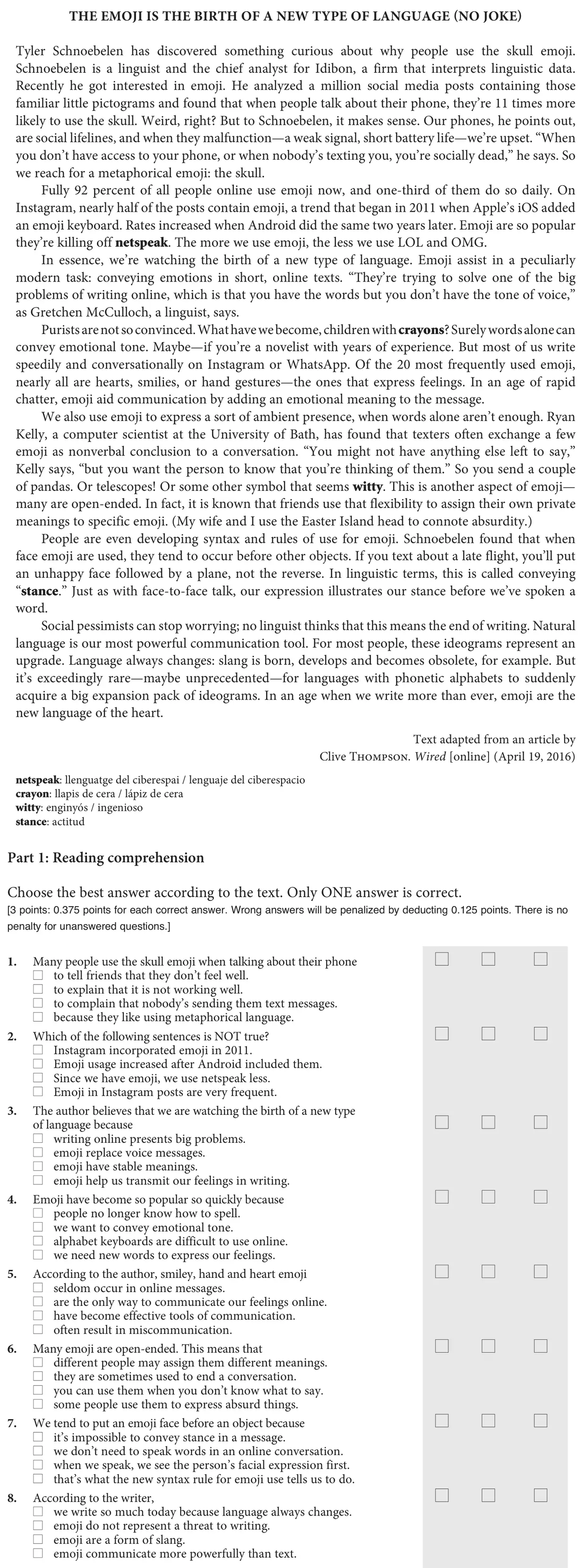
Text de l'enunciat (transcripció automàtica)
THE EMOJI IS THE BIRTH OF A NEW TYPE OF LANGUAGE (NO JOKE)
Tyler Schnoebelen has discovered something curious about why people use the skull emoji.
Schnoebelen is a linguist and the chief analyst for Idibon, a firm that interprets linguistic data.
Recently he got interested in emoji. He analyzed a million social media posts containing those
familiar little pictograms and found that when people talk about their phone, they’re 11 times more
likely to use the skull. Weird, right? But to Schnoebelen, it makes sense. Our phones, he points out,
are social lifelines, and when they malfunction—a weak signal, short battery life—we’re upset. “When
you don’t have access to your phone, or when nobody’s texting you, you’re socially dead,” he says. So
we reach for a metaphorical emoji: the skull.
Fully 92 percent of all people online use emoji now, and one-third of them do so daily. On
Instagram, nearly half of the posts contain emoji, a trend that began in 2011 when Apple’s iOS added
an emoji keyboard. Rates increased when Android did the same two years later. Emoji are so popular
they’re killing off netspeak. The more we use emoji, the less we use LOL and OMG.
In essence, we’re watching the birth of a new type of language. Emoji assist in a peculiarly
modern task: conveying emotions in short, online texts. “They’re trying to solve one of the big
problems of writing online, which is that you have the words but you don’t have the tone of voice,”
as Gretchen McCulloch, a linguist, says.
Purists are not so convinced. What have we become, children with crayons? Surely words alone can
convey emotional tone. Maybe—if you’re a novelist with years of experience. But most of us write
speedily and conversationally on Instagram or WhatsApp. Of the 20 most frequently used emoji,
nearly all are hearts, smilies, or hand gestures—the ones that express feelings. In an age of rapid
chatter, emoji aid communication by adding an emotional meaning to the message.
We also use emoji to express a sort of ambient presence, when words alone aren’t enough. Ryan
Kelly, a computer scientist at the University of Bath, has found that texters often exchange a few
emoji as nonverbal conclusion to a conversation. “You might not have anything else left to say,”
Kelly says, “but you want the person to know that you’re thinking of them.” So you send a couple
of pandas. Or telescopes! Or some other symbol that seems witty. This is another aspect of emoji—
many are open-ended. In fact, it is known that friends use that flexibility to assign their own private
meanings to specific emoji. (My wife and I use the Easter Island head to connote absurdity.)
People are even developing syntax and rules of use for emoji. Schnoebelen found that when
face emoji are used, they tend to occur before other objects. If you text about a late flight, you’ll put
an unhappy face followed by a plane, not the reverse. In linguistic terms, this is called conveying
“stance.” Just as with face-to-face talk, our expression illustrates our stance before we’ve spoken a
word.
Social pessimists can stop worrying; no linguist thinks that this means the end of writing. Natural
language is our most powerful communication tool. For most people, these ideograms represent an
upgrade. Language always changes: slang is born, develops and becomes obsolete, for example. But
it’s exceedingly rare—maybe unprecedented—for languages with phonetic alphabets to suddenly
acquire a big expansion pack of ideograms. In an age when we write more than ever, emoji are the
new language of the heart.
Text adapted from an article by
Clive Thompson. Wired [online] (April 19, 2016)
netspeak: llenguatge del ciberespai / lenguaje del ciberespacio
crayon: llapis de cera / lápiz de cera
witty: enginyós / ingenioso
stance: actitud
Part 1: Reading comprehension
Choose the best answer according to the text. Only ONE answer is correct.
[3 points: 0.375 points for each correct answer. Wrong answers will be penalized by deducting 0.125 points. T
Criteris oficials de correcció
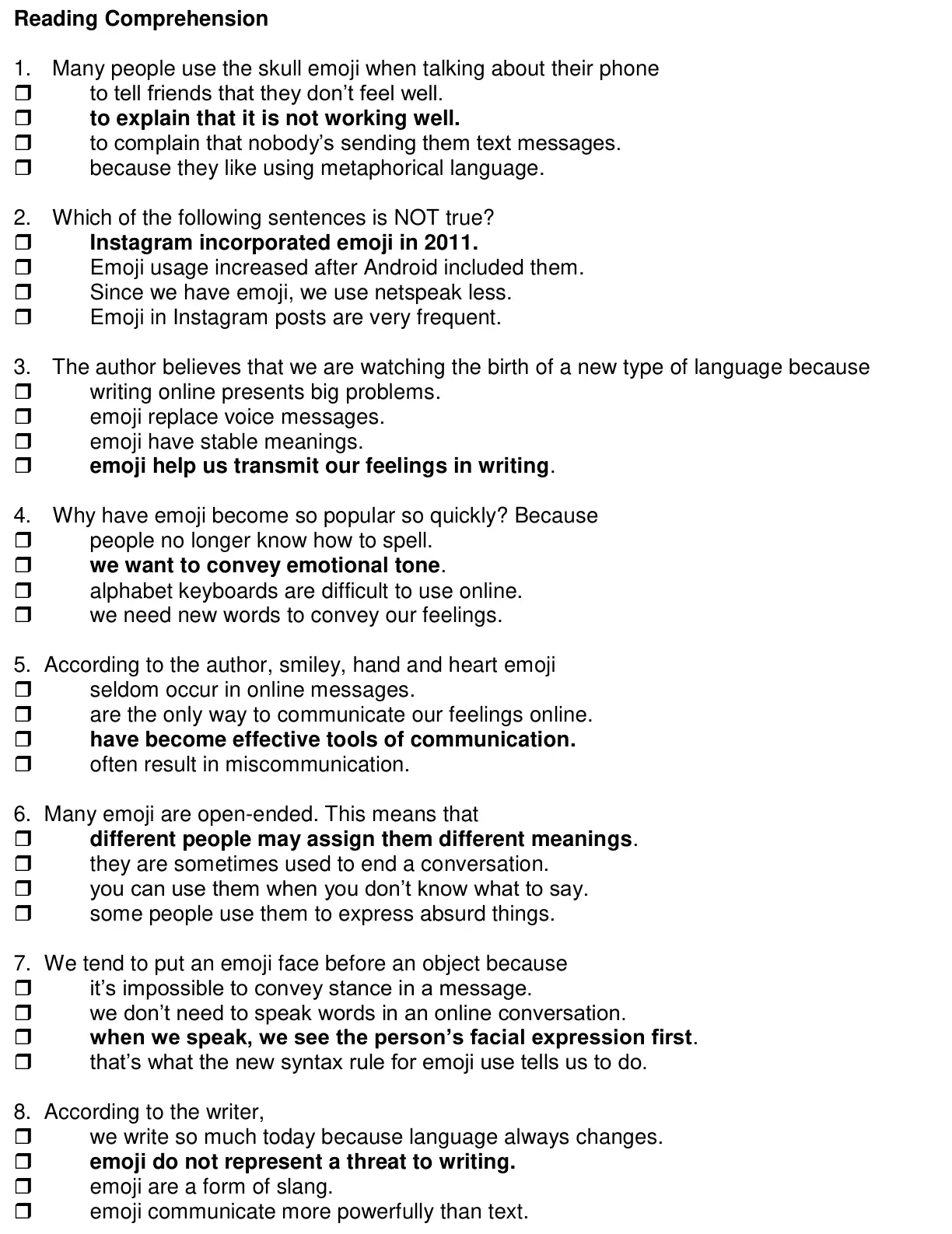
Text dels criteris (transcripció automàtica)
Reading Comprehension
1. Many people use the skull emoji when talking about their phone
to tell friends that they don’t feel well.
to explain that it is not working well.
to complain that nobody’s sending them text messages.
because they like using metaphorical language.
2. Which of the following sentences is NOT true?
Instagram incorporated emoji in 2011.
Emoji usage increased after Android included them.
Since we have emoji, we use netspeak less.
Emoji in Instagram posts are very frequent.
3. The author believes that we are watching the birth of a new type of language because
writing online presents big problems.
emoji replace voice messages.
emoji have stable meanings.
emoji help us transmit our feelings in writing.
4. Why have emoji become so popular so quickly? Because
people no longer know how to spell.
we want to convey emotional tone.
alphabet keyboards are difficult to use online.
we need new words to convey our feelings.
5. According to the aut […]
Resolució pas a pas
Encara no hi ha resolució pròpia verificada d'aquest exercici. Mentrestant, tens els criteris oficials de correcció a sobre. Si tens dubtes, pregunta'ls al xat de la Sala d'estudi.
Font: enunciat i criteris de correcció oficials de les PAU 2019 de Catalunya, publicats per la Generalitat de Catalunya (universitats.gencat.cat) i les universitats catalanes. La resolució pas a pas és pròpia de L'Acadèmia de Vic.
Altres exercicis d'aquest examen
- Part 2 · Writing Writing
- Part 3 · Listening comprehension Listening comprehension