
PAU Anglès 2019 · Juny · Sèrie 4 · Part 3 · Listening comprehension
Enunciat
Text de l'enunciat (transcripció automàtica)
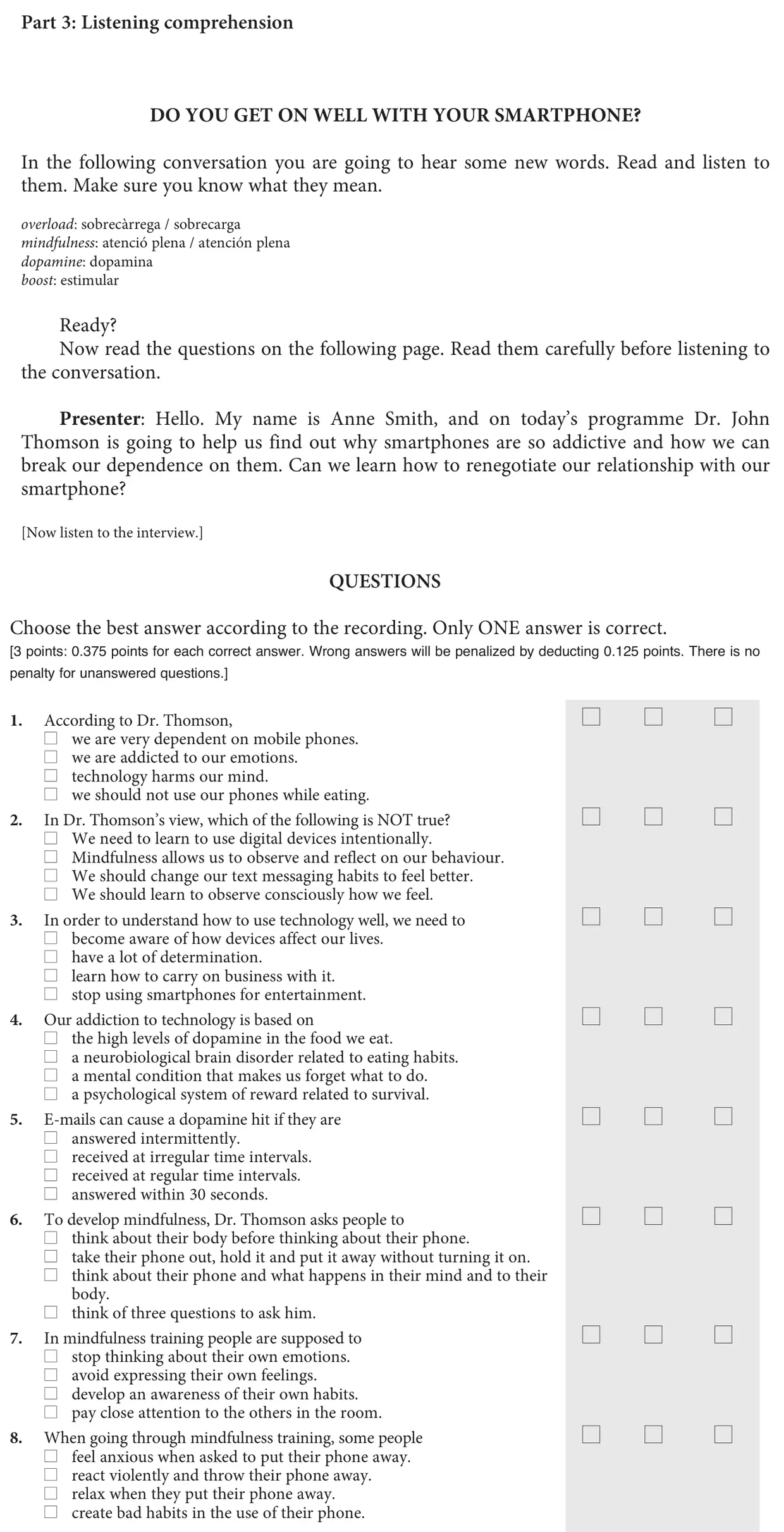
Part 3: Listening comprehension
DO YOU GET ON WELL WITH YOUR SMARTPHONE?
In the following conversation you are going to hear some new words. Read and listen to
them. Make sure you know what they mean.
overload: sobrecàrrega / sobrecarga
mindfulness: atenció plena / atención plena
dopamine: dopamina
boost: estimular
Ready?
Now read the questions on the following page. Read them carefully before listening to
the conversation.
Presenter: Hello. My name is Anne Smith, and on today’s programme Dr. John
Thomson is going to help us find out why smartphones are so addictive and how we can
break our dependence on them. Can we learn how to renegotiate our relationship with our
smartphone?
[Now listen to the interview.]
QUESTIONS
Choose the best answer according to the recording. Only ONE answer is correct.
[3 points: 0.375 points for each correct answer. Wrong answers will be penalized by deducting 0.125 points. There is no
penalty for unanswered questions.]
1. According to Dr. Thomson,
we are very dependent on mobile phones.
we are addicted to our emotions.
technology harms our mind.
we should not use our phones while eating.
2. In Dr. Thomson’s view, which of the following is NOT true?
We need to learn to use digital devices intentionally.
Mindfulness allows us to observe and reflect on our behaviour.
We should change our text messaging habits to feel better.
We should learn to observe consciously how we feel.
3. In order to understand how to use technology well, we need to
become aware of how devices affect our lives.
have a lot of determination.
learn how to carry on business with it.
stop using smartphones for entertainment.
4. Our addiction to technology is based on
the high levels of dopamine in the food we eat.
a neurobiological brain disorder related to eating habits.
a mental condition that makes us forget what to do.
a psychological system of reward related to survival.
5. E-mails can cause a dopamine hit if they are
answered intermittently.
received at irregular time intervals.
received at regular time intervals.
answered within 30 seconds.
6. To develop mindfulness, Dr. Thomson asks people to
think about their body before thinking about their phone.
take their phone out, hold it and put it away without turning it on.
think about their phone and what happens in their mind and to their
body.
think of three questions to ask him.
7. In mindfulness training people are supposed to
stop thinking about their own emotions.
avoid expressing their own feelings.
develop an awareness of their own habits.
pay close attention to the others in the room.
8. When going through mindfulness training, some people
feel anxious when asked to put their phone away.
react violently and throw their phone away.
relax when they put their phone away.
create bad habits in the use of their phone.
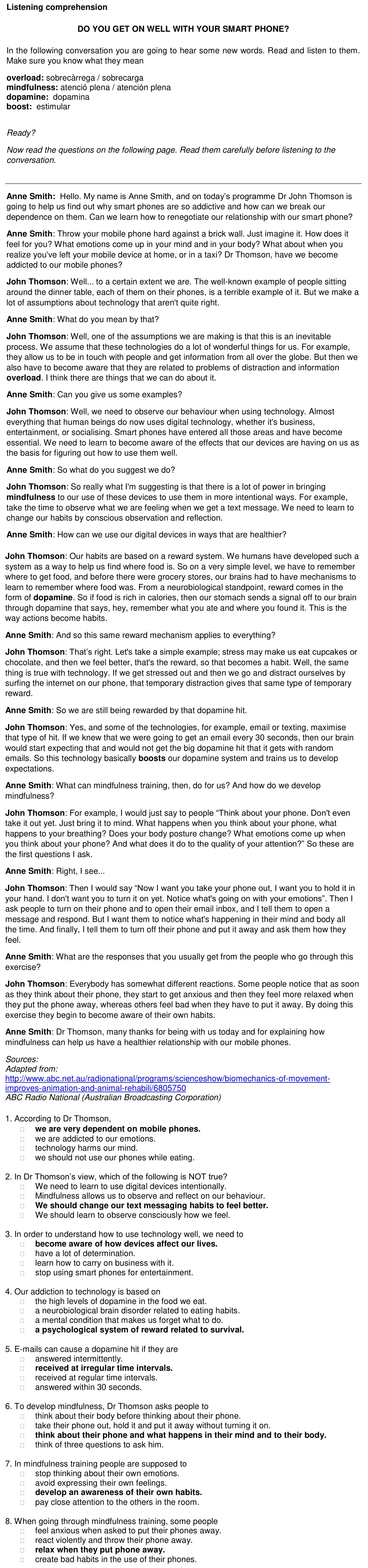
Criteris oficials de correcció
Resolució pas a pas
Aquest exercici no té una resolució escrita pas a pas (requereix l'àudio de la prova). Fes servir els criteris oficials de correcció.
Font: enunciat i criteris de correcció oficials de les PAU 2019 de Catalunya, publicats per la Generalitat de Catalunya (universitats.gencat.cat) i les universitats catalanes. La resolució pas a pas és pròpia de L'Acadèmia de Vic.
Altres exercicis d'aquest examen
- Part 1 · Reading comprehension Reading comprehension
- Part 2 · Writing Writing
Tots els exercicis de Listening comprehension · PAU de Anglès