
PAU Anglès 2020 · Juny · Sèrie 1 · Part 2 · Reading comprehension
Enunciat
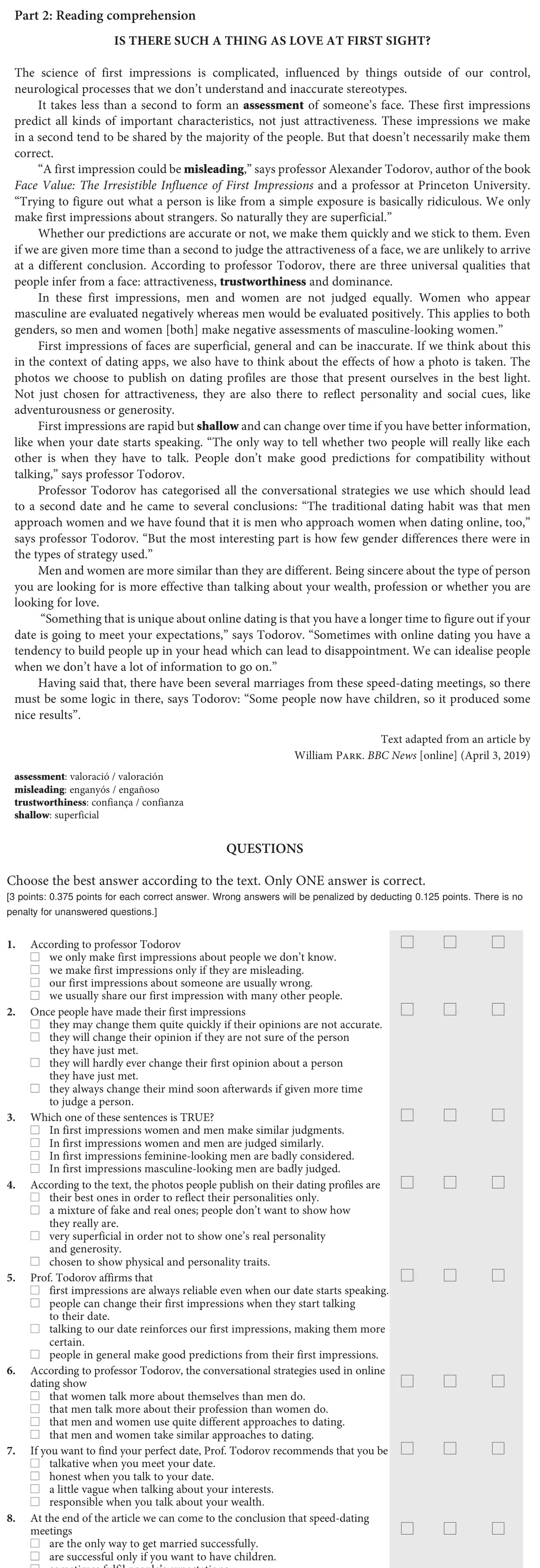
Text de l'enunciat (transcripció automàtica)
Part 2: Reading comprehension
IS THERE SUCH A THING AS LOVE AT FIRST SIGHT?
The science of first impressions is complicated, influenced by things outside of our control,
neurological processes that we don’t understand and inaccurate stereotypes.
It takes less than a second to form an assessment of someone’s face. These first impressions
predict all kinds of important characteristics, not just attractiveness. These impressions we make
in a second tend to be shared by the majority of the people. But that doesn’t necessarily make them
correct.
“A first impression could be misleading,” says professor Alexander Todorov, author of the book
Face Value: The Irresistible Influence of First Impressions and a professor at Princeton University.
“Trying to figure out what a person is like from a simple exposure is basically ridiculous. We only
make first impressions about strangers. So naturally they are superficial.”
Whether our predictions are accurate or not, we make them quickly and we stick to them. Even
if we are given more time than a second to judge the attractiveness of a face, we are unlikely to arrive
at a different conclusion. According to professor Todorov, there are three universal qualities that
people infer from a face: attractiveness, trustworthiness and dominance.
In these first impressions, men and women are not judged equally. Women who appear
masculine are evaluated negatively whereas men would be evaluated positively. This applies to both
genders, so men and women [both] make negative assessments of masculine-looking women.”
First impressions of faces are superficial, general and can be inaccurate. If we think about this
in the context of dating apps, we also have to think about the effects of how a photo is taken. The
photos we choose to publish on dating profiles are those that present ourselves in the best light.
Not just chosen for attractiveness, they are also there to reflect personality and social cues, like
adventurousness or generosity.
First impressions are rapid but shallow and can change over time if you have better information,
like when your date starts speaking. “The only way to tell whether two people will really like each
other is when they have to talk. People don’t make good predictions for compatibility without
talking,” says professor Todorov.
Professor Todorov has categorised all the conversational strategies we use which should lead
to a second date and he came to several conclusions: “The traditional dating habit was that men
approach women and we have found that it is men who approach women when dating online, too,”
says professor Todorov. “But the most interesting part is how few gender differences there were in
the types of strategy used.”
Men and women are more similar than they are different. Being sincere about the type of person
you are looking for is more effective than talking about your wealth, profession or whether you are
looking for love.
“Something that is unique about online dating is that you have a longer time to figure out if your
date is going to meet your expectations,” says Todorov. “Sometimes with online dating you have a
tendency to build people up in your head which can lead to disappointment. We can idealise people
when we don’t have a lot of information to go on.”
Having said that, there have been several marriages from these speed-dating meetings, so there
must be some logic in there, says Todorov: “Some people now have children, so it produced some
nice results”.
Text adapted from an article by
William Park. BBC News [online] (April 3, 2019)
assessment: valoració / valoración
misleading: enganyós / engañoso
trustworthiness: confiança / confianza
shallow: superficial
QUESTIONS
Choose the best answer according to the text. Only ONE answer is correct.
[3 points: 0.375 points for each correct answer. Wrong answers will be penalized by deducting 0.125 points. There is no
penalty for unanswered questions.]
1. According to professor Todorov
we only make first impressions a
Criteris oficials de correcció
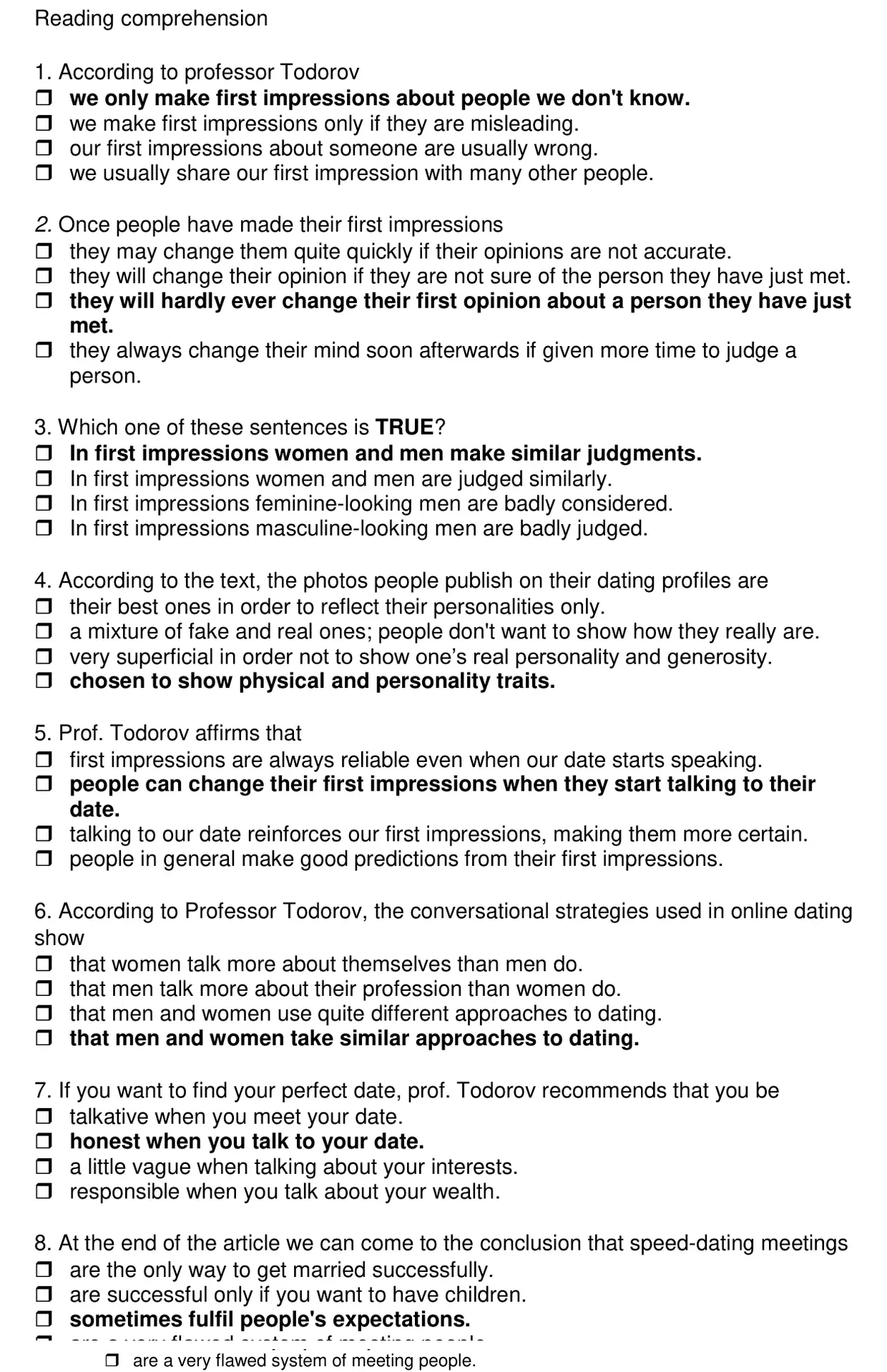
Text dels criteris (transcripció automàtica)
Reading comprehension
1. According to professor Todorov
we only make first impressions about people we don't know.
we make first impressions only if they are misleading.
our first impressions about someone are usually wrong.
we usually share our first impression with many other people.
2. Once people have made their first impressions
they may change them quite quickly if their opinions are not accurate.
they will change their opinion if they are not sure of the person they have just met.
they will hardly ever change their first opinion about a person they have just
met.
they always change their mind soon afterwards if given more time to judge a
person.
3. Which one of these sentences is TRUE?
In first impressions women and men make similar judgments.
In first impressions women and men are judged similarly.
In first impressions feminine-looking men are badly considered.
In first impressions masculine-looking men are badly judged.
4. According to the text, the pho […]
Resolució pas a pas
Encara no hi ha resolució pròpia verificada d'aquest exercici. Mentrestant, tens els criteris oficials de correcció a sobre. Si tens dubtes, pregunta'ls al xat de la Sala d'estudi.
Font: enunciat i criteris de correcció oficials de les PAU 2020 de Catalunya, publicats per la Generalitat de Catalunya (universitats.gencat.cat) i les universitats catalanes. La resolució pas a pas és pròpia de L'Acadèmia de Vic.
Altres exercicis d'aquest examen
- Part 1 · Listening comprehension Listening comprehension
- Part 3 · Writing Writing