
PAU Anglès 2020 · Setembre · Sèrie 4 · Part 2 · Reading comprehension
Enunciat
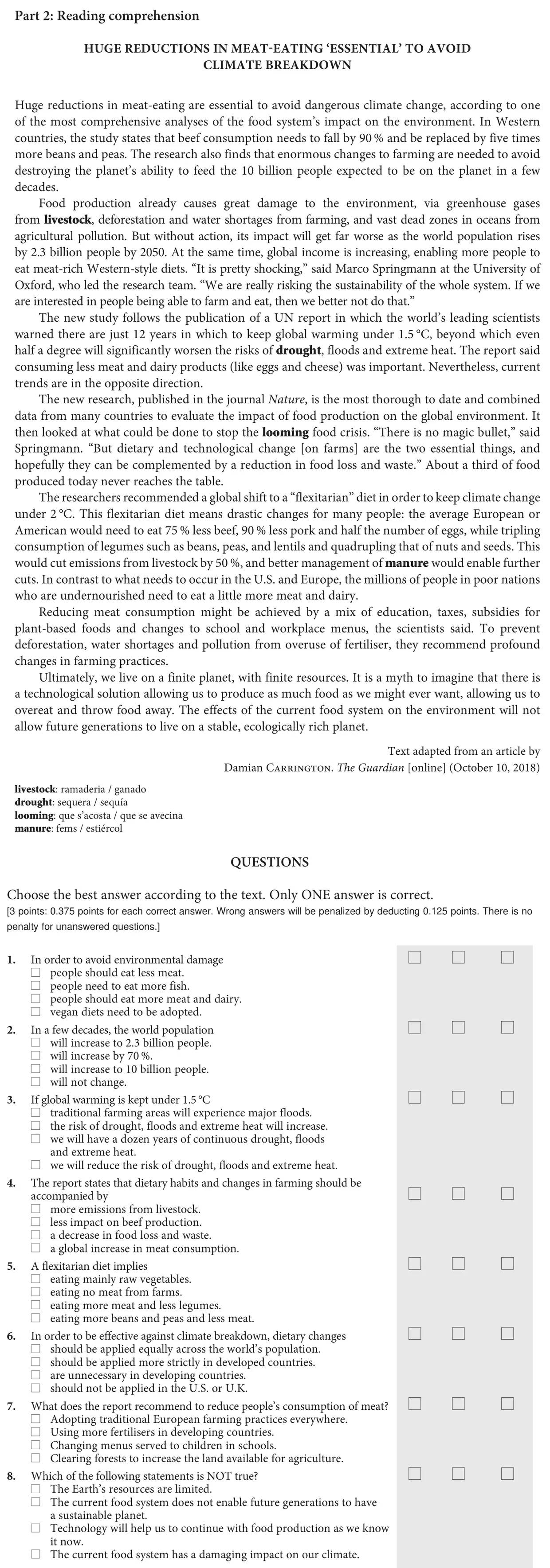
Text de l'enunciat (transcripció automàtica)
Part 2: Reading comprehension
HUGE REDUCTIONS IN MEAT-EATING ‘ESSENTIAL’ TO AVOID
CLIMATE BREAKDOWN
Huge reductions in meat-eating are essential to avoid dangerous climate change, according to one
of the most comprehensive analyses of the food system’s impact on the environment. In Western
countries, the study states that beef consumption needs to fall by 90 % and be replaced by five times
more beans and peas. The research also finds that enormous changes to farming are needed to avoid
destroying the planet’s ability to feed the 10 billion people expected to be on the planet in a few
decades.
Food production already causes great damage to the environment, via greenhouse gases
from livestock, deforestation and water shortages from farming, and vast dead zones in oceans from
agricultural pollution. But without action, its impact will get far worse as the world population rises
by 2.3 billion people by 2050. At the same time, global income is increasing, enabling more people to
eat meat-rich Western-style diets. “It is pretty shocking,” said Marco Springmann at the University of
Oxford, who led the research team. “We are really risking the sustainability of the whole system. If we
are interested in people being able to farm and eat, then we better not do that.”
The new study follows the publication of a UN report in which the world’s leading scientists
warned there are just 12 years in which to keep global warming under 1.5 °C, beyond which even
half a degree will significantly worsen the risks of drought, floods and extreme heat. The report said
consuming less meat and dairy products (like eggs and cheese) was important. Nevertheless, current
trends are in the opposite direction.
The new research, published in the journal Nature, is the most thorough to date and combined
data from many countries to evaluate the impact of food production on the global environment. It
then looked at what could be done to stop the looming food crisis. “There is no magic bullet,” said
Springmann. “But dietary and technological change [on farms] are the two essential things, and
hopefully they can be complemented by a reduction in food loss and waste.” About a third of food
produced today never reaches the table.
The researchers recommended a global shift to a “flexitarian” diet in order to keep climate change
under 2 °C. This flexitarian diet means drastic changes for many people: the average European or
American would need to eat 75 % less beef, 90 % less pork and half the number of eggs, while tripling
consumption of legumes such as beans, peas, and lentils and quadrupling that of nuts and seeds. This
would cut emissions from livestock by 50 %, and better management of manure would enable further
cuts. In contrast to what needs to occur in the U.S. and Europe, the millions of people in poor nations
who are undernourished need to eat a little more meat and dairy.
Reducing meat consumption might be achieved by a mix of education, taxes, subsidies for
plant-based foods and changes to school and workplace menus, the scientists said. To prevent
deforestation, water shortages and pollution from overuse of fertiliser, they recommend profound
changes in farming practices.
Ultimately, we live on a finite planet, with finite resources. It is a myth to imagine that there is
a technological solution allowing us to produce as much food as we might ever want, allowing us to
overeat and throw food away. The effects of the current food system on the environment will not
allow future generations to live on a stable, ecologically rich planet.
Text adapted from an article by
Damian Carrington. The Guardian [online] (October 10, 2018)
livestock: ramaderia / ganado
drought: sequera / sequía
looming: que s’acosta / que se avecina
manure: fems / estiércol
QUESTIONS
Choose the best answer according to the text. Only ONE answer is correct.
[3 points: 0.375 points for each correct answer. Wrong answers will be penalized by deducting 0.125 points. There is no
penalty for un
Criteris oficials de correcció
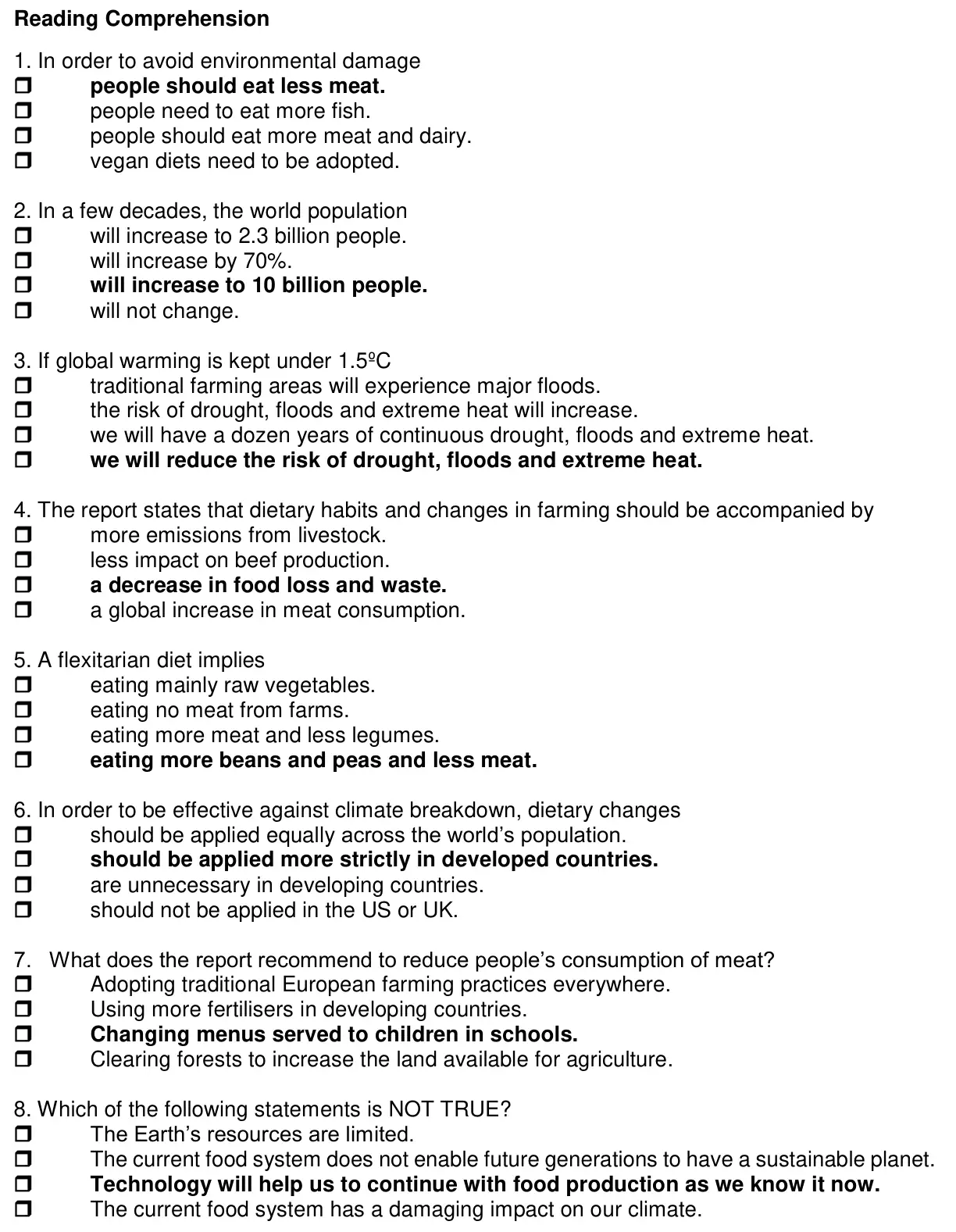
Text dels criteris (transcripció automàtica)
Reading Comprehension
1. In order to avoid environmental damage
people should eat less meat.
people need to eat more fish.
people should eat more meat and dairy.
vegan diets need to be adopted.
2. In a few decades, the world population
will increase to 2.3 billion people.
will increase by 70%.
will increase to 10 billion people.
will not change.
3. If global warming is kept under 1.5ºC
traditional farming areas will experience major floods.
the risk of drought, floods and extreme heat will increase.
we will have a dozen years of continuous drought, floods and extreme heat.
we will reduce the risk of drought, floods and extreme heat.
4. The report states that dietary habits and changes in farming should be accompanied by
more emissions from livestock.
less impact on beef production.
a decrease in food loss and waste.
a global increase in meat consumption.
5. A flexitarian diet implies
eating mainly raw vegetables.
eating no meat from farms.
eating m […]
Resolució pas a pas
Encara no hi ha resolució pròpia verificada d'aquest exercici. Mentrestant, tens els criteris oficials de correcció a sobre. Si tens dubtes, pregunta'ls al xat de la Sala d'estudi.
Font: enunciat i criteris de correcció oficials de les PAU 2020 de Catalunya, publicats per la Generalitat de Catalunya (universitats.gencat.cat) i les universitats catalanes. La resolució pas a pas és pròpia de L'Acadèmia de Vic.
Altres exercicis d'aquest examen
- Part 1 · Listening comprehension Listening comprehension
- Part 3 · Writing Writing