
PAU Anglès 2020 · Juny · Sèrie 1 · Part 1 · Listening comprehension
Enunciat
Text de l'enunciat (transcripció automàtica)
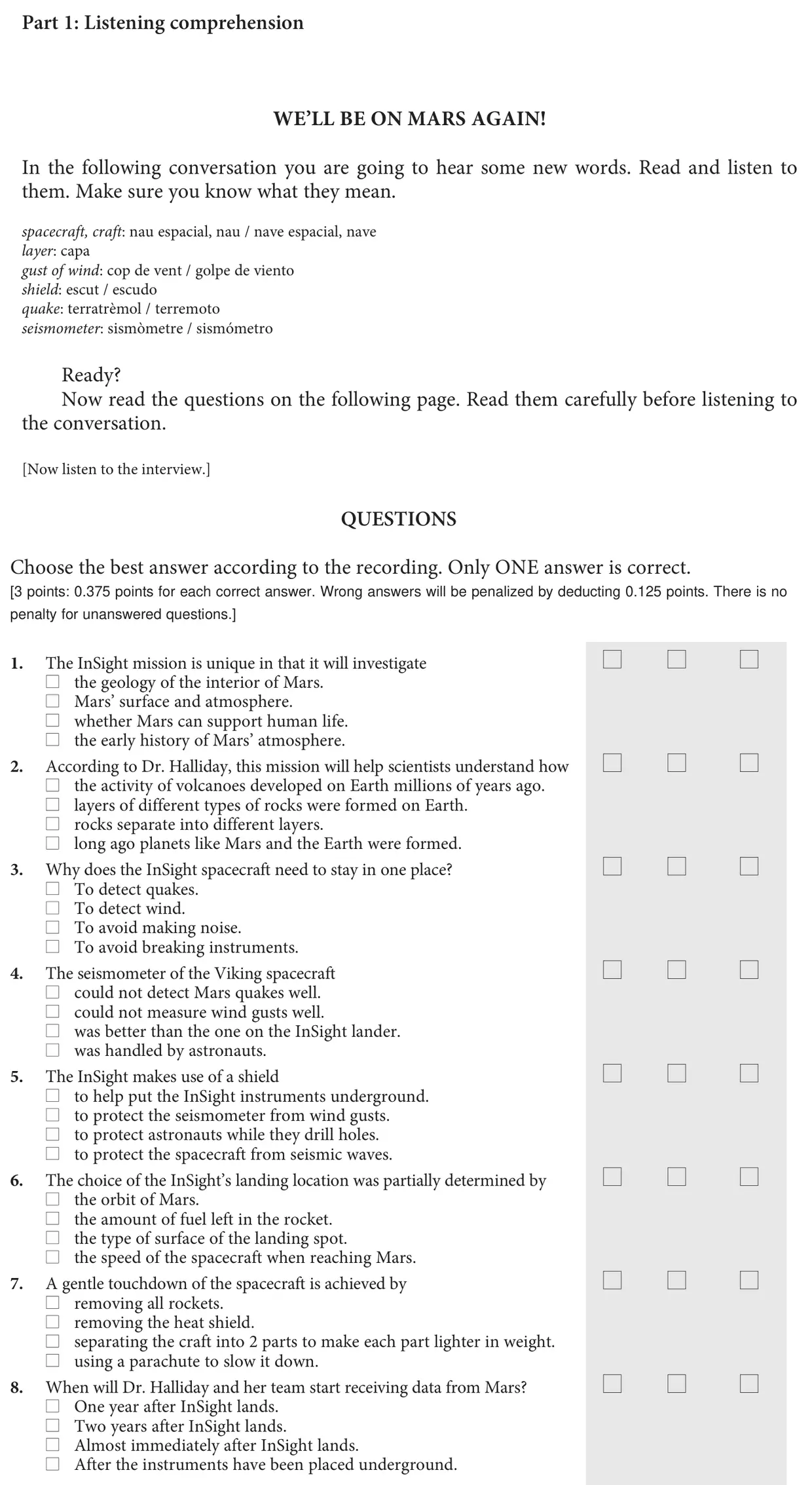
Part 1: Listening comprehension
WE’LL BE ON MARS AGAIN!
In the following conversation you are going to hear some new words. Read and listen to
them. Make sure you know what they mean.
spacecraft, craft: nau espacial, nau / nave espacial, nave
layer: capa
gust of wind: cop de vent / golpe de viento
shield: escut / escudo
quake: terratrèmol / terremoto
seismometer: sismòmetre / sismómetro
Ready?
Now read the questions on the following page. Read them carefully before listening to
the conversation.
[Now listen to the interview.]
QUESTIONS
Choose the best answer according to the recording. Only ONE answer is correct.
[3 points: 0.375 points for each correct answer. Wrong answers will be penalized by deducting 0.125 points. There is no
penalty for unanswered questions.]
1. The InSight mission is unique in that it will investigate
the geology of the interior of Mars.
Mars’ surface and atmosphere.
whether Mars can support human life.
the early history of Mars’ atmosphere.
2. According to Dr. Halliday, this mission will help scientists understand how
the activity of volcanoes developed on Earth millions of years ago.
layers of different types of rocks were formed on Earth.
rocks separate into different layers.
long ago planets like Mars and the Earth were formed.
3. Why does the InSight spacecraft need to stay in one place?
To detect quakes.
To detect wind.
To avoid making noise.
To avoid breaking instruments.
4. The seismometer of the Viking spacecraft
could not detect Mars quakes well.
could not measure wind gusts well.
was better than the one on the InSight lander.
was handled by astronauts.
5. The InSight makes use of a shield
to help put the InSight instruments underground.
to protect the seismometer from wind gusts.
to protect astronauts while they drill holes.
to protect the spacecraft from seismic waves.
6. The choice of the InSight’s landing location was partially determined by
the orbit of Mars.
the amount of fuel left in the rocket.
the type of surface of the landing spot.
the speed of the spacecraft when reaching Mars.
7. A gentle touchdown of the spacecraft is achieved by
removing all rockets.
removing the heat shield.
separating the craft into 2 parts to make each part lighter in weight.
using a parachute to slow it down.
8. When will Dr. Halliday and her team start receiving data from Mars?
One year after InSight lands.
Two years after InSight lands.
Almost immediately after InSight lands.
After the instruments have been placed underground.
Criteris oficials de correcció
Text dels criteris (transcripció automàtica)
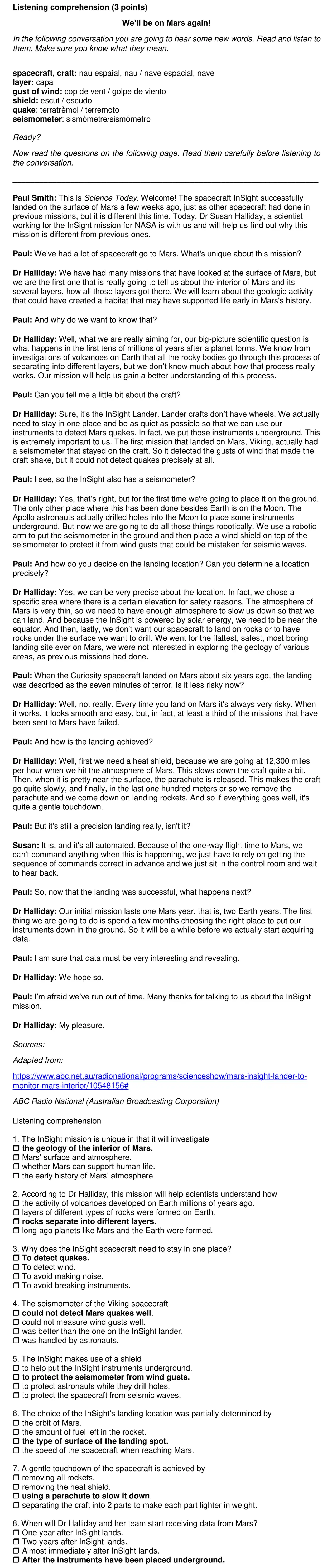
Listening comprehension (3 points)
We’ll be on Mars again!
In the following conversation you are going to hear some new words. Read and listen to
them. Make sure you know what they mean.
spacecraft, craft: nau espaial, nau / nave espacial, nave
layer: capa
gust of wind: cop de vent / golpe de viento
shield: escut / escudo
quake: terratrèmol / terremoto
seismometer: sismòmetre/sismómetro
Ready?
Now read the questions on the following page. Read them carefully before listening to
the conversation.
_____________________________________________________________________
Paul Smith: This is Science Today. Welcome! The spacecraft InSight successfully
landed on the surface of Mars a few weeks ago, just as other spacecraft had done in
previous missions, but it is different this time. Today, Dr Susan Halliday, a scientist
working for the InSight mission for NASA is with us and will help us find out why this
mission is different from previous ones.
Paul: We've had a lot of spacecraft go to Mars. W […]
Resolució pas a pas
Aquest exercici no té una resolució escrita pas a pas (requereix l'àudio de la prova). Fes servir els criteris oficials de correcció.
Font: enunciat i criteris de correcció oficials de les PAU 2020 de Catalunya, publicats per la Generalitat de Catalunya (universitats.gencat.cat) i les universitats catalanes. La resolució pas a pas és pròpia de L'Acadèmia de Vic.
Altres exercicis d'aquest examen
- Part 2 · Reading comprehension Reading comprehension
- Part 3 · Writing Writing
Tots els exercicis de Listening comprehension · PAU de Anglès