
PAU Anglès 2019 · Setembre · Sèrie 5 · Part 1 · Reading comprehension
Enunciat
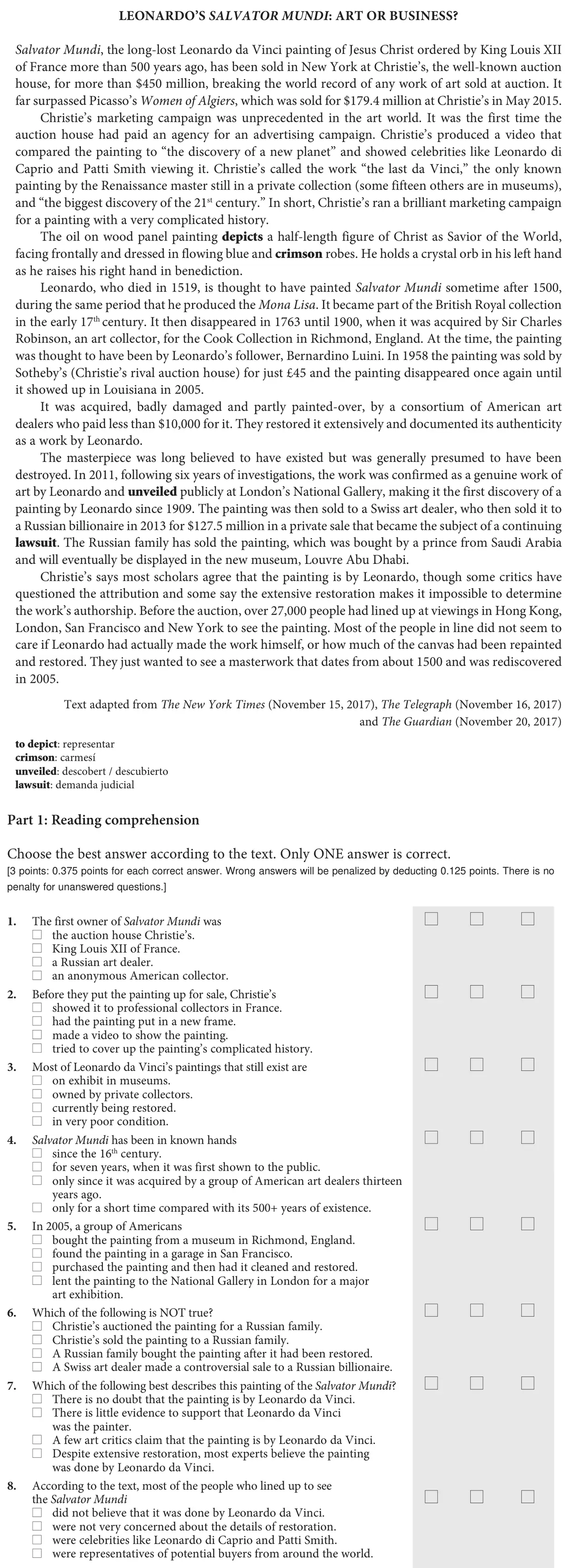
Text de l'enunciat (transcripció automàtica)
LEONARDO’S SALVATOR MUNDI: ART OR BUSINESS?
Salvator Mundi, the long-lost Leonardo da Vinci painting of Jesus Christ ordered by King Louis XII
of France more than 500 years ago, has been sold in New York at Christie’s, the well-known auction
house, for more than $450 million, breaking the world record of any work of art sold at auction. It
far surpassed Picasso’s Women of Algiers, which was sold for $179.4 million at Christie’s in May 2015.
Christie’s marketing campaign was unprecedented in the art world. It was the first time the
auction house had paid an agency for an advertising campaign. Christie’s produced a video that
compared the painting to “the discovery of a new planet” and showed celebrities like Leonardo di
Caprio and Patti Smith viewing it. Christie’s called the work “the last da Vinci,” the only known
painting by the Renaissance master still in a private collection (some fifteen others are in museums),
and “the biggest discovery of the 21st century.” In short, Christie’s ran a brilliant marketing campaign
for a painting with a very complicated history.
The oil on wood panel painting depicts a half-length figure of Christ as Savior of the World,
facing frontally and dressed in flowing blue and crimson robes. He holds a crystal orb in his left hand
as he raises his right hand in benediction.
Leonardo, who died in 1519, is thought to have painted Salvator Mundi sometime after 1500,
during the same period that he produced the Mona Lisa. It became part of the British Royal collection
in the early 17th century. It then disappeared in 1763 until 1900, when it was acquired by Sir Charles
Robinson, an art collector, for the Cook Collection in Richmond, England. At the time, the painting
was thought to have been by Leonardo’s follower, Bernardino Luini. In 1958 the painting was sold by
Sotheby’s (Christie’s rival auction house) for just £45 and the painting disappeared once again until
it showed up in Louisiana in 2005.
It was acquired, badly damaged and partly painted-over, by a consortium of American art
dealers who paid less than $10,000 for it. They restored it extensively and documented its authenticity
as a work by Leonardo.
The masterpiece was long believed to have existed but was generally presumed to have been
destroyed. In 2011, following six years of investigations, the work was confirmed as a genuine work of
art by Leonardo and unveiled publicly at London’s National Gallery, making it the first discovery of a
painting by Leonardo since 1909. The painting was then sold to a Swiss art dealer, who then sold it to
a Russian billionaire in 2013 for $127.5 million in a private sale that became the subject of a continuing
lawsuit. The Russian family has sold the painting, which was bought by a prince from Saudi Arabia
and will eventually be displayed in the new museum, Louvre Abu Dhabi.
Christie’s says most scholars agree that the painting is by Leonardo, though some critics have
questioned the attribution and some say the extensive restoration makes it impossible to determine
the work’s authorship. Before the auction, over 27,000 people had lined up at viewings in Hong Kong,
London, San Francisco and New York to see the painting. Most of the people in line did not seem to
care if Leonardo had actually made the work himself, or how much of the canvas had been repainted
and restored. They just wanted to see a masterwork that dates from about 1500 and was rediscovered
in 2005.
Text adapted from The New York Times (November 15, 2017), The Telegraph (November 16, 2017)
and The Guardian (November 20, 2017)
to depict: representar
crimson: carmesí
unveiled: descobert / descubierto
lawsuit: demanda judicial
Part 1: Reading comprehension
Choose the best answer according to the text. Only ONE answer is correct.
[3 points: 0.375 points for each correct answer. Wrong answers will be penalized by deducting 0.125 points. There is no
penalty for unanswered questions.]
1. The first owner of Salvator Mundi was
the auction house Christ
Criteris oficials de correcció
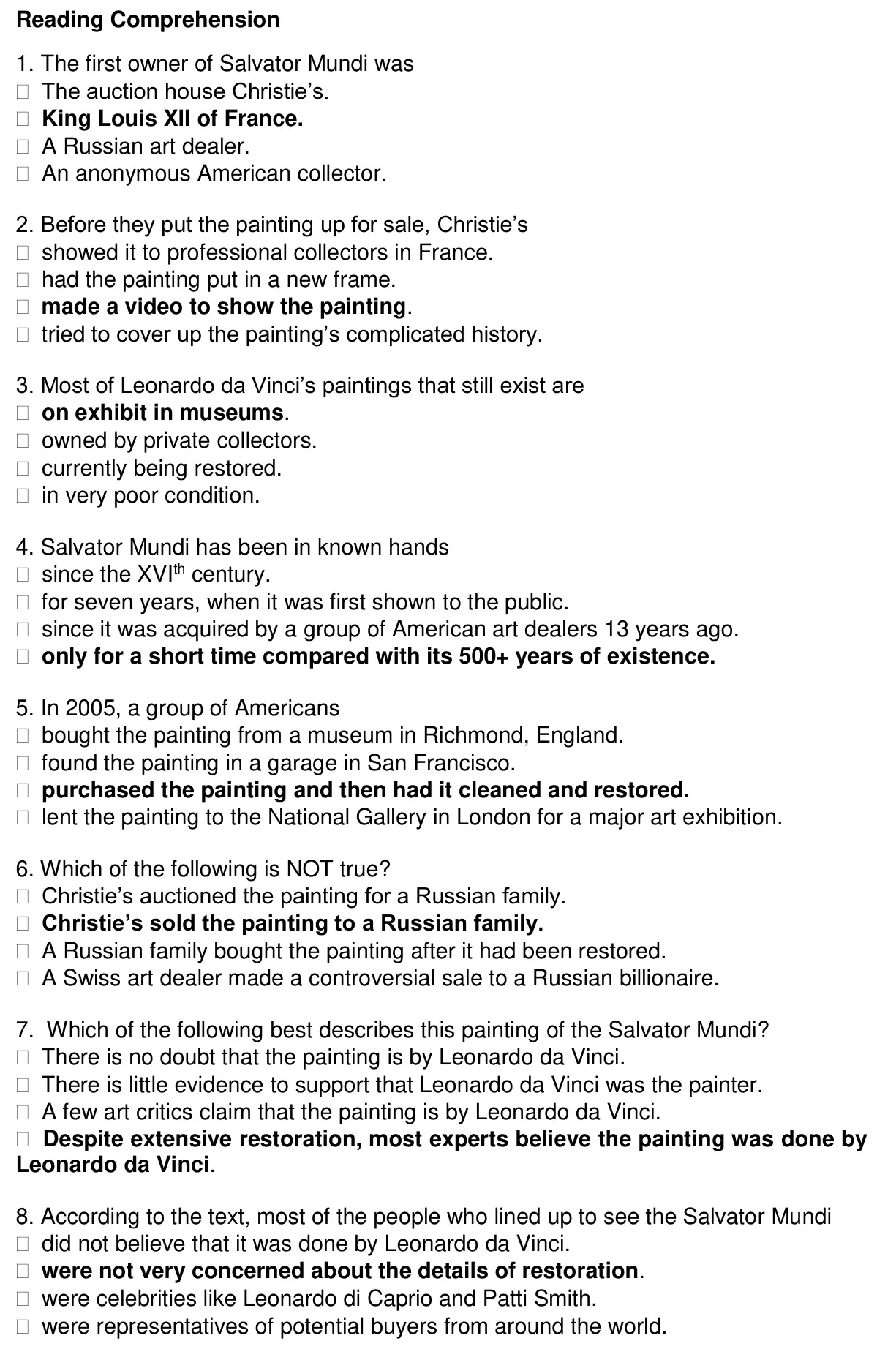
Text dels criteris (transcripció automàtica)
Reading Comprehension
1. The first owner of Salvator Mundi was
The auction house Christie’s.
King Louis XII of France.
A Russian art dealer.
An anonymous American collector.
2. Before they put the painting up for sale, Christie’s
showed it to professional collectors in France.
had the painting put in a new frame.
made a video to show the painting.
tried to cover up the painting’s complicated history.
3. Most of Leonardo da Vinci’s paintings that still exist are
on exhibit in museums.
owned by private collectors.
currently being restored.
in very poor condition.
4. Salvator Mundi has been in known hands
since the XVIth century.
for seven years, when it was first shown to the public.
since it was acquired by a group of American art dealers 13 years ago.
only for a short time compared with its 500+ years of existence.
5. In 2005, a group of Americans
bought the painting from a museum in Richmond, England.
found the painting in a garage in San Francisco. […]
Resolució pas a pas
Encara no hi ha resolució pròpia verificada d'aquest exercici. Mentrestant, tens els criteris oficials de correcció a sobre. Si tens dubtes, pregunta'ls al xat de la Sala d'estudi.
Font: enunciat i criteris de correcció oficials de les PAU 2019 de Catalunya, publicats per la Generalitat de Catalunya (universitats.gencat.cat) i les universitats catalanes. La resolució pas a pas és pròpia de L'Acadèmia de Vic.
Altres exercicis d'aquest examen
- Part 2 · Writing Writing
- Part 3 · Listening comprehension Listening comprehension