
PAU Anglès 2018 · Setembre · Sèrie 3 · Part 1 · Reading comprehension
Enunciat
Text de l'enunciat (transcripció automàtica)
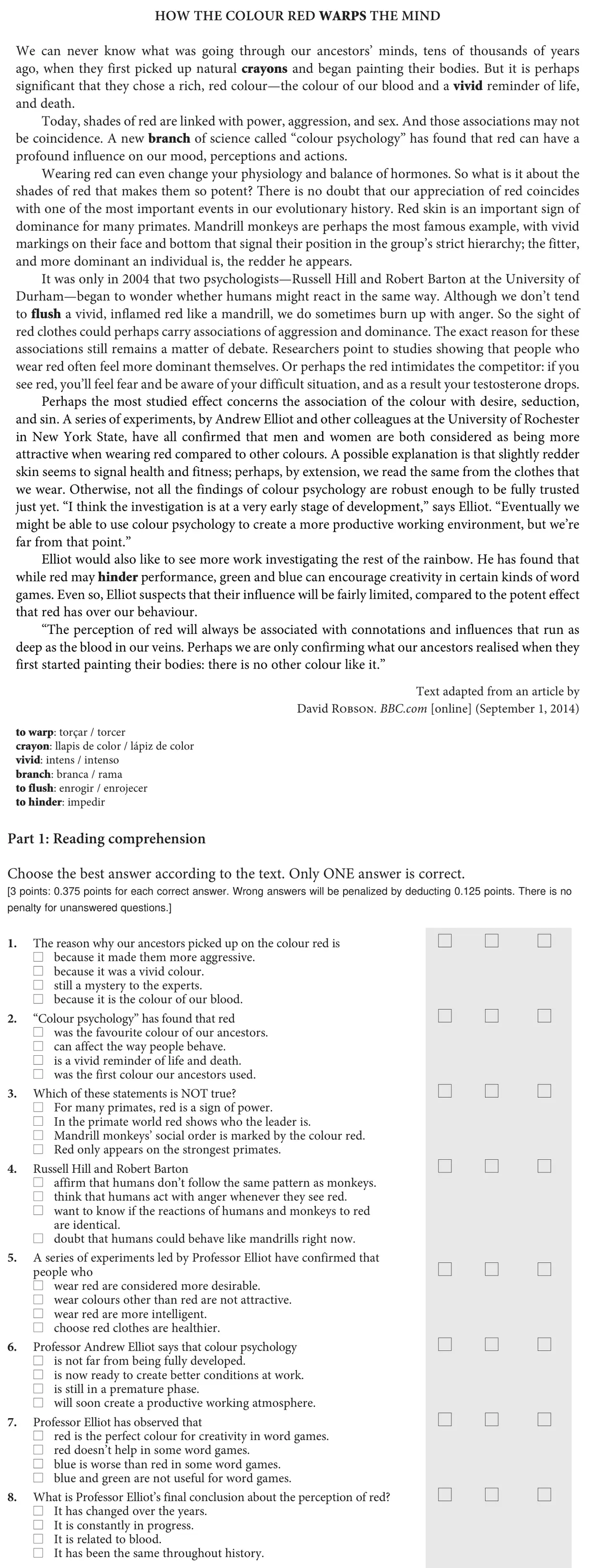
HOW THE COLOUR RED WARPS THE MIND
We can never know what was going through our ancestors’ minds, tens of thousands of years
ago, when they first picked up natural crayons and began painting their bodies. But it is perhaps
significant that they chose a rich, red colour—the colour of our blood and a vivid reminder of life,
and death.
Today, shades of red are linked with power, aggression, and sex. And those associations may not
be coincidence. A new branch of science called “colour psychology” has found that red can have a
profound influence on our mood, perceptions and actions.
Wearing red can even change your physiology and balance of hormones. So what is it about the
shades of red that makes them so potent? There is no doubt that our appreciation of red coincides
with one of the most important events in our evolutionary history. Red skin is an important sign of
dominance for many primates. Mandrill monkeys are perhaps the most famous example, with vivid
markings on their face and bottom that signal their position in the group’s strict hierarchy; the fitter,
and more dominant an individual is, the redder he appears.
It was only in 2004 that two psychologists—Russell Hill and Robert Barton at the University of
Durham—began to wonder whether humans might react in the same way. Although we don’t tend
to flush a vivid, inflamed red like a mandrill, we do sometimes burn up with anger. So the sight of
red clothes could perhaps carry associations of aggression and dominance. The exact reason for these
associations still remains a matter of debate. Researchers point to studies showing that people who
wear red often feel more dominant themselves. Or perhaps the red intimidates the competitor: if you
see red, you’ll feel fear and be aware of your difficult situation, and as a result your testosterone drops.
Perhaps the most studied effect concerns the association of the colour with desire, seduction,
and sin. A series of experiments, by Andrew Elliot and other colleagues at the University of Rochester
in New York State, have all confirmed that men and women are both considered as being more
attractive when wearing red compared to other colours. A possible explanation is that slightly redder
skin seems to signal health and fitness; perhaps, by extension, we read the same from the clothes that
we wear. Otherwise, not all the findings of colour psychology are robust enough to be fully trusted
just yet. “I think the investigation is at a very early stage of development,” says Elliot. “Eventually we
might be able to use colour psychology to create a more productive working environment, but we’re
far from that point.”
Elliot would also like to see more work investigating the rest of the rainbow. He has found that
while red may hinder performance, green and blue can encourage creativity in certain kinds of word
games. Even so, Elliot suspects that their influence will be fairly limited, compared to the potent effect
that red has over our behaviour.
“The perception of red will always be associated with connotations and influences that run as
deep as the blood in our veins. Perhaps we are only confirming what our ancestors realised when they
first started painting their bodies: there is no other colour like it.”
Text adapted from an article by
David Robson. BBC.com [online] (September 1, 2014)
to warp: torçar / torcer
crayon: llapis de color / lápiz de color
vivid: intens / intenso
branch: branca / rama
to flush: enrogir / enrojecer
to hinder: impedir
Part 1: Reading comprehension
Choose the best answer according to the text. Only ONE answer is correct.
[3 points: 0.375 points for each correct answer. Wrong answers will be penalized by deducting 0.125 points. There is no
penalty for unanswered questions.]
1. The reason why our ancestors picked up on the colour red is
because it made them more aggressive.
because it was a vivid colour.
still a mystery to the experts.
because it is the colour of our blood.
2. “Colour psychology” has found that r
Criteris oficials de correcció
Text dels criteris (transcripció automàtica)
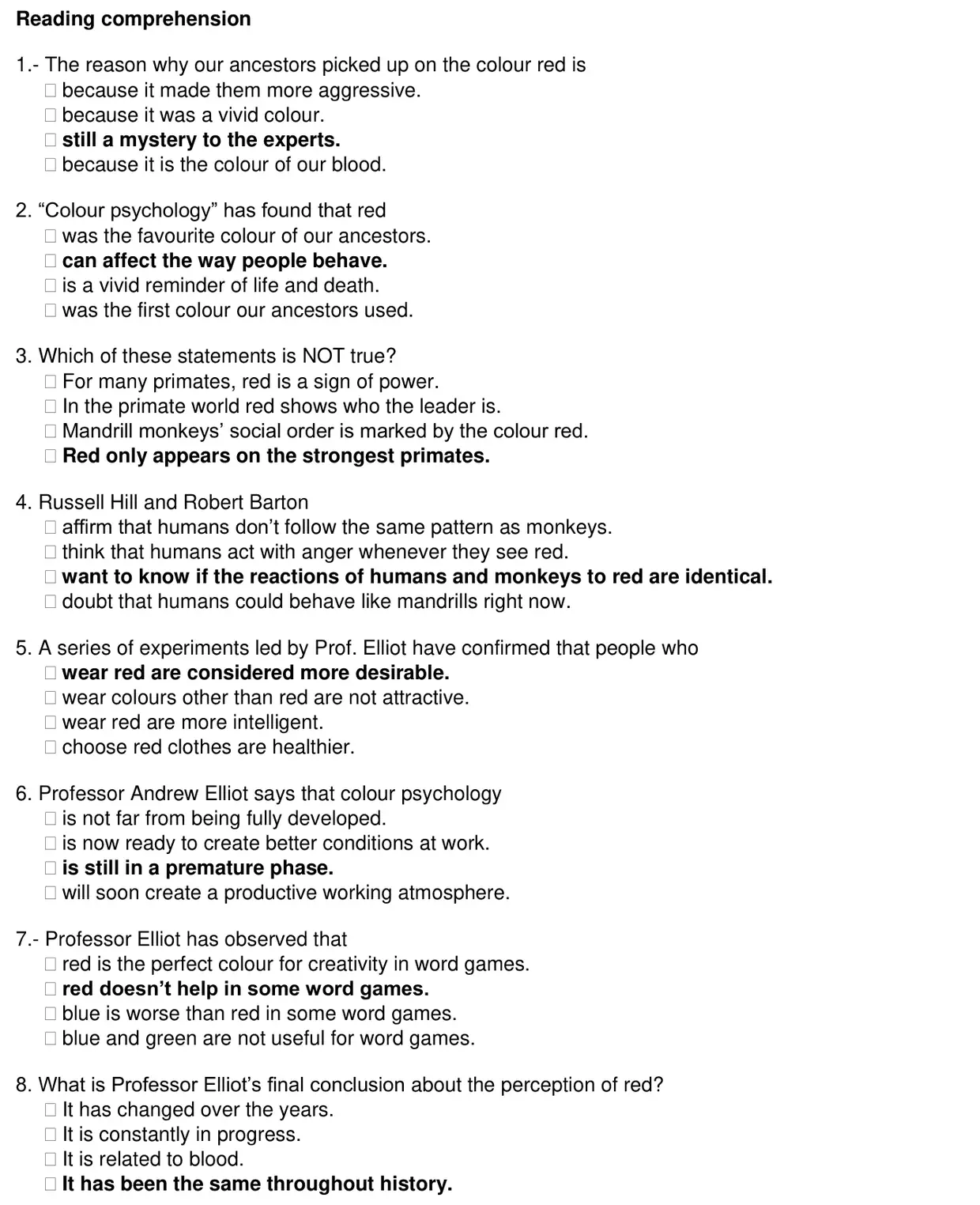
Reading comprehension
1.- The reason why our ancestors picked up on the colour red is
because it made them more aggressive.
because it was a vivid colour.
still a mystery to the experts.
because it is the colour of our blood.
2. “Colour psychology” has found that red
was the favourite colour of our ancestors.
can affect the way people behave.
is a vivid reminder of life and death.
was the first colour our ancestors used.
3. Which of these statements is NOT true?
For many primates, red is a sign of power.
In the primate world red shows who the leader is.
Mandrill monkeys’ social order is marked by the colour red.
Red only appears on the strongest primates.
4. Russell Hill and Robert Barton
affirm that humans don’t follow the same pattern as monkeys.
think that humans act with anger whenever they see red.
want to know if the reactions of humans and monkeys to red are identical.
doubt that humans could behave like mandrills right now.
5. A series of experim […]
Resolució pas a pas
Encara no hi ha resolució pròpia verificada d'aquest exercici. Mentrestant, tens els criteris oficials de correcció a sobre. Si tens dubtes, pregunta'ls al xat de la Sala d'estudi.
Font: enunciat i criteris de correcció oficials de les PAU 2018 de Catalunya, publicats per la Generalitat de Catalunya (universitats.gencat.cat) i les universitats catalanes. La resolució pas a pas és pròpia de L'Acadèmia de Vic.
Altres exercicis d'aquest examen
- Part 2 · Writing Writing
- Part 3 · Listening comprehension Listening comprehension