
PAU Anglès 2018 · Setembre · Sèrie 3 · Part 3 · Listening comprehension
Enunciat
Text de l'enunciat (transcripció automàtica)
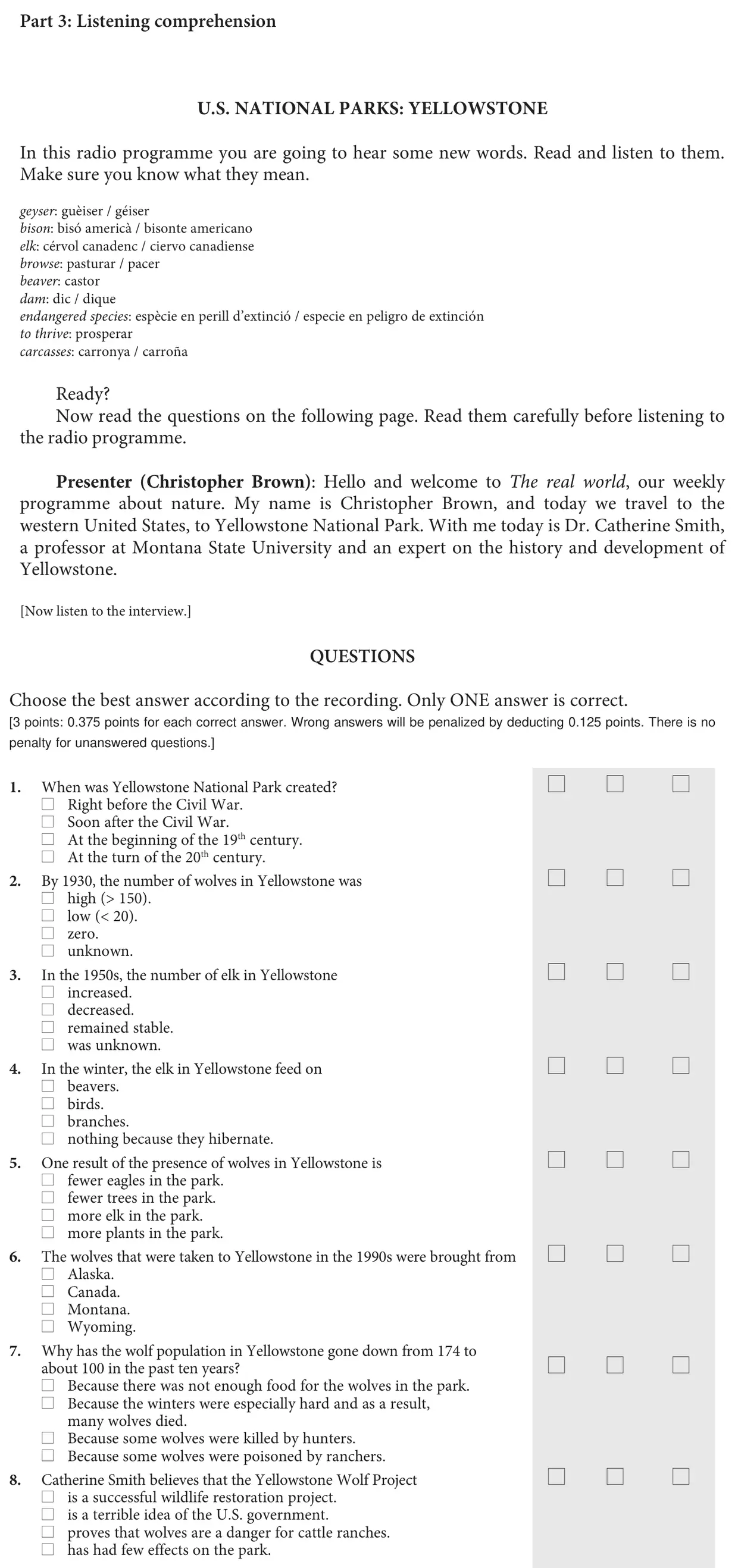
Part 3: Listening comprehension
U.S. NATIONAL PARKS: YELLOWSTONE
In this radio programme you are going to hear some new words. Read and listen to them.
Make sure you know what they mean.
geyser: guèiser / géiser
bison: bisó americà / bisonte americano
elk: cérvol canadenc / ciervo canadiense
browse: pasturar / pacer
beaver: castor
dam: dic / dique
endangered species: espècie en perill d’extinció / especie en peligro de extinción
to thrive: prosperar
carcasses: carronya / carroña
Ready?
Now read the questions on the following page. Read them carefully before listening to
the radio programme.
Presenter (Christopher Brown): Hello and welcome to The real world, our weekly
programme about nature. My name is Christopher Brown, and today we travel to the
western United States, to Yellowstone National Park. With me today is Dr. Catherine Smith,
a professor at Montana State University and an expert on the history and development of
Yellowstone.
[Now listen to the interview.]
QUESTIONS
Choose the best answer according to the recording. Only ONE answer is correct.
[3 points: 0.375 points for each correct answer. Wrong answers will be penalized by deducting 0.125 points. There is no
penalty for unanswered questions.]
1. When was Yellowstone National Park created?
Right before the Civil War.
Soon after the Civil War.
At the beginning of the 19th century.
At the turn of the 20th century.
2. By 1930, the number of wolves in Yellowstone was
high (> 150).
low (< 20).
zero.
unknown.
3. In the 1950s, the number of elk in Yellowstone
increased.
decreased.
remained stable.
was unknown.
4. In the winter, the elk in Yellowstone feed on
beavers.
birds.
branches.
nothing because they hibernate.
5. One result of the presence of wolves in Yellowstone is
fewer eagles in the park.
fewer trees in the park.
more elk in the park.
more plants in the park.
6. The wolves that were taken to Yellowstone in the 1990s were brought from
Alaska.
Canada.
Montana.
Wyoming.
7. Why has the wolf population in Yellowstone gone down from 174 to
about 100 in the past ten years?
Because there was not enough food for the wolves in the park.
Because the winters were especially hard and as a result,
many wolves died.
Because some wolves were killed by hunters.
Because some wolves were poisoned by ranchers.
8. Catherine Smith believes that the Yellowstone Wolf Project
is a successful wildlife restoration project.
is a terrible idea of the U.S. government.
proves that wolves are a danger for cattle ranches.
has had few effects on the park.
Criteris oficials de correcció
Text dels criteris (transcripció automàtica)
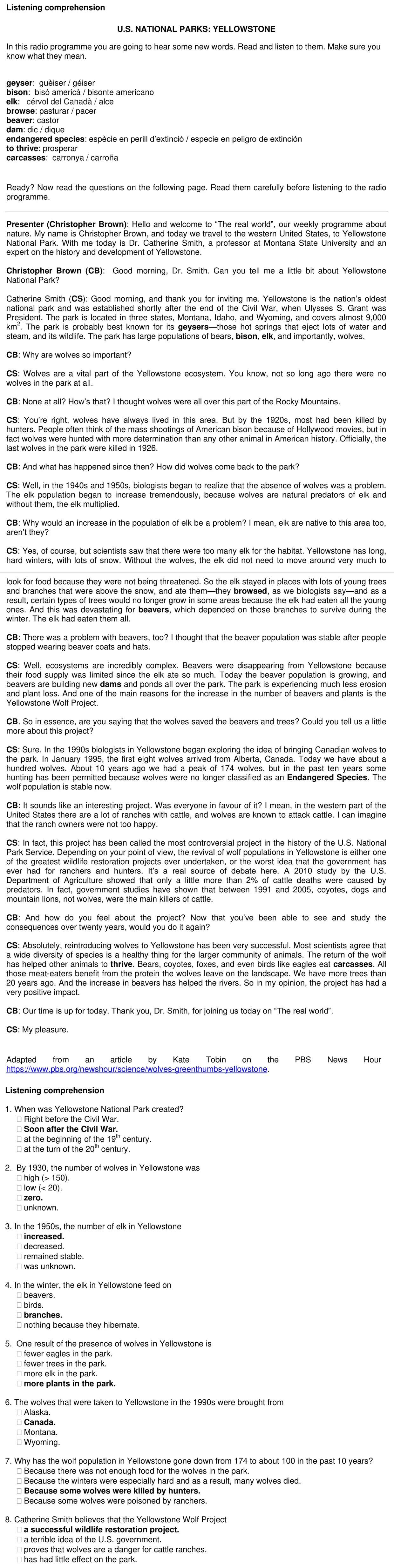
Listening comprehension
U.S. NATIONAL PARKS: YELLOWSTONE
In this radio programme you are going to hear some new words. Read and listen to them. Make sure you
know what they mean.
geyser: guèiser / géiser
bison: bisó americà / bisonte americano
elk: cérvol del Canadà / alce
browse: pasturar / pacer
beaver: castor
dam: dic / dique
endangered species: espècie en perill d’extinció / especie en peligro de extinción
to thrive: prosperar
carcasses: carronya / carroña
Ready? Now read the questions on the following page. Read them carefully before listening to the radio
programme.
Presenter (Christopher Brown): Hello and welcome to “The real world”, our weekly programme about
nature. My name is Christopher Brown, and today we travel to the western United States, to Yellowstone
National Park. With me today is Dr. Catherine Smith, a professor at Montana State University and an
expert on the history and development of Yellowstone.
Christopher Brown (CB): Good morning, Dr. Smith. Can you tell me a […]
Resolució pas a pas
Aquest exercici no té una resolució escrita pas a pas (requereix l'àudio de la prova). Fes servir els criteris oficials de correcció.
Font: enunciat i criteris de correcció oficials de les PAU 2018 de Catalunya, publicats per la Generalitat de Catalunya (universitats.gencat.cat) i les universitats catalanes. La resolució pas a pas és pròpia de L'Acadèmia de Vic.
Altres exercicis d'aquest examen
- Part 1 · Reading comprehension Reading comprehension
- Part 2 · Writing Writing
Tots els exercicis de Listening comprehension · PAU de Anglès