
PAU Anglès 2016 · Setembre · Sèrie 1 · Part 1 · Reading comprehension
Enunciat
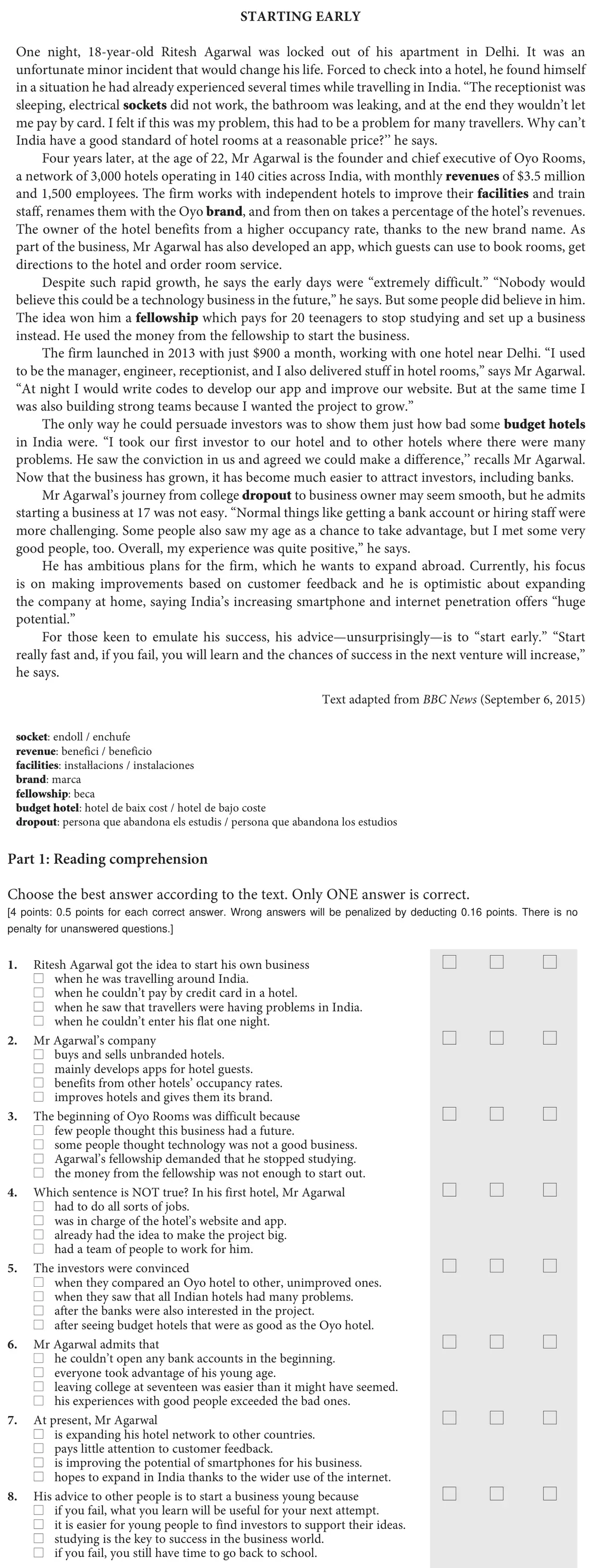
Text de l'enunciat (transcripció automàtica)
STARTING EARLY
One night, 18-year-old Ritesh Agarwal was locked out of his apartment in Delhi. It was an
unfortunate minor incident that would change his life. Forced to check into a hotel, he found himself
in a situation he had already experienced several times while travelling in India. “The receptionist was
sleeping, electrical sockets did not work, the bathroom was leaking, and at the end they wouldn’t let
me pay by card. I felt if this was my problem, this had to be a problem for many travellers. Why can’t
India have a good standard of hotel rooms at a reasonable price?’’ he says.
Four years later, at the age of 22, Mr Agarwal is the founder and chief executive of Oyo Rooms,
a network of 3,000 hotels operating in 140 cities across India, with monthly revenues of $3.5 million
and 1,500 employees. The firm works with independent hotels to improve their facilities and train
staff, renames them with the Oyo brand, and from then on takes a percentage of the hotel’s revenues.
The owner of the hotel benefits from a higher occupancy rate, thanks to the new brand name. As
part of the business, Mr Agarwal has also developed an app, which guests can use to book rooms, get
directions to the hotel and order room service.
Despite such rapid growth, he says the early days were “extremely difficult.” “Nobody would
believe this could be a technology business in the future,” he says. But some people did believe in him.
The idea won him a fellowship which pays for 20 teenagers to stop studying and set up a business
instead. He used the money from the fellowship to start the business.
The firm launched in 2013 with just $900 a month, working with one hotel near Delhi. “I used
to be the manager, engineer, receptionist, and I also delivered stuff in hotel rooms,” says Mr Agarwal.
“At night I would write codes to develop our app and improve our website. But at the same time I
was also building strong teams because I wanted the project to grow.”
The only way he could persuade investors was to show them just how bad some budget hotels
in India were. “I took our first investor to our hotel and to other hotels where there were many
problems. He saw the conviction in us and agreed we could make a difference,’’ recalls Mr Agarwal.
Now that the business has grown, it has become much easier to attract investors, including banks.
Mr Agarwal’s journey from college dropout to business owner may seem smooth, but he admits
starting a business at 17 was not easy. “Normal things like getting a bank account or hiring staff were
more challenging. Some people also saw my age as a chance to take advantage, but I met some very
good people, too. Overall, my experience was quite positive,” he says.
He has ambitious plans for the firm, which he wants to expand abroad. Currently, his focus
is on making improvements based on customer feedback and he is optimistic about expanding
the company at home, saying India’s increasing smartphone and internet penetration offers “huge
potential.”
For those keen to emulate his success, his advice—unsurprisingly—is to “start early.” “Start
really fast and, if you fail, you will learn and the chances of success in the next venture will increase,”
he says.
Text adapted from BBC News (September 6, 2015)
socket: endoll / enchufe
revenue: benefici / beneficio
facilities: instaŀlacions / instalaciones
brand: marca
fellowship: beca
budget hotel: hotel de baix cost / hotel de bajo coste
dropout: persona que abandona els estudis / persona que abandona los estudios
Part 1: Reading comprehension
Choose the best answer according to the text. Only ONE answer is correct.
[4 points: 0.5 points for each correct answer. Wrong answers will be penalized by deducting 0.16 points. There is no
penalty for unanswered questions.]
1. Ritesh Agarwal got the idea to start his own business
when he was travelling around India.
when he couldn’t pay by credit card in a hotel.
when he saw that travellers were having problems in India.
when he couldn’t enter his f
Criteris oficials de correcció
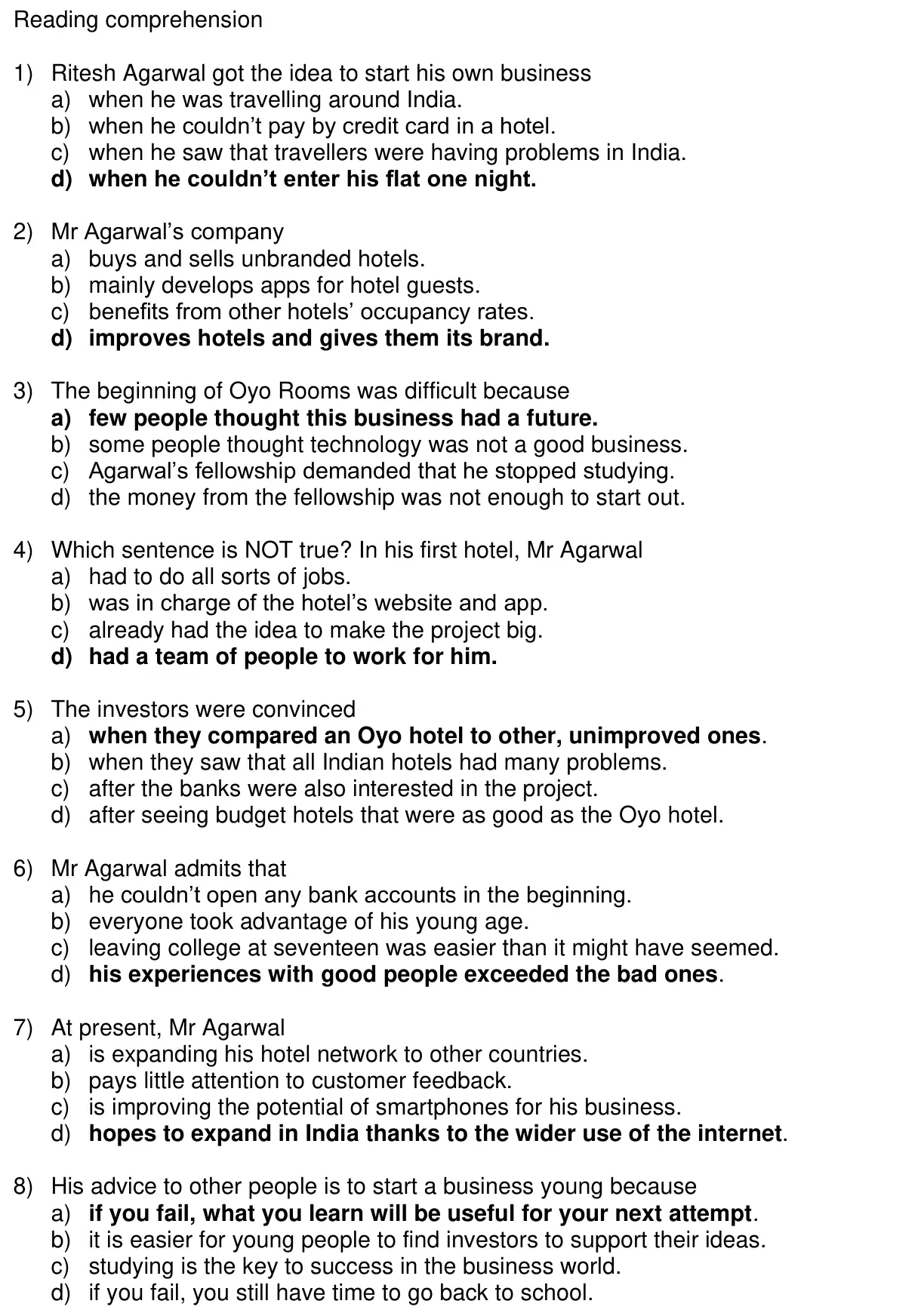
Text dels criteris (transcripció automàtica)
Reading comprehension
1) Ritesh Agarwal got the idea to start his own business
a) when he was travelling around India.
b) when he couldn’t pay by credit card in a hotel.
c) when he saw that travellers were having problems in India.
d) when he couldn’t enter his flat one night.
2) Mr Agarwal’s company
a) buys and sells unbranded hotels.
b) mainly develops apps for hotel guests.
c) benefits from other hotels’ occupancy rates.
d) improves hotels and gives them its brand.
3) The beginning of Oyo Rooms was difficult because
a) few people thought this business had a future.
b) some people thought technology was not a good business.
c) Agarwal’s fellowship demanded that he stopped studying.
d) the money from the fellowship was not enough to start out.
4) Which sentence is NOT true? In his first hotel, Mr Agarwal
a) had to do all sorts of jobs.
b) was in charge of the hotel’s website and app.
c) already had the idea to make the project big.
d) had a team of people to work for him.
5) The inves […]
Resolució pas a pas
Encara no hi ha resolució pròpia verificada d'aquest exercici. Mentrestant, tens els criteris oficials de correcció a sobre. Si tens dubtes, pregunta'ls al xat de la Sala d'estudi.
Font: enunciat i criteris de correcció oficials de les PAU 2016 de Catalunya, publicats per la Generalitat de Catalunya (universitats.gencat.cat) i les universitats catalanes. La resolució pas a pas és pròpia de L'Acadèmia de Vic.
Altres exercicis d'aquest examen
- Part 2 · Writing Writing
- Part 3 · Listening comprehension Listening comprehension