
PAU Anglès 2015 · Juny · Sèrie 4 · Part 1 · Reading comprehension
Enunciat
Text de l'enunciat (transcripció automàtica)
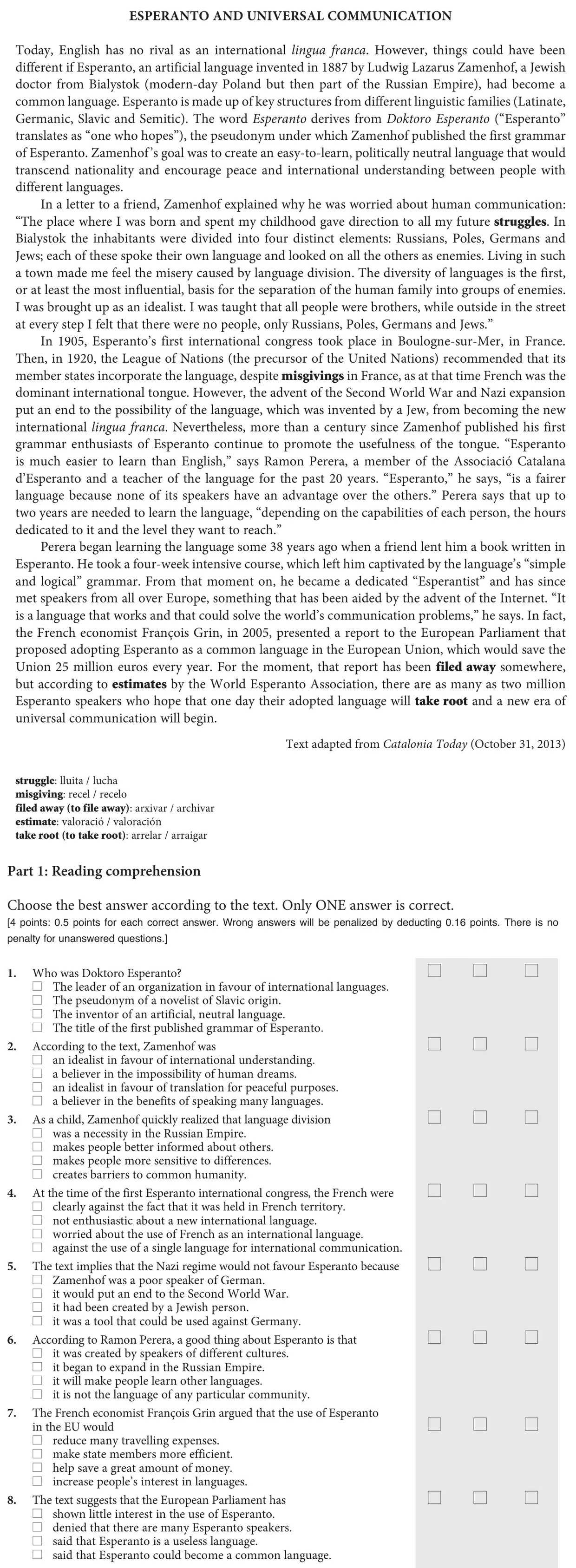
ESPERANTO AND UNIVERSAL COMMUNICATION
Today, English has no rival as an international lingua franca. However, things could have been
different if Esperanto, an artificial language invented in 1887 by Ludwig Lazarus Zamenhof, a Jewish
doctor from Bialystok (modern-day Poland but then part of the Russian Empire), had become a
common language. Esperanto is made up of key structures from different linguistic families (Latinate,
Germanic, Slavic and Semitic). The word Esperanto derives from Doktoro Esperanto (“Esperanto”
translates as “one who hopes”), the pseudonym under which Zamenhof published the first grammar
of Esperanto. Zamenhof’s goal was to create an easy-to-learn, politically neutral language that would
transcend nationality and encourage peace and international understanding between people with
different languages.
In a letter to a friend, Zamenhof explained why he was worried about human communication:
“The place where I was born and spent my childhood gave direction to all my future struggles. In
Bialystok the inhabitants were divided into four distinct elements: Russians, Poles, Germans and
Jews; each of these spoke their own language and looked on all the others as enemies. Living in such
a town made me feel the misery caused by language division. The diversity of languages is the first,
or at least the most influential, basis for the separation of the human family into groups of enemies.
I was brought up as an idealist. I was taught that all people were brothers, while outside in the street
at every step I felt that there were no people, only Russians, Poles, Germans and Jews.”
In 1905, Esperanto’s first international congress took place in Boulogne-sur-Mer, in France.
Then, in 1920, the League of Nations (the precursor of the United Nations) recommended that its
member states incorporate the language, despite misgivings in France, as at that time French was the
dominant international tongue. However, the advent of the Second World War and Nazi expansion
put an end to the possibility of the language, which was invented by a Jew, from becoming the new
international lingua franca. Nevertheless, more than a century since Zamenhof published his first
grammar enthusiasts of Esperanto continue to promote the usefulness of the tongue. “Esperanto
is much easier to learn than English,” says Ramon Perera, a member of the Associació Catalana
d’Esperanto and a teacher of the language for the past 20 years. “Esperanto,” he says, “is a fairer
language because none of its speakers have an advantage over the others.” Perera says that up to
two years are needed to learn the language, “depending on the capabilities of each person, the hours
dedicated to it and the level they want to reach.”
Perera began learning the language some 38 years ago when a friend lent him a book written in
Esperanto. He took a four-week intensive course, which left him captivated by the language’s “simple
and logical” grammar. From that moment on, he became a dedicated “Esperantist” and has since
met speakers from all over Europe, something that has been aided by the advent of the Internet. “It
is a language that works and that could solve the world’s communication problems,” he says. In fact,
the French economist François Grin, in 2005, presented a report to the European Parliament that
proposed adopting Esperanto as a common language in the European Union, which would save the
Union 25 million euros every year. For the moment, that report has been filed away somewhere,
but according to estimates by the World Esperanto Association, there are as many as two million
Esperanto speakers who hope that one day their adopted language will take root and a new era of
universal communication will begin.
Text adapted from Catalonia Today (October 31, 2013)
struggle: lluita / lucha
misgiving: recel / recelo
filed away (to file away): arxivar / archivar
estimate: valoració / valoración
take root (to take root): arrelar / arraigar
Part 1: Reading comprehension
Choose t
Criteris oficials de correcció
Text dels criteris (transcripció automàtica)
Comprensió Escrita
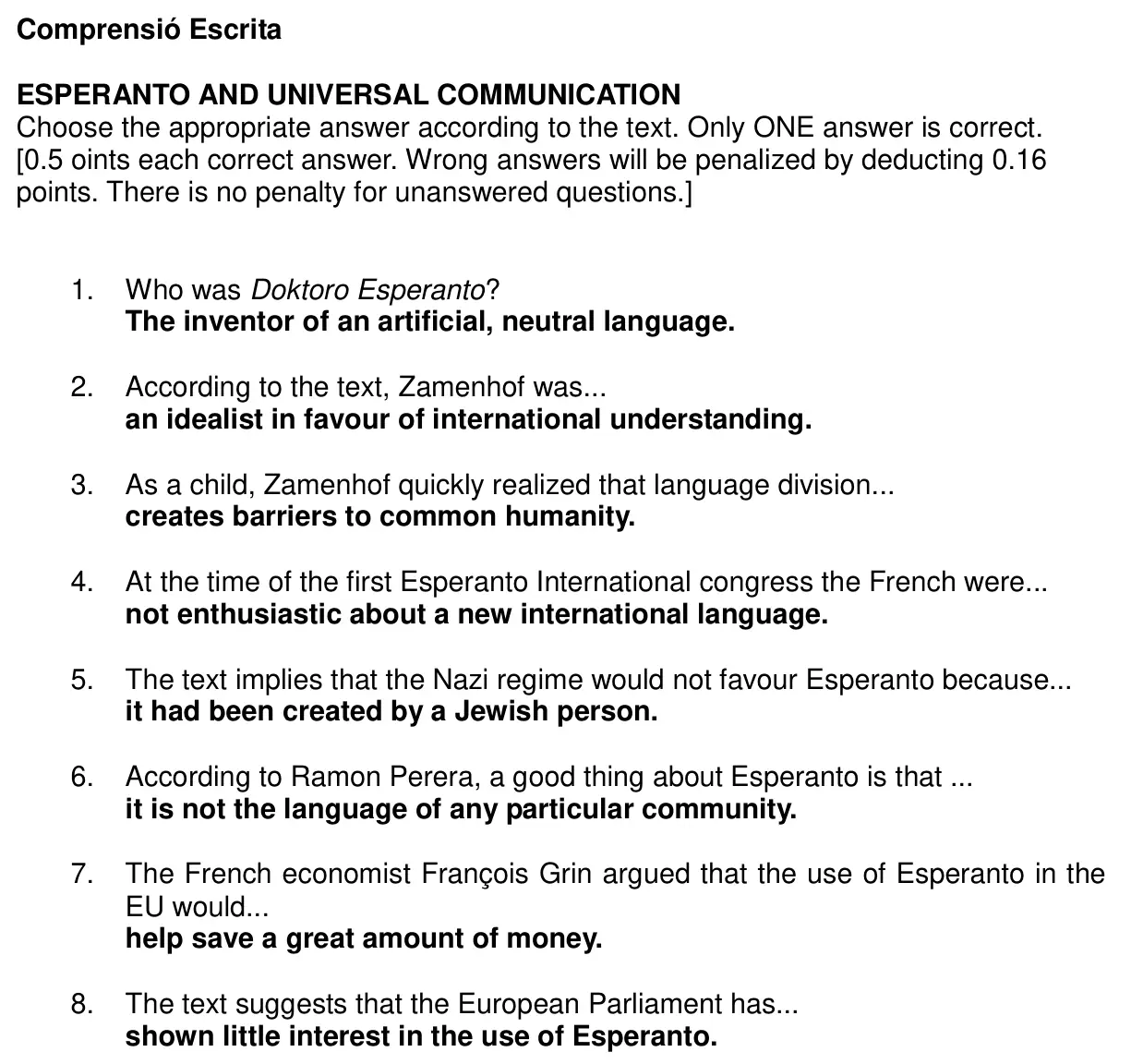
ESPERANTO AND UNIVERSAL COMMUNICATION
Choose the appropriate answer according to the text. Only ONE answer is correct.
[0.5 oints each correct answer. Wrong answers will be penalized by deducting 0.16
points. There is no penalty for unanswered questions.]
1. Who was Doktoro Esperanto?
The inventor of an artificial, neutral language.
2. According to the text, Zamenhof was...
an idealist in favour of international understanding.
3. As a child, Zamenhof quickly realized that language division...
creates barriers to common humanity.
4. At the time of the first Esperanto International congress the French were...
not enthusiastic about a new international language.
5. The text implies that the Nazi regime would not favour Esperanto because...
it had been created by a Jewish person.
6. According to Ramon Perera, a good thing about Esperanto is that ...
it is not the language of any particular community.
7. The French economist François Grin argued that the use of Esperanto […]
Resolució pas a pas
Encara no hi ha resolució pròpia verificada d'aquest exercici. Mentrestant, tens els criteris oficials de correcció a sobre. Si tens dubtes, pregunta'ls al xat de la Sala d'estudi.
Font: enunciat i criteris de correcció oficials de les PAU 2015 de Catalunya, publicats per la Generalitat de Catalunya (universitats.gencat.cat) i les universitats catalanes. La resolució pas a pas és pròpia de L'Acadèmia de Vic.
Altres exercicis d'aquest examen
- Part 2 · Writing Writing
- Part 3 · Listening comprehension Listening comprehension