
PAU Anglès 2014 · Juny · Sèrie 3 · Part 3 · Listening comprehension
Enunciat
Text de l'enunciat (transcripció automàtica)
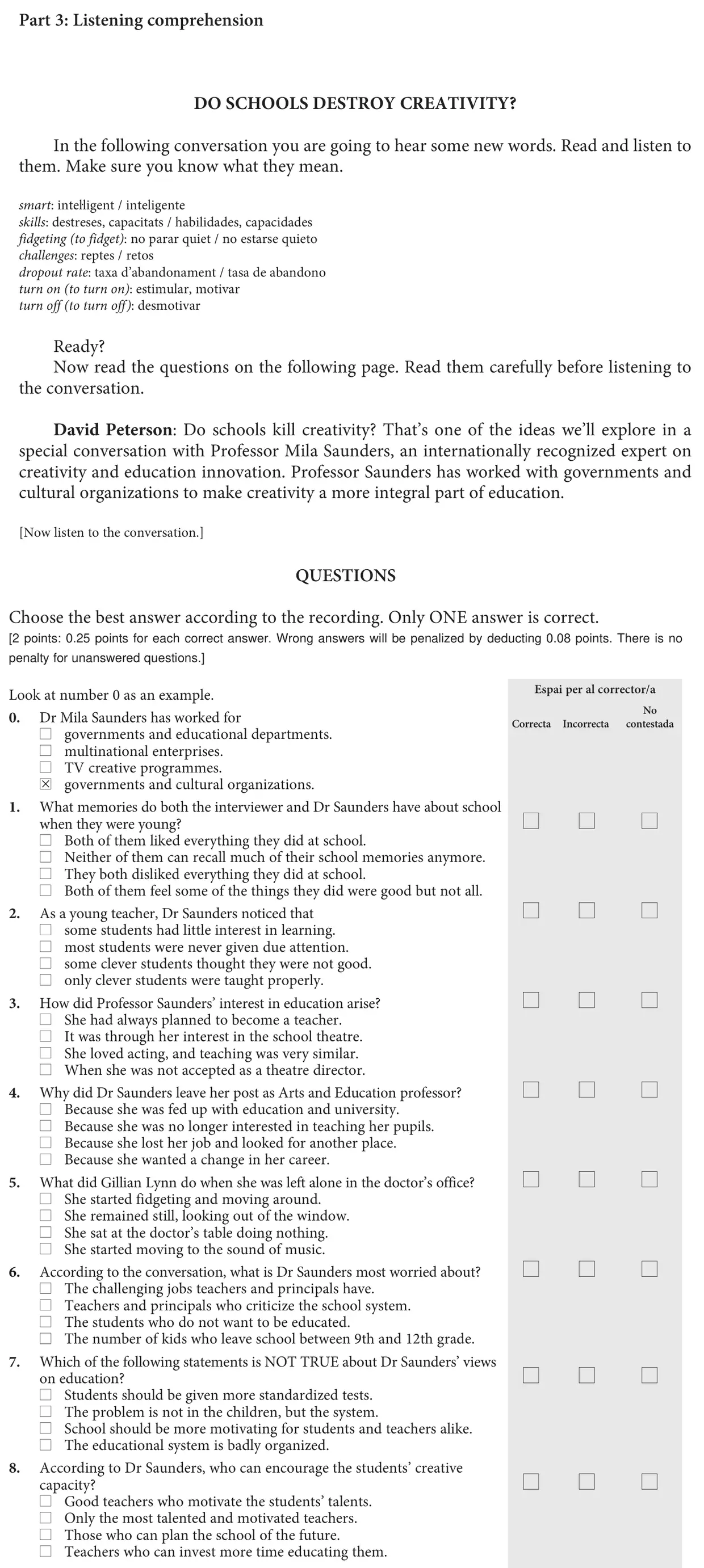
Part 3: Listening comprehension
DO SCHOOLS DESTROY CREATIVITY?
In the following conversation you are going to hear some new words. Read and listen to
them. Make sure you know what they mean.
smart: inteŀligent / inteligente
skills: destreses, capacitats / habilidades, capacidades
fidgeting (to fidget): no parar quiet / no estarse quieto
challenges: reptes / retos
dropout rate: taxa d’abandonament / tasa de abandono
turn on (to turn on): estimular, motivar
turn off (to turn off): desmotivar
Ready?
Now read the questions on the following page. Read them carefully before listening to
the conversation.
David Peterson: Do schools kill creativity? That’s one of the ideas we’ll explore in a
special conversation with Professor Mila Saunders, an internationally recognized expert on
creativity and education innovation. Professor Saunders has worked with governments and
cultural organizations to make creativity a more integral part of education.
[Now listen to the conversation.]
QUESTIONS
Choose the best answer according to the recording. Only ONE answer is correct.
[2 points: 0.25 points for each correct answer. Wrong answers will be penalized by deducting 0.08 points. There is no
penalty for unanswered questions.]
Look at number 0 as an example.
0. Dr Mila Saunders has worked for
governments and educational departments.
multinational enterprises.
TV creative programmes.
× governments and cultural organizations.
1. What memories do both the interviewer and Dr Saunders have about school
when they were young?
Both of them liked everything they did at school.
Neither of them can recall much of their school memories anymore.
They both disliked everything they did at school.
Both of them feel some of the things they did were good but not all.
2. As a young teacher, Dr Saunders noticed that
some students had little interest in learning.
most students were never given due attention.
some clever students thought they were not good.
only clever students were taught properly.
3. How did Professor Saunders’ interest in education arise?
She had always planned to become a teacher.
It was through her interest in the school theatre.
She loved acting, and teaching was very similar.
When she was not accepted as a theatre director.
4. Why did Dr Saunders leave her post as Arts and Education professor?
Because she was fed up with education and university.
Because she was no longer interested in teaching her pupils.
Because she lost her job and looked for another place.
Because she wanted a change in her career.
5. What did Gillian Lynn do when she was left alone in the doctor’s office?
She started fidgeting and moving around.
She remained still, looking out of the window.
She sat at the doctor’s table doing nothing.
She started moving to the sound of music.
6. According to the conversation, what is Dr Saunders most worried about?
The challenging jobs teachers and principals have.
Teachers and principals who criticize the school system.
The students who do not want to be educated.
The number of kids who leave school between 9th and 12th grade.
7. Which of the following statements is NOT TRUE about Dr Saunders’ views
on education?
Students should be given more standardized tests.
The problem is not in the children, but the system.
School should be more motivating for students and teachers alike.
The educational system is badly organized.
8. According to Dr Saunders, who can encourage the students’ creative
capacity?
Good teachers who motivate the students’ talents.
Only the most talented and motivated teachers.
Those who can plan the school of the future.
Teachers who can invest more time educating them.
Criteris oficials de correcció
Resolució pas a pas
Aquest exercici no té una resolució escrita pas a pas (requereix l'àudio de la prova). Fes servir els criteris oficials de correcció.
Font: enunciat i criteris de correcció oficials de les PAU 2014 de Catalunya, publicats per la Generalitat de Catalunya (universitats.gencat.cat) i les universitats catalanes. La resolució pas a pas és pròpia de L'Acadèmia de Vic.
Altres exercicis d'aquest examen
- Part 1 · Reading comprehension Reading comprehension
- Part 2 · Writing Writing
Tots els exercicis de Listening comprehension · PAU de Anglès