
PAU Anglès 2012 · Juny · Sèrie 1 · Part 1 · Reading comprehension
Enunciat
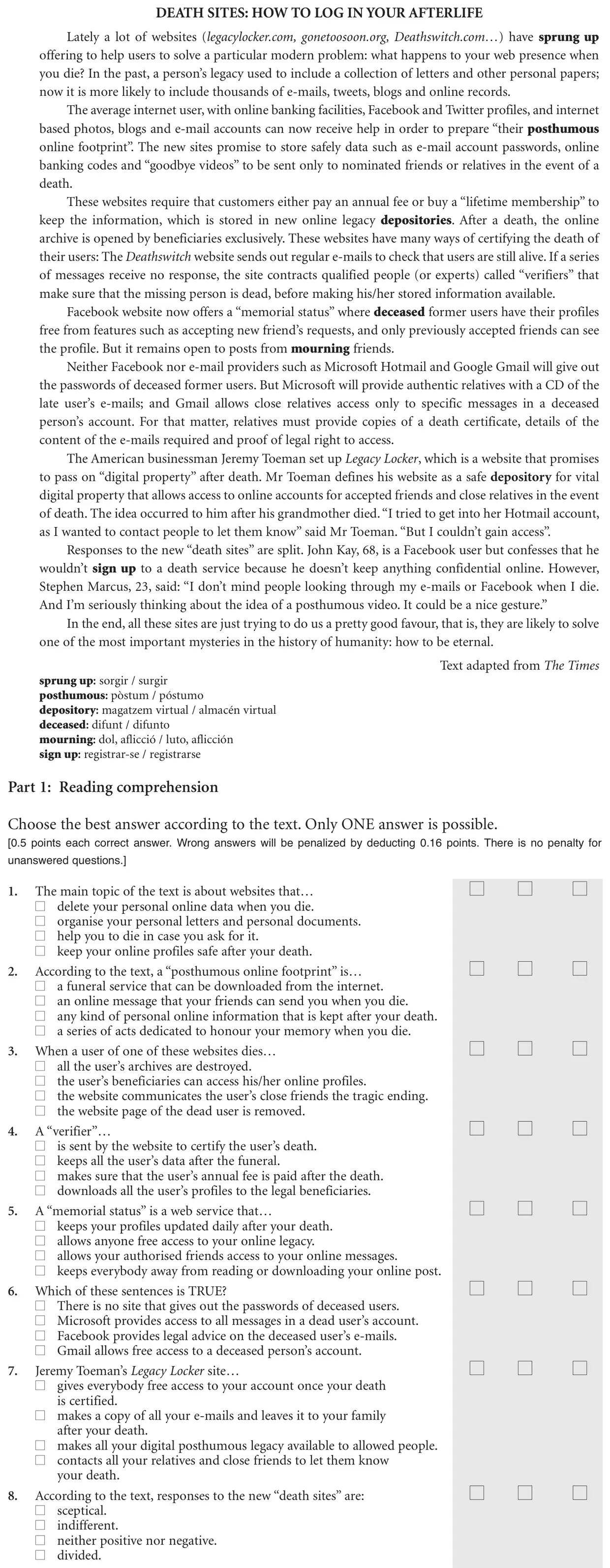
Text de l'enunciat (transcripció automàtica)
DEATH SITES: HOW TO LOG IN YOUR AFTERLIFE
Lately a lot of websites (legacylocker.com, gonetoosoon.org, Deathswitch.com…) have sprung up
offering to help users to solve a particular modern problem: what happens to your web presence when
you die? In the past, a person’s legacy used to include a collection of letters and other personal papers;
now it is more likely to include thousands of e-mails, tweets, blogs and online records.
The average internet user, with online banking facilities, Facebook and Twitter profiles, and internet
based photos, blogs and e-mail accounts can now receive help in order to prepare “their posthumous
online footprint”. The new sites promise to store safely data such as e-mail account passwords, online
banking codes and “goodbye videos” to be sent only to nominated friends or relatives in the event of a
death.
These websites require that customers either pay an annual fee or buy a “lifetime membership” to
keep the information, which is stored in new online legacy depositories. After a death, the online
archive is opened by beneficiaries exclusively. These websites have many ways of certifying the death of
their users: The Deathswitch website sends out regular e-mails to check that users are still alive. If a series
of messages receive no response, the site contracts qualified people (or experts) called “verifiers” that
make sure that the missing person is dead, before making his/her stored information available.
Facebook website now offers a “memorial status” where deceased former users have their profiles
free from features such as accepting new friend’s requests, and only previously accepted friends can see
the profile. But it remains open to posts from mourning friends.
Neither Facebook nor e-mail providers such as Microsoft Hotmail and Google Gmail will give out
the passwords of deceased former users. But Microsoft will provide authentic relatives with a CD of the
late user’s e-mails; and Gmail allows close relatives access only to specific messages in a deceased
person’s account. For that matter, relatives must provide copies of a death certificate, details of the
content of the e-mails required and proof of legal right to access.
The American businessman Jeremy Toeman set up Legacy Locker, which is a website that promises
to pass on “digital property” after death. Mr Toeman defines his website as a safe depository for vital
digital property that allows access to online accounts for accepted friends and close relatives in the event
of death. The idea occurred to him after his grandmother died. “I tried to get into her Hotmail account,
as I wanted to contact people to let them know” said Mr Toeman. “But I couldn’t gain access”.
Responses to the new “death sites” are split. John Kay, 68, is a Facebook user but confesses that he
wouldn’t sign up to a death service because he doesn’t keep anything confidential online. However,
Stephen Marcus, 23, said: “I don’t mind people looking through my e-mails or Facebook when I die.
And I’m seriously thinking about the idea of a posthumous video. It could be a nice gesture.”
In the end, all these sites are just trying to do us a pretty good favour, that is, they are likely to solve
one of the most important mysteries in the history of humanity: how to be eternal.
Text adapted from The Times
sprung up: sorgir / surgir
posthumous: pòstum / póstumo
depository: magatzem virtual / almacén virtual
deceased: difunt / difunto
mourning: dol, aflicció / luto, aflicción
sign up: registrar-se / registrarse
Part 1: Reading comprehension
Choose the best answer according to the text. Only ONE answer is possible.
[0.5 points each correct answer. Wrong answers will be penalized by deducting 0.16 points. There is no penalty for
unanswered questions.]
1. The main topic of the text is about websites that…
I delete your personal online data when you die.
I organise your personal letters and personal documents.
I help you to die in case you ask for it.
I keep your online profiles s
Criteris oficials de correcció
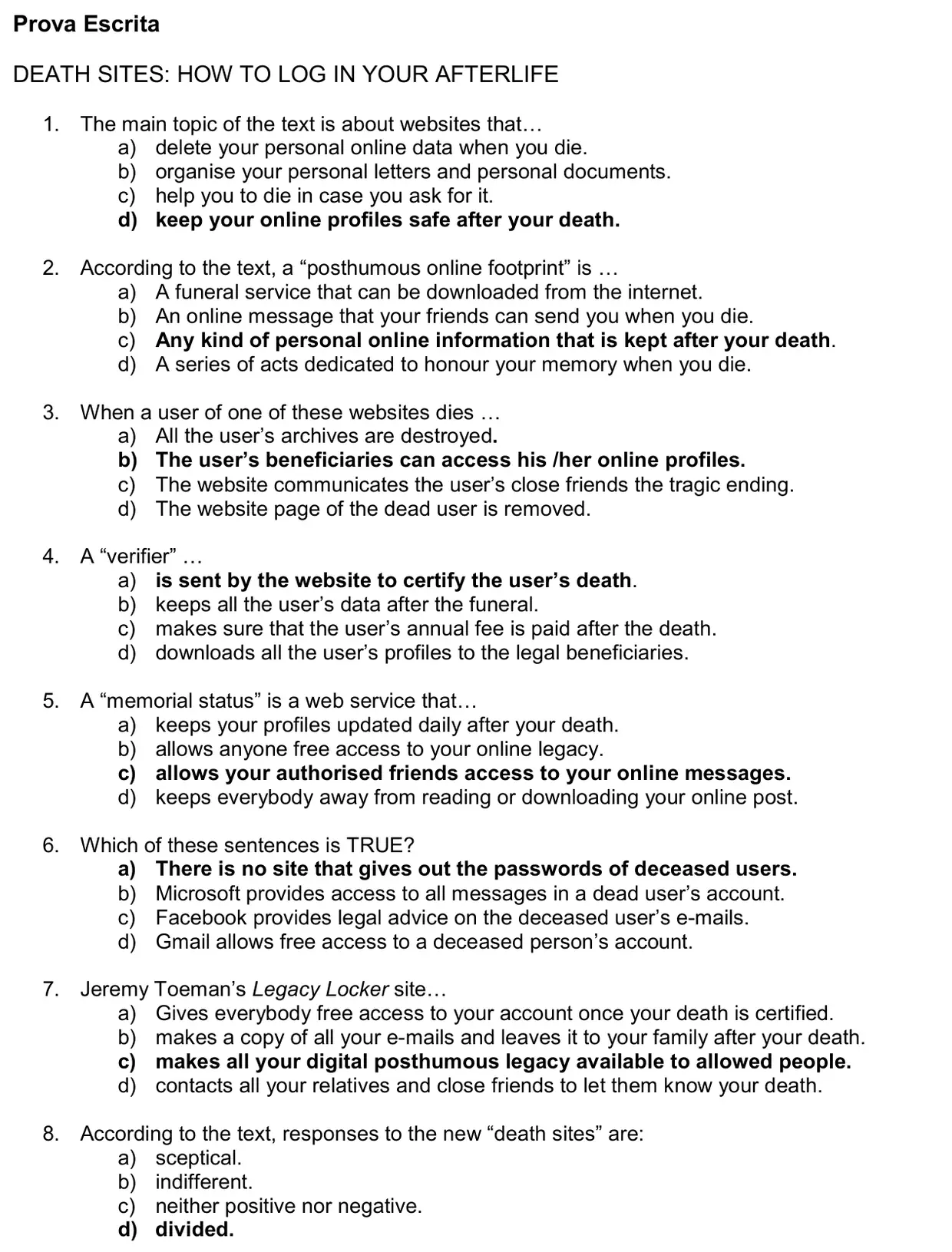
Text dels criteris (transcripció automàtica)
1. The main topic of the text is about websites that…
a) delete your personal online data when you die.
b) organise your personal letters and personal documents.
c) help you to die in case you ask for it.
d) keep your online profiles safe after your death.
2. According to the text, a “posthumous online footprint” is …
a) A funeral service that can be downloaded from the internet.
b) An online message that your friends can send you when you die.
c) Any kind of personal online information that is kept after your death.
d) A series of acts dedicated to honour your memory when you die.
3. When a user of one of these websites dies …
a) All the user’s archives are destroyed.
b) The user’s beneficiaries can access his /her online profiles.
c) The website communicates the user’s close friends the tragic ending.
d) The website page of the dead user is removed.
4. A “verifier” …
a) is sent by the website to certify the user’s death.
b) keeps all the user’s data after the funeral.
c) makes sure t […]
Resolució pas a pas
Encara no hi ha resolució pròpia verificada d'aquest exercici. Mentrestant, tens els criteris oficials de correcció a sobre. Si tens dubtes, pregunta'ls al xat de la Sala d'estudi.
Font: enunciat i criteris de correcció oficials de les PAU 2012 de Catalunya, publicats per la Generalitat de Catalunya (universitats.gencat.cat) i les universitats catalanes. La resolució pas a pas és pròpia de L'Acadèmia de Vic.
Altres exercicis d'aquest examen
- Part 2 · Writing Writing
- Part 3 · Listening comprehension Listening comprehension