
PAU Anglès 2011 · Setembre · Sèrie 2 · Part 1 · Reading comprehension
Enunciat
Text de l'enunciat (transcripció automàtica)
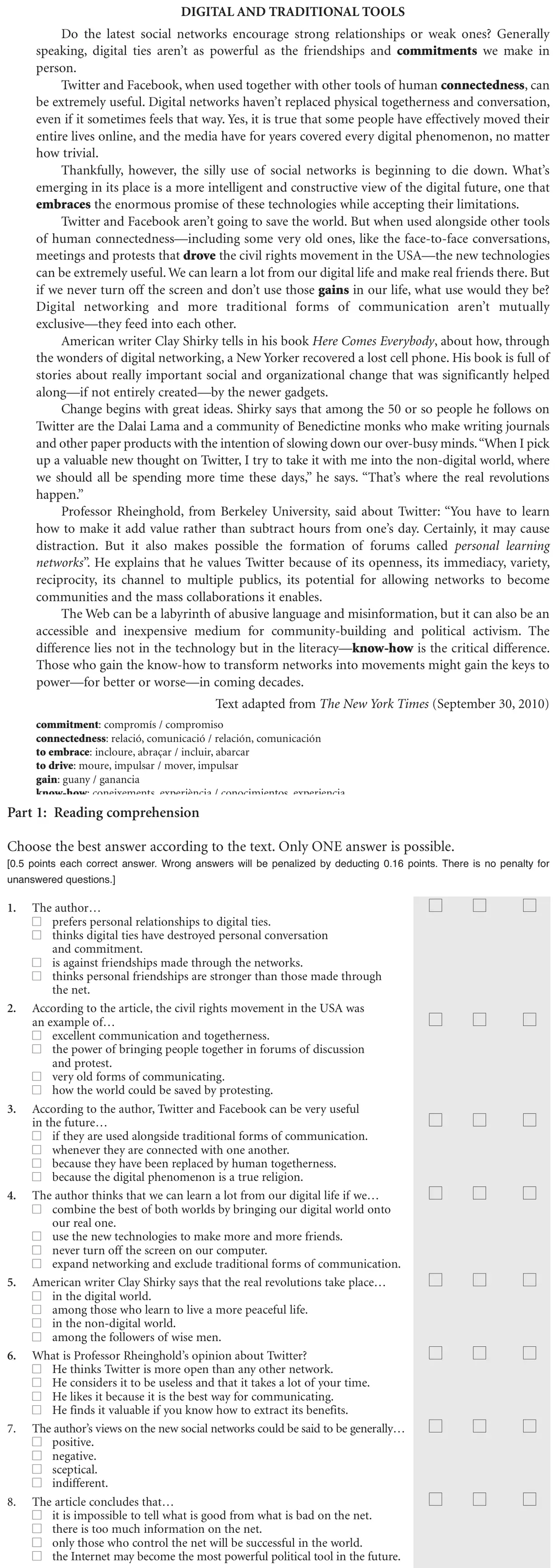
DIGITAL AND TRADITIONAL TOOLS
Do the latest social networks encourage strong relationships or weak ones? Generally
speaking, digital ties aren’t as powerful as the friendships and commitments we make in
person.
Twitter and Facebook, when used together with other tools of human connectedness, can
be extremely useful. Digital networks haven’t replaced physical togetherness and conversation,
even if it sometimes feels that way. Yes, it is true that some people have effectively moved their
entire lives online, and the media have for years covered every digital phenomenon, no matter
how trivial.
Thankfully, however, the silly use of social networks is beginning to die down. What’s
emerging in its place is a more intelligent and constructive view of the digital future, one that
embraces the enormous promise of these technologies while accepting their limitations.
Twitter and Facebook aren’t going to save the world. But when used alongside other tools
of human connectedness—including some very old ones, like the face-to-face conversations,
meetings and protests that drove the civil rights movement in the USA—the new technologies
can be extremely useful. We can learn a lot from our digital life and make real friends there. But
if we never turn off the screen and don’t use those gains in our life, what use would they be?
Digital networking and more traditional forms of communication aren’t mutually
exclusive—they feed into each other.
American writer Clay Shirky tells in his book Here Comes Everybody, about how, through
the wonders of digital networking, a New Yorker recovered a lost cell phone. His book is full of
stories about really important social and organizational change that was significantly helped
along—if not entirely created—by the newer gadgets.
Change begins with great ideas. Shirky says that among the 50 or so people he follows on
Twitter are the Dalai Lama and a community of Benedictine monks who make writing journals
and other paper products with the intention of slowing down our over-busy minds. “When I pick
up a valuable new thought on Twitter, I try to take it with me into the non-digital world, where
we should all be spending more time these days,” he says. “That’s where the real revolutions
happen.”
Professor Rheinghold, from Berkeley University, said about Twitter: “You have to learn
how to make it add value rather than subtract hours from one’s day. Certainly, it may cause
distraction. But it also makes possible the formation of forums called personal learning
networks”. He explains that he values Twitter because of its openness, its immediacy, variety,
reciprocity, its channel to multiple publics, its potential for allowing networks to become
communities and the mass collaborations it enables.
The Web can be a labyrinth of abusive language and misinformation, but it can also be an
accessible and inexpensive medium for community-building and political activism. The
difference lies not in the technology but in the literacy—know-how is the critical difference.
Those who gain the know-how to transform networks into movements might gain the keys to
power—for better or worse—in coming decades.
Text adapted from The New York Times (September 30, 2010)
commitment: compromís / compromiso
connectedness: relació, comunicació / relación, comunicación
to embrace: incloure, abraçar / incluir, abarcar
to drive: moure, impulsar / mover, impulsar
gain: guany / ganancia
know-how: coneixements, experiència / conocimientos, experiencia
Part 1: Reading comprehension
Choose the best answer according to the text. Only ONE answer is possible.
[0.5 points each correct answer. Wrong answers will be penalized by deducting 0.16 points. There is no penalty for
unanswered questions.]
1. The author…
I prefers personal relationships to digital ties.
I thinks digital ties have destroyed personal conversation
and commitment.
I is against friendships made through the networks.
I thinks personal friendships are stronger than those made through
t
Criteris oficials de correcció
Text dels criteris (transcripció automàtica)
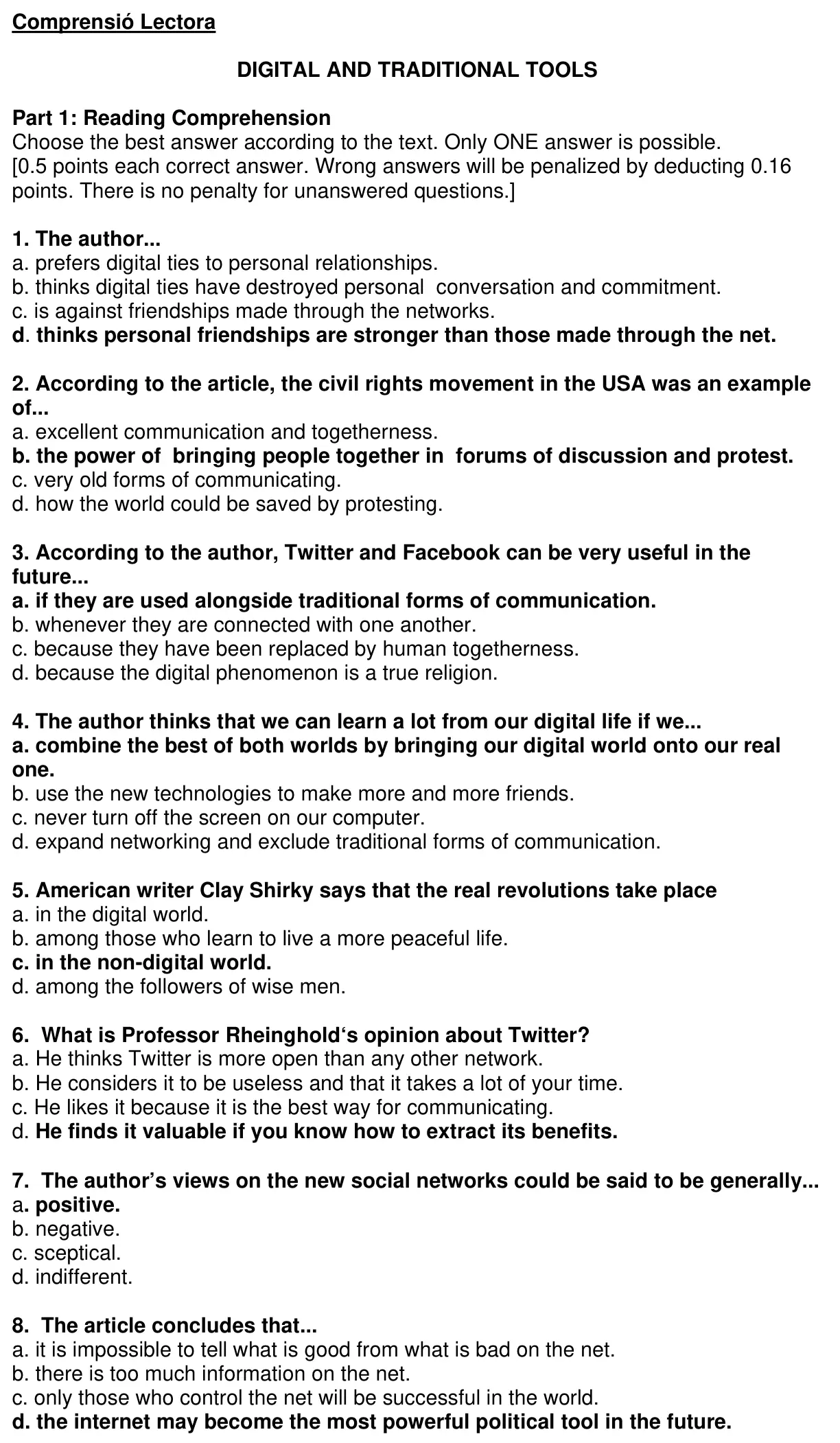
1. The author...
a. prefers digital ties to personal relationships.
b. thinks digital ties have destroyed personal conversation and commitment.
c. is against friendships made through the networks.
d. thinks personal friendships are stronger than those made through the net.
2. According to the article, the civil rights movement in the USA was an example
of...
a. excellent communication and togetherness.
b. the power of bringing people together in forums of discussion and protest.
c. very old forms of communicating.
d. how the world could be saved by protesting.
3. According to the author, Twitter and Facebook can be very useful in the
future...
a. if they are used alongside traditional forms of communication.
b. whenever they are connected with one another.
c. because they have been replaced by human togetherness.
d. because the digital phenomenon is a true religion.
4. The author thinks that we can learn a lot from our digital life if we...
a. combine the best of both worlds by bringin […]
Resolució pas a pas
Encara no hi ha resolució pròpia verificada d'aquest exercici. Mentrestant, tens els criteris oficials de correcció a sobre. Si tens dubtes, pregunta'ls al xat de la Sala d'estudi.
Font: enunciat i criteris de correcció oficials de les PAU 2011 de Catalunya, publicats per la Generalitat de Catalunya (universitats.gencat.cat) i les universitats catalanes. La resolució pas a pas és pròpia de L'Acadèmia de Vic.
Altres exercicis d'aquest examen
- Part 2 · Writing Writing
- Part 3 · Listening comprehension Listening comprehension