
PAU Anglès 2011 · Juny · Sèrie 1 · Part 1 · Reading comprehension
Enunciat
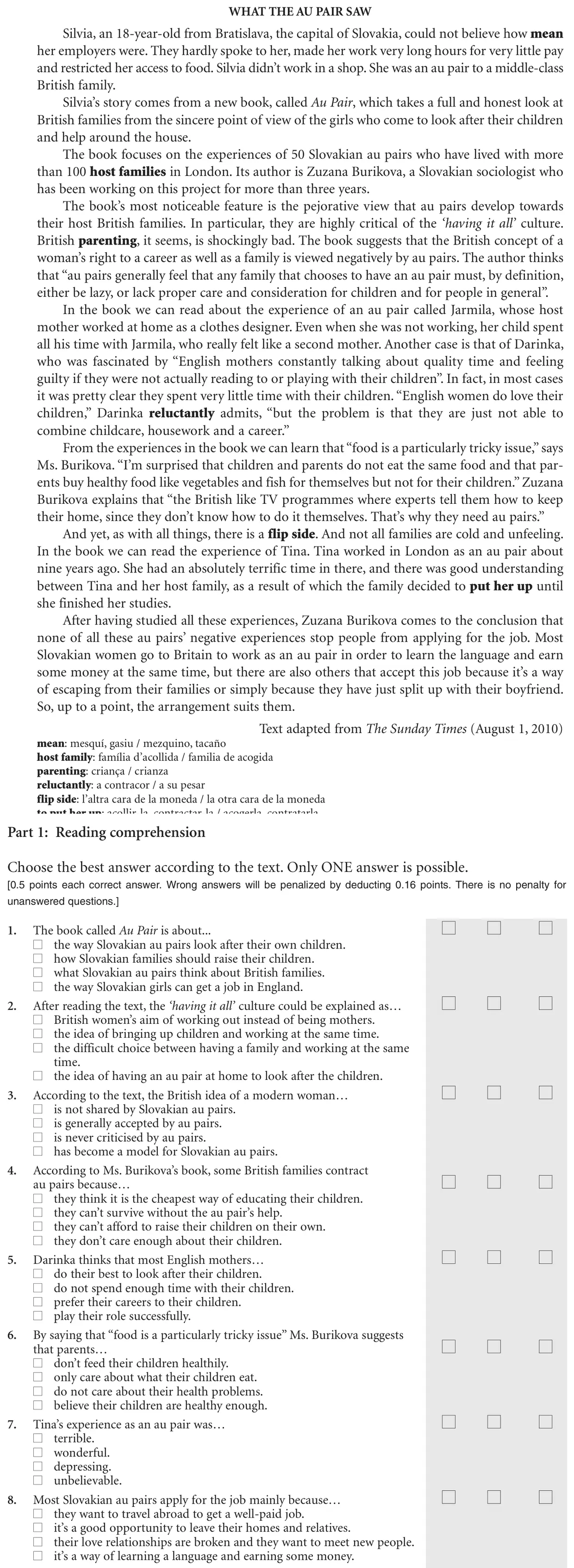
Text de l'enunciat (transcripció automàtica)
WHAT THE AU PAIR SAW
Silvia, an 18-year-old from Bratislava, the capital of Slovakia, could not believe how mean
her employers were. They hardly spoke to her, made her work very long hours for very little pay
and restricted her access to food. Silvia didn’t work in a shop. She was an au pair to a middle-class
British family.
Silvia’s story comes from a new book, called Au Pair, which takes a full and honest look at
British families from the sincere point of view of the girls who come to look after their children
and help around the house.
The book focuses on the experiences of 50 Slovakian au pairs who have lived with more
than 100 host families in London. Its author is Zuzana Burikova, a Slovakian sociologist who
has been working on this project for more than three years.
The book’s most noticeable feature is the pejorative view that au pairs develop towards
their host British families. In particular, they are highly critical of the ‘having it all’ culture.
British parenting, it seems, is shockingly bad. The book suggests that the British concept of a
woman’s right to a career as well as a family is viewed negatively by au pairs. The author thinks
that “au pairs generally feel that any family that chooses to have an au pair must, by definition,
either be lazy, or lack proper care and consideration for children and for people in general”.
In the book we can read about the experience of an au pair called Jarmila, whose host
mother worked at home as a clothes designer. Even when she was not working, her child spent
all his time with Jarmila, who really felt like a second mother. Another case is that of Darinka,
who was fascinated by “English mothers constantly talking about quality time and feeling
guilty if they were not actually reading to or playing with their children”. In fact, in most cases
it was pretty clear they spent very little time with their children. “English women do love their
children,” Darinka reluctantly admits, “but the problem is that they are just not able to
combine childcare, housework and a career.”
From the experiences in the book we can learn that “food is a particularly tricky issue,” says
Ms. Burikova. “I’m surprised that children and parents do not eat the same food and that par-
ents buy healthy food like vegetables and fish for themselves but not for their children.” Zuzana
Burikova explains that “the British like TV programmes where experts tell them how to keep
their home, since they don’t know how to do it themselves. That’s why they need au pairs.”
And yet, as with all things, there is a flip side. And not all families are cold and unfeeling.
In the book we can read the experience of Tina. Tina worked in London as an au pair about
nine years ago. She had an absolutely terrific time in there, and there was good understanding
between Tina and her host family, as a result of which the family decided to put her up until
she finished her studies.
After having studied all these experiences, Zuzana Burikova comes to the conclusion that
none of all these au pairs’ negative experiences stop people from applying for the job. Most
Slovakian women go to Britain to work as an au pair in order to learn the language and earn
some money at the same time, but there are also others that accept this job because it’s a way
of escaping from their families or simply because they have just split up with their boyfriend.
So, up to a point, the arrangement suits them.
Text adapted from The Sunday Times (August 1, 2010)
mean: mesquí, gasiu / mezquino, tacaño
host family: família d’acollida / familia de acogida
parenting: criança / crianza
reluctantly: a contracor / a su pesar
flip side: l’altra cara de la moneda / la otra cara de la moneda
to put her up: acollir-la, contractar-la / acogerla, contratarla
Part 1: Reading comprehension
Choose the best answer according to the text. Only ONE answer is possible.
[0.5 points each correct answer. Wrong answers will be penalized by deducting 0.16 points. There is no penalty fo
Criteris oficials de correcció
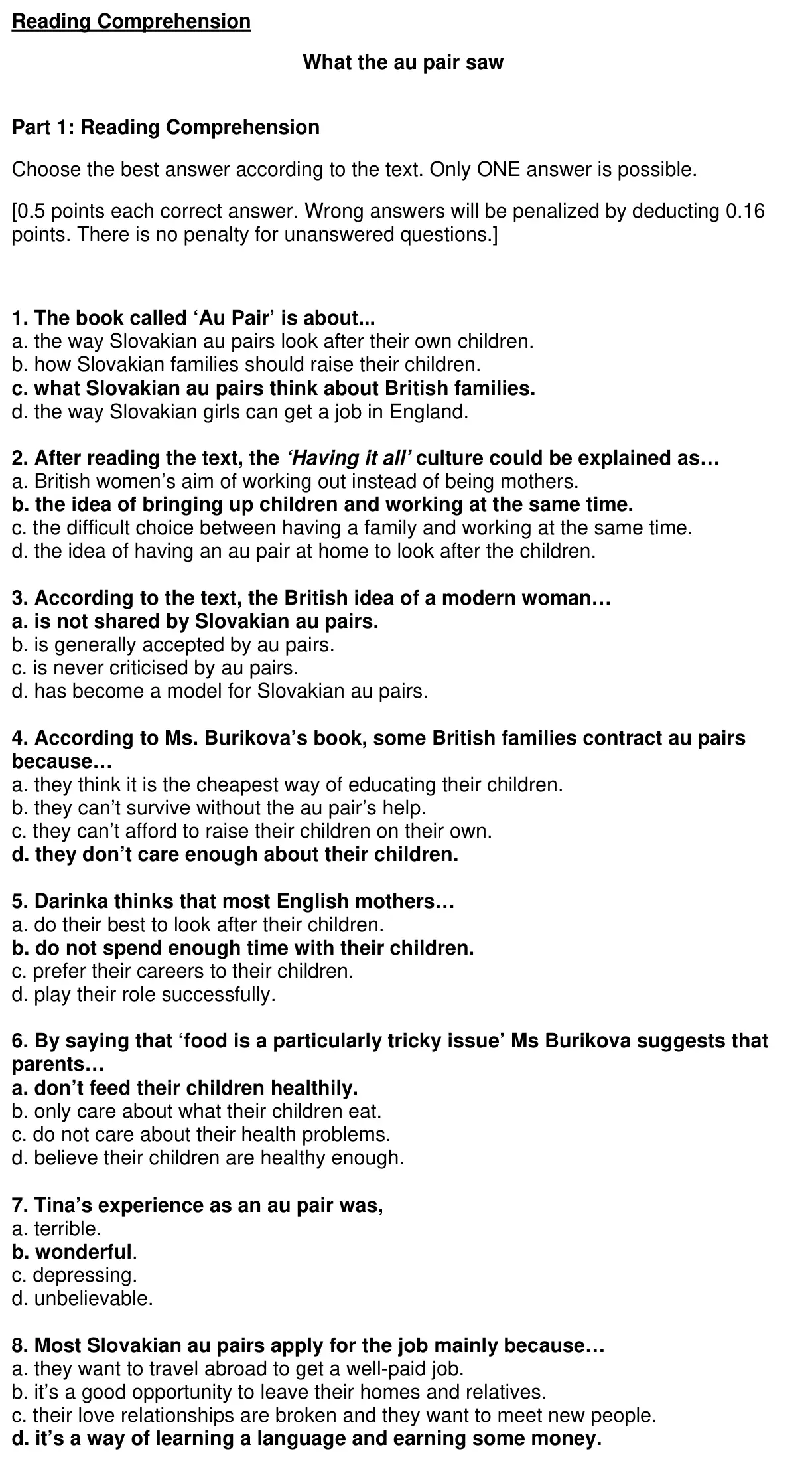
Text dels criteris (transcripció automàtica)
1. The book called ‘Au Pair’ is about...
a. the way Slovakian au pairs look after their own children.
b. how Slovakian families should raise their children.
c. what Slovakian au pairs think about British families.
d. the way Slovakian girls can get a job in England.
2. After reading the text, the ‘Having it all’ culture could be explained as…
a. British women’s aim of working out instead of being mothers.
b. the idea of bringing up children and working at the same time.
c. the difficult choice between having a family and working at the same time.
d. the idea of having an au pair at home to look after the children.
3. According to the text, the British idea of a modern woman…
a. is not shared by Slovakian au pairs.
b. is generally accepted by au pairs.
c. is never criticised by au pairs.
d. has become a model for Slovakian au pairs.
4. According to Ms. Burikova’s book, some British families contract au pairs
because…
a. they think it is the cheapest way of educating their children.
b. t […]
Resolució pas a pas
Encara no hi ha resolució pròpia verificada d'aquest exercici. Mentrestant, tens els criteris oficials de correcció a sobre. Si tens dubtes, pregunta'ls al xat de la Sala d'estudi.
Font: enunciat i criteris de correcció oficials de les PAU 2011 de Catalunya, publicats per la Generalitat de Catalunya (universitats.gencat.cat) i les universitats catalanes. La resolució pas a pas és pròpia de L'Acadèmia de Vic.
Altres exercicis d'aquest examen
- Part 2 · Writing Writing
- Part 3 · Listening comprehension Listening comprehension