
PAU Anglès 2011 · Setembre · Sèrie 2 · Part 3 · Listening comprehension
Enunciat
Text de l'enunciat (transcripció automàtica)
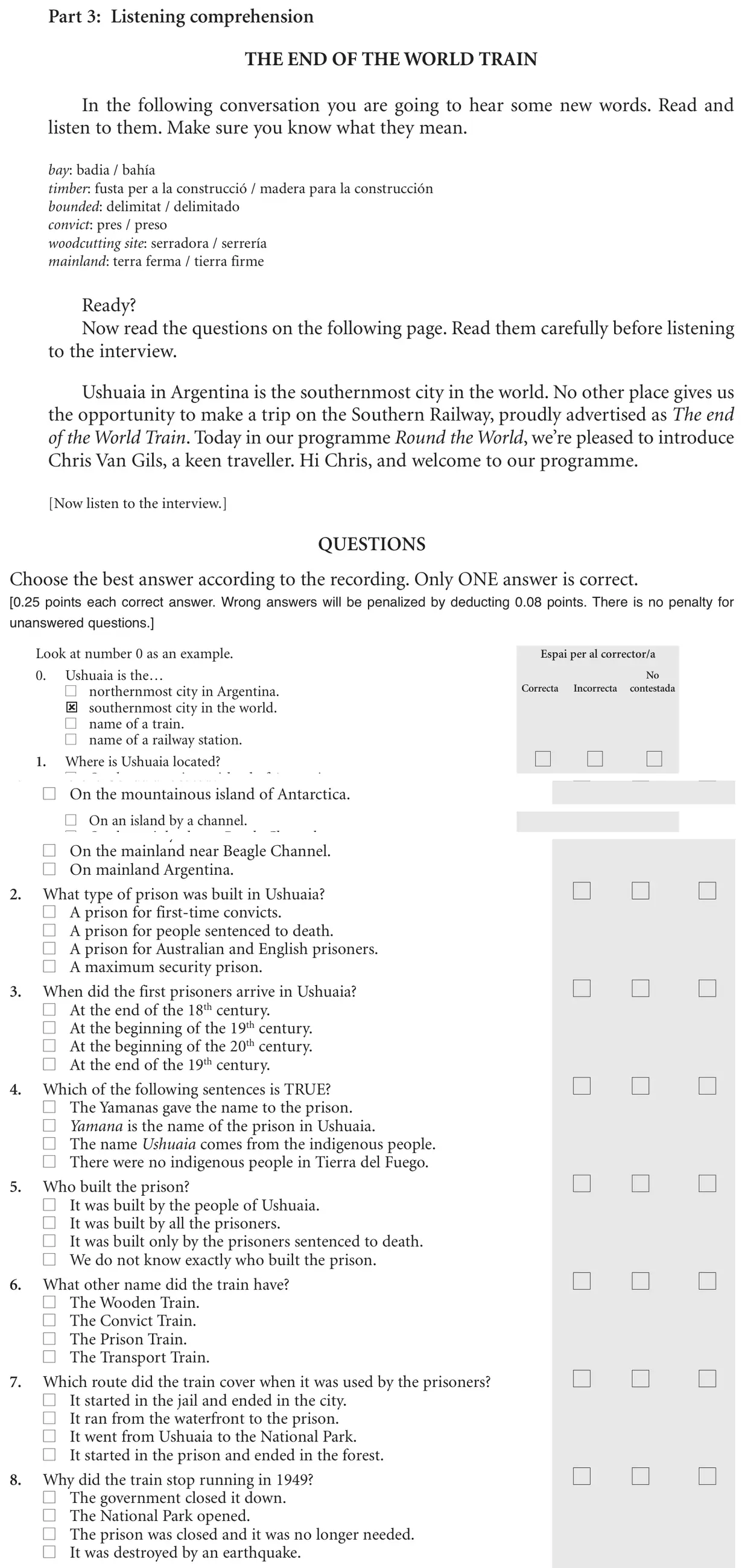
Part 3: Listening comprehension
THE END OF THE WORLD TRAIN
In the following conversation you are going to hear some new words. Read and
listen to them. Make sure you know what they mean.
bay: badia / bahía
timber: fusta per a la construcció / madera para la construcción
bounded: delimitat / delimitado
convict: pres / preso
woodcutting site: serradora / serrería
mainland: terra ferma / tierra firme
Ready?
Now read the questions on the following page. Read them carefully before listening
to the interview.
Ushuaia in Argentina is the southernmost city in the world. No other place gives us
the opportunity to make a trip on the Southern Railway, proudly advertised as The end
of the World Train. Today in our programme Round the World, we’re pleased to introduce
Chris Van Gils, a keen traveller. Hi Chris, and welcome to our programme.
[Now listen to the interview.]
QUESTIONS
Choose the best answer according to the recording. Only ONE answer is correct.
[0.25 points each correct answer. Wrong answers will be penalized by deducting 0.08 points. There is no penalty for
unanswered questions.]
I On the mountainous island of Antarctica.
I On the mountainous island of Antarctica.
I On the mainland near Beagle Channel.
I On the mainland near Beagle Channel.
I On mainland Argentina.
2. What type of prison was built in Ushuaia?
I A prison for first-time convicts.
I A prison for people sentenced to death.
I A prison for Australian and English prisoners.
I A maximum security prison.
3. When did the first prisoners arrive in Ushuaia?
At the end of the 18th century.
I
At the beginning of the 19th century.
I
At the beginning of the 20th century.
I
At the end of the 19th century.
I
4. Which of the following sentences is TRUE?
I The Yamanas gave the name to the prison.
I Yamana is the name of the prison in Ushuaia.
I The name Ushuaia comes from the indigenous people.
I There were no indigenous people in Tierra del Fuego.
5. Who built the prison?
I It was built by the people of Ushuaia.
I It was built by all the prisoners.
I It was built only by the prisoners sentenced to death.
I We do not know exactly who built the prison.
6. What other name did the train have?
I The Wooden Train.
I The Convict Train.
I The Prison Train.
I The Transport Train.
7. Which route did the train cover when it was used by the prisoners?
I It started in the jail and ended in the city.
I It ran from the waterfront to the prison.
I It went from Ushuaia to the National Park.
I It started in the prison and ended in the forest.
8. Why did the train stop running in 1949?
I The government closed it down.
I The National Park opened.
I The prison was closed and it was no longer needed.
I It was destroyed by an earthquake.
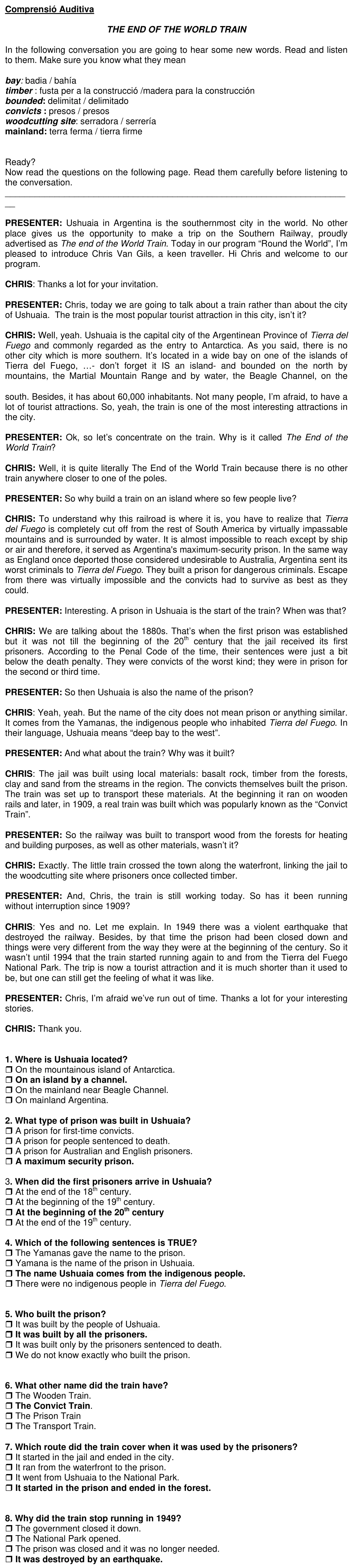
Criteris oficials de correcció
Resolució pas a pas
Aquest exercici no té una resolució escrita pas a pas (requereix l'àudio de la prova). Fes servir els criteris oficials de correcció.
Font: enunciat i criteris de correcció oficials de les PAU 2011 de Catalunya, publicats per la Generalitat de Catalunya (universitats.gencat.cat) i les universitats catalanes. La resolució pas a pas és pròpia de L'Acadèmia de Vic.
Altres exercicis d'aquest examen
- Part 1 · Reading comprehension Reading comprehension
- Part 2 · Writing Writing
Tots els exercicis de Listening comprehension · PAU de Anglès