
PAU Anglès 2011 · Juny · Sèrie 4 · Part 1 · Reading comprehension
Enunciat
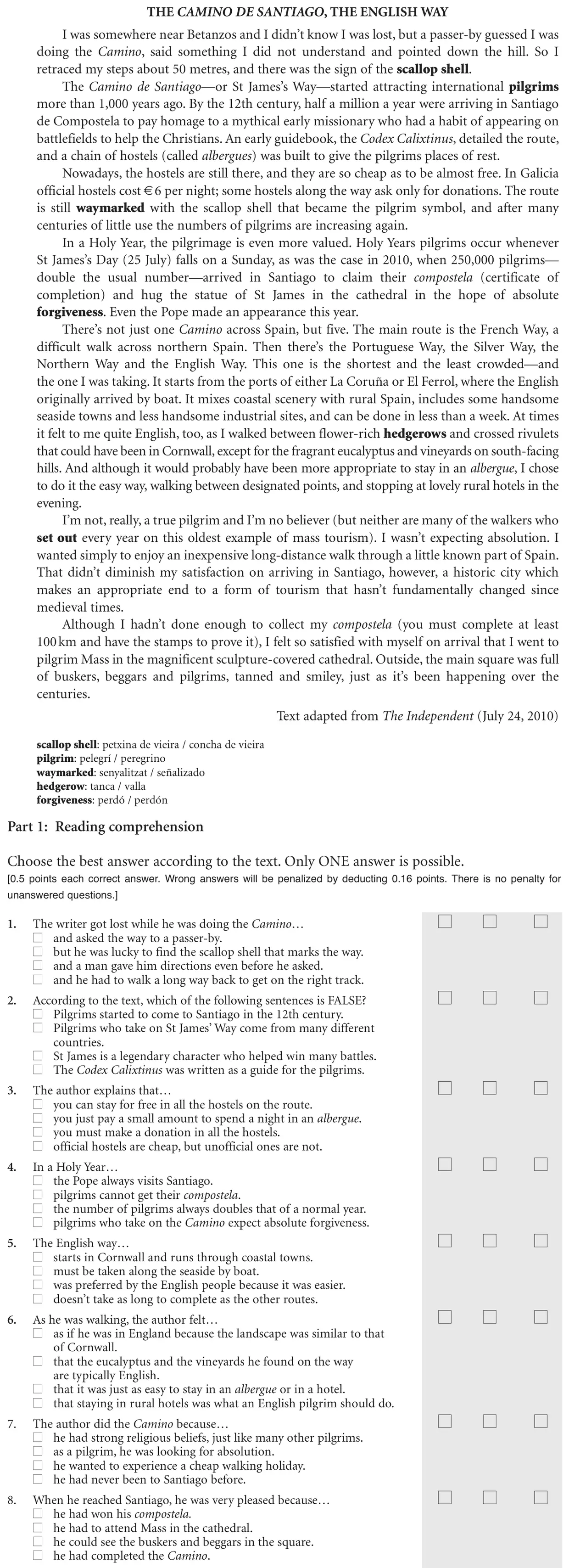
Text de l'enunciat (transcripció automàtica)
THE CAMINO DE SANTIAGO, THE ENGLISH WAY
I was somewhere near Betanzos and I didn’t know I was lost, but a passer-by guessed I was
doing the Camino, said something I did not understand and pointed down the hill. So I
retraced my steps about 50 metres, and there was the sign of the scallop shell.
The Camino de Santiago—or St James’s Way—started attracting international pilgrims
more than 1,000 years ago. By the 12th century, half a million a year were arriving in Santiago
de Compostela to pay homage to a mythical early missionary who had a habit of appearing on
battlefields to help the Christians. An early guidebook, the Codex Calixtinus, detailed the route,
and a chain of hostels (called albergues) was built to give the pilgrims places of rest.
Nowadays, the hostels are still there, and they are so cheap as to be almost free. In Galicia
official hostels cost €6 per night; some hostels along the way ask only for donations. The route
is still waymarked with the scallop shell that became the pilgrim symbol, and after many
centuries of little use the numbers of pilgrims are increasing again.
In a Holy Year, the pilgrimage is even more valued. Holy Years pilgrims occur whenever
St James’s Day (25 July) falls on a Sunday, as was the case in 2010, when 250,000 pilgrims—
double the usual number—arrived in Santiago to claim their compostela (certificate of
completion) and hug the statue of St James in the cathedral in the hope of absolute
forgiveness. Even the Pope made an appearance this year.
There’s not just one Camino across Spain, but five. The main route is the French Way, a
difficult walk across northern Spain. Then there’s the Portuguese Way, the Silver Way, the
Northern Way and the English Way. This one is the shortest and the least crowded—and
the one I was taking. It starts from the ports of either La Coruña or El Ferrol, where the English
originally arrived by boat. It mixes coastal scenery with rural Spain, includes some handsome
seaside towns and less handsome industrial sites, and can be done in less than a week. At times
it felt to me quite English, too, as I walked between flower-rich hedgerows and crossed rivulets
that could have been in Cornwall, except for the fragrant eucalyptus and vineyards on south-facing
hills. And although it would probably have been more appropriate to stay in an albergue, I chose
to do it the easy way, walking between designated points, and stopping at lovely rural hotels in the
evening.
I’m not, really, a true pilgrim and I’m no believer (but neither are many of the walkers who
set out every year on this oldest example of mass tourism). I wasn’t expecting absolution. I
wanted simply to enjoy an inexpensive long-distance walk through a little known part of Spain.
That didn’t diminish my satisfaction on arriving in Santiago, however, a historic city which
makes an appropriate end to a form of tourism that hasn’t fundamentally changed since
medieval times.
Although I hadn’t done enough to collect my compostela (you must complete at least
100km and have the stamps to prove it), I felt so satisfied with myself on arrival that I went to
pilgrim Mass in the magnificent sculpture-covered cathedral. Outside, the main square was full
of buskers, beggars and pilgrims, tanned and smiley, just as it’s been happening over the
centuries.
Text adapted from The Independent (July 24, 2010)
scallop shell: petxina de vieira / concha de vieira
pilgrim: pelegrí / peregrino
waymarked: senyalitzat / señalizado
hedgerow: tanca / valla
forgiveness: perdó / perdón
Part 1: Reading comprehension
Choose the best answer according to the text. Only ONE answer is possible.
[0.5 points each correct answer. Wrong answers will be penalized by deducting 0.16 points. There is no penalty for
unanswered questions.]
1. The writer got lost while he was doing the Camino…
I and asked the way to a passer-by.
I but he was lucky to find the scallop shell that marks the way.
I and a man gave him directions even before he asked.
I and he
Criteris oficials de correcció
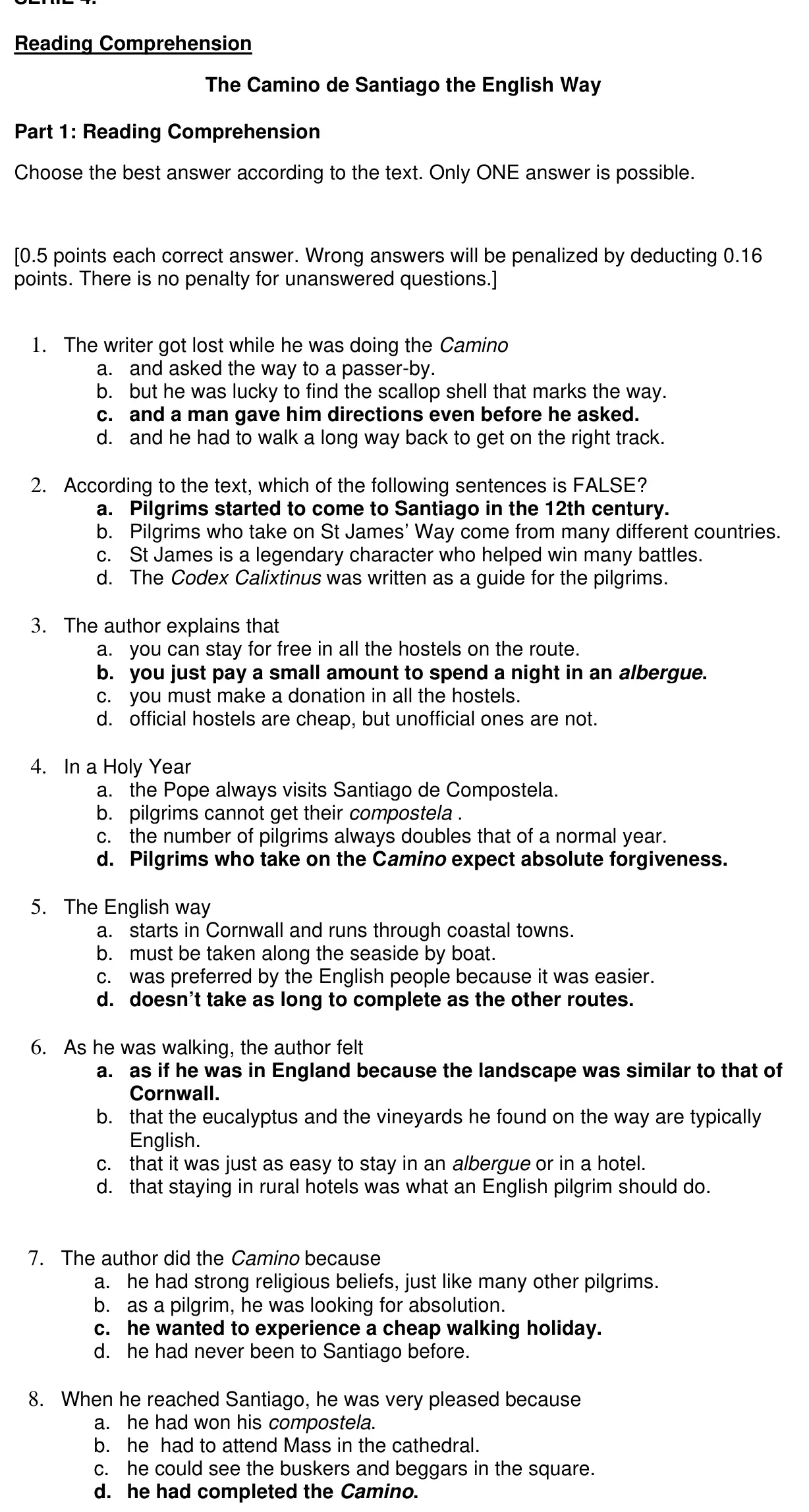
Text dels criteris (transcripció automàtica)
1. The writer got lost while he was doing the Camino
a. and asked the way to a passer-by.
b. but he was lucky to find the scallop shell that marks the way.
c. and a man gave him directions even before he asked.
d. and he had to walk a long way back to get on the right track.
2. According to the text, which of the following sentences is FALSE?
a. Pilgrims started to come to Santiago in the 12th century.
b. Pilgrims who take on St James’ Way come from many different countries.
c. St James is a legendary character who helped win many battles.
d. The Codex Calixtinus was written as a guide for the pilgrims.
3. The author explains that
a. you can stay for free in all the hostels on the route.
b. you just pay a small amount to spend a night in an albergue.
c. you must make a donation in all the hostels.
d. official hostels are cheap, but unofficial ones are not.
4. In a Holy Year
a. the Pope always visits Santiago de Compostela.
b. pilgrims cannot get their compostela .
c. the number of pilg […]
Resolució pas a pas
Encara no hi ha resolució pròpia verificada d'aquest exercici. Mentrestant, tens els criteris oficials de correcció a sobre. Si tens dubtes, pregunta'ls al xat de la Sala d'estudi.
Font: enunciat i criteris de correcció oficials de les PAU 2011 de Catalunya, publicats per la Generalitat de Catalunya (universitats.gencat.cat) i les universitats catalanes. La resolució pas a pas és pròpia de L'Acadèmia de Vic.
Altres exercicis d'aquest examen
- Part 2 · Writing Writing
- Part 3 · Listening comprehension Listening comprehension