
PAU Anglès 2010 · Setembre · Sèrie 2 · Part 1 · Reading comprehension
Enunciat
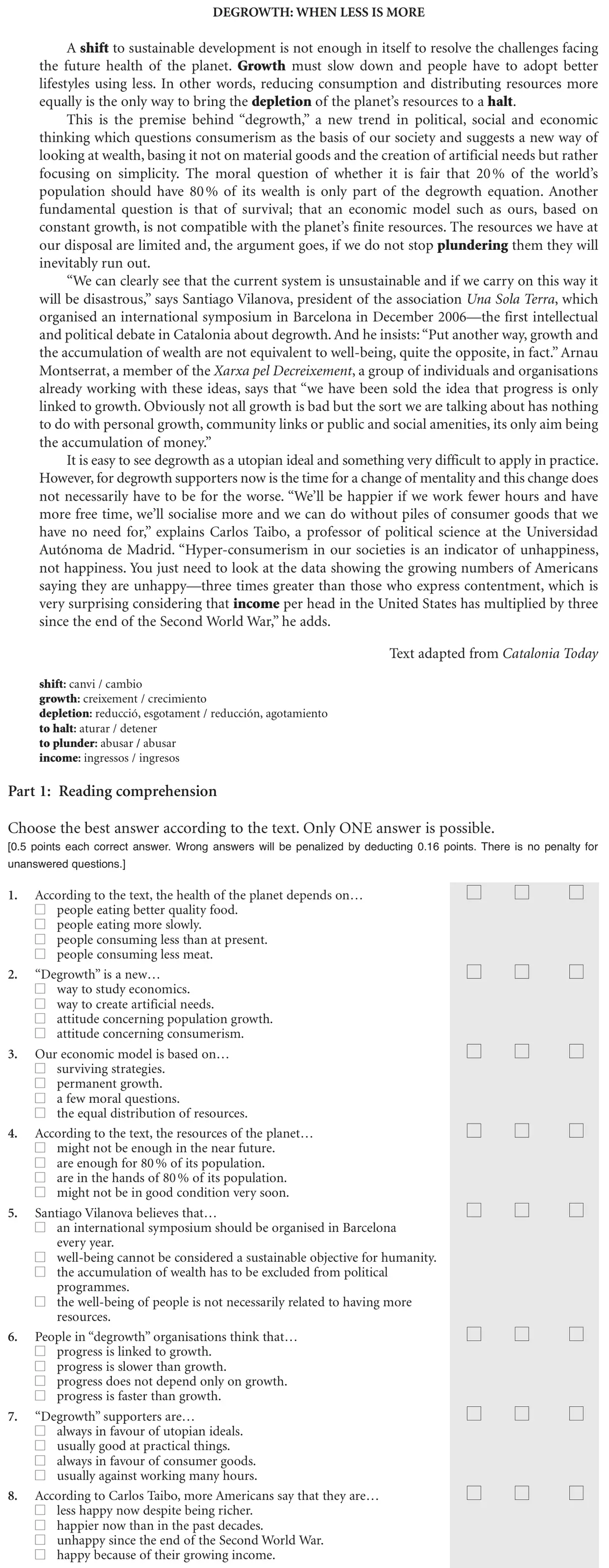
Text de l'enunciat (transcripció automàtica)
DEGROWTH: WHEN LESS IS MORE
A shift to sustainable development is not enough in itself to resolve the challenges facing
the future health of the planet. Growth must slow down and people have to adopt better
life styles using less. In other words, reducing consumption and distributing resources more
equally is the only way to bring the depletion of the planet’s resources to a halt.
This is the premise behind “degrowth,” a new trend in political, social and economic
think ing which questions consumerism as the basis of our society and suggests a new way of
looking at wealth, basing it not on material goods and the creation of artificial needs but rather
focusing on simplicity. The moral question of whether it is fair that 20% of the world’s
population should have 80% of its wealth is only part of the degrowth equation. Another
fundamental question is that of survival; that an economic model such as ours, based on
constant growth, is not compatible with the planet’s finite resources. The resources we have at
our disposal are limited and, the argument goes, if we do not stop plundering them they will
inevitably run out.
“We can clearly see that the current system is unsustainable and if we carry on this way it
will be disastrous,” says Santiago Vilanova, president of the association Una Sola Terra, which
organised an international symposium in Barcelona in December 2006—the first intellectual
and political debate in Catalonia about degrowth. And he insists: “Put another way, growth and
the accumulation of wealth are not equivalent to well-being, quite the opposite, in fact.” Arnau
Montserrat, a member of the Xarxa pel Decreixement, a group of individuals and organisations
already working with these ideas, says that “we have been sold the idea that progress is only
linked to growth. Obviously not all growth is bad but the sort we are talking about has nothing
to do with personal growth, community links or public and social amenities, its only aim being
the accumulation of money.”
It is easy to see degrowth as a utopian ideal and something very difficult to apply in practice.
However, for degrowth supporters now is the time for a change of mentality and this change does
not necessarily have to be for the worse. “We’ll be happier if we work fewer hours and have
more free time, we’ll socialise more and we can do without piles of consumer goods that we
have no need for,” explains Carlos Taibo, a professor of political science at the Universidad
Autónoma de Madrid. “Hyper-consumerism in our societies is an indicator of unhappiness,
not happiness. You just need to look at the data showing the growing numbers of Americans
saying they are unhappy—three times greater than those who express contentment, which is
very surprising considering that income per head in the United States has multiplied by three
since the end of the Second World War,” he adds.
Text adapted from Catalonia Today
shift: canvi / cambio
growth: creixement / crecimiento
depletion: reducció, esgotament / reducción, agotamiento
to halt: aturar / detener
to plunder: abusar / abusar
income: ingressos / ingresos
Part 1: Reading comprehension
Choose the best answer according to the text. Only ONE answer is possible.
[0.5 points each correct answer. Wrong answers will be penalized by deducting 0.16 points. There is no penalty for
unanswered questions.]
1. According to the text, the health of the planet depends on…
I people eating better quality food.
I people eating more slowly.
I people consuming less than at present.
I people consuming less meat.
2. “Degrowth” is a new…
I way to study economics.
I way to create artificial needs.
I attitude concerning population growth.
I attitude concerning consumerism.
3. Our economic model is based on…
I surviving strategies.
I permanent growth.
I a few moral questions.
I the equal distribution of resources.
4. According to the text, the resources of the planet…
I might not be enough in the near future.
I are enough for 80% of its populatio
Criteris oficials de correcció
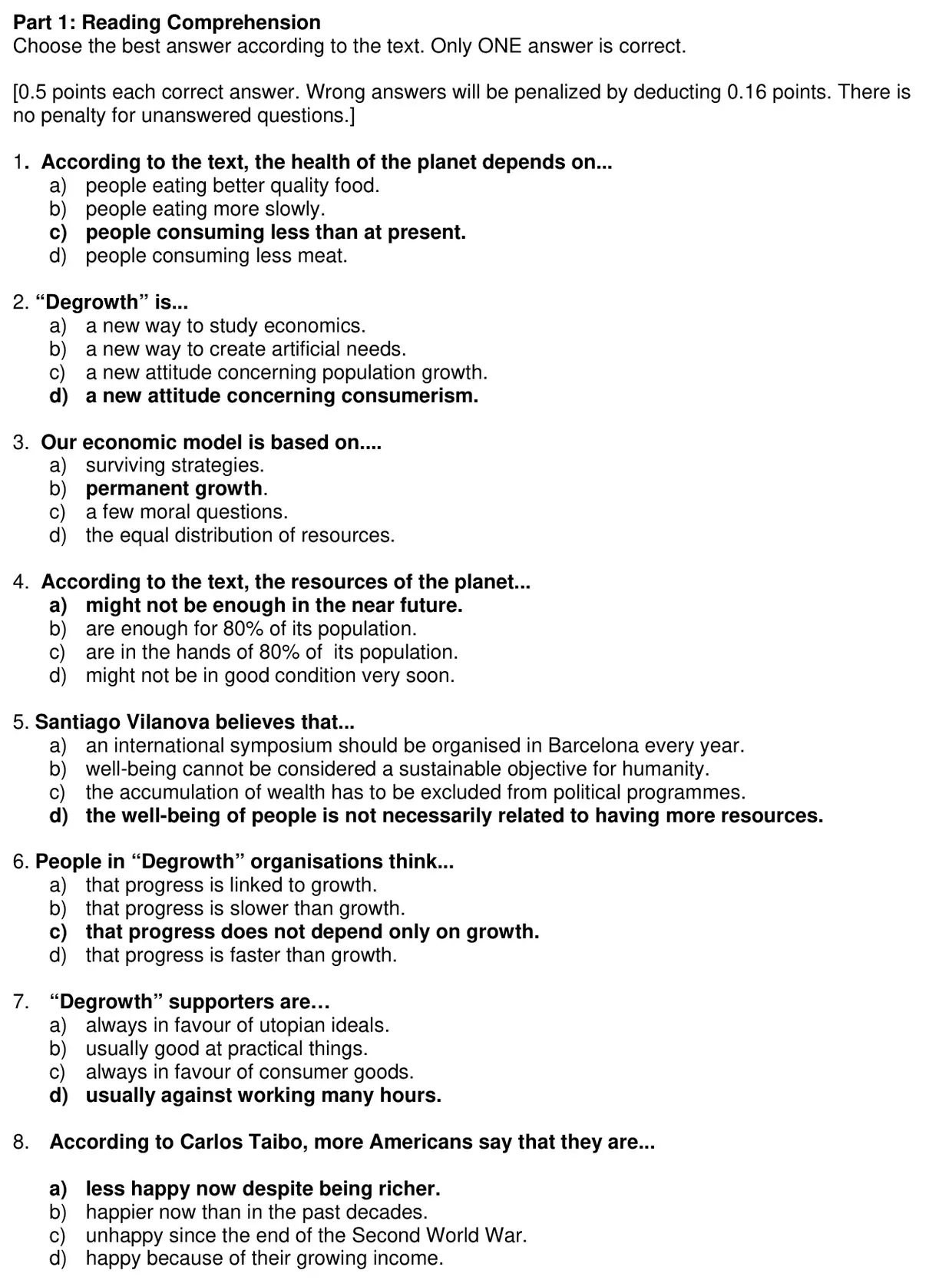
Text dels criteris (transcripció automàtica)
Part 1: Reading Comprehension
Choose the best answer according to the text. Only ONE answer is correct.
[0.5 points each correct answer. Wrong answers will be penalized by deducting 0.16 points. There is
no penalty for unanswered questions.]
1. According to the text, the health of the planet depends on...
a) people eating better quality food.
b) people eating more slowly.
c) people consuming less than at present.
d) people consuming less meat.
2. “Degrowth” is...
a) a new way to study economics.
b) a new way to create artificial needs.
c) a new attitude concerning population growth.
d) a new attitude concerning consumerism.
3. Our economic model is based on....
a) surviving strategies.
b) permanent growth.
c) a few moral questions.
d) the equal distribution of resources.
4. According to the text, the resources of the planet...
a) might not be enough in the near future.
b) are enough for 80% of its population.
c) are in the hands of 80% of its population.
d) might not be in good conditi […]
Resolució pas a pas
Encara no hi ha resolució pròpia verificada d'aquest exercici. Mentrestant, tens els criteris oficials de correcció a sobre. Si tens dubtes, pregunta'ls al xat de la Sala d'estudi.
Font: enunciat i criteris de correcció oficials de les PAU 2010 de Catalunya, publicats per la Generalitat de Catalunya (universitats.gencat.cat) i les universitats catalanes. La resolució pas a pas és pròpia de L'Acadèmia de Vic.
Altres exercicis d'aquest examen
- Part 2 · Writing Writing
- Part 3 · Listening comprehension Listening comprehension