
PAU Anglès 2010 · Setembre · Sèrie 2 · Part 3 · Listening comprehension
Enunciat
Text de l'enunciat (transcripció automàtica)
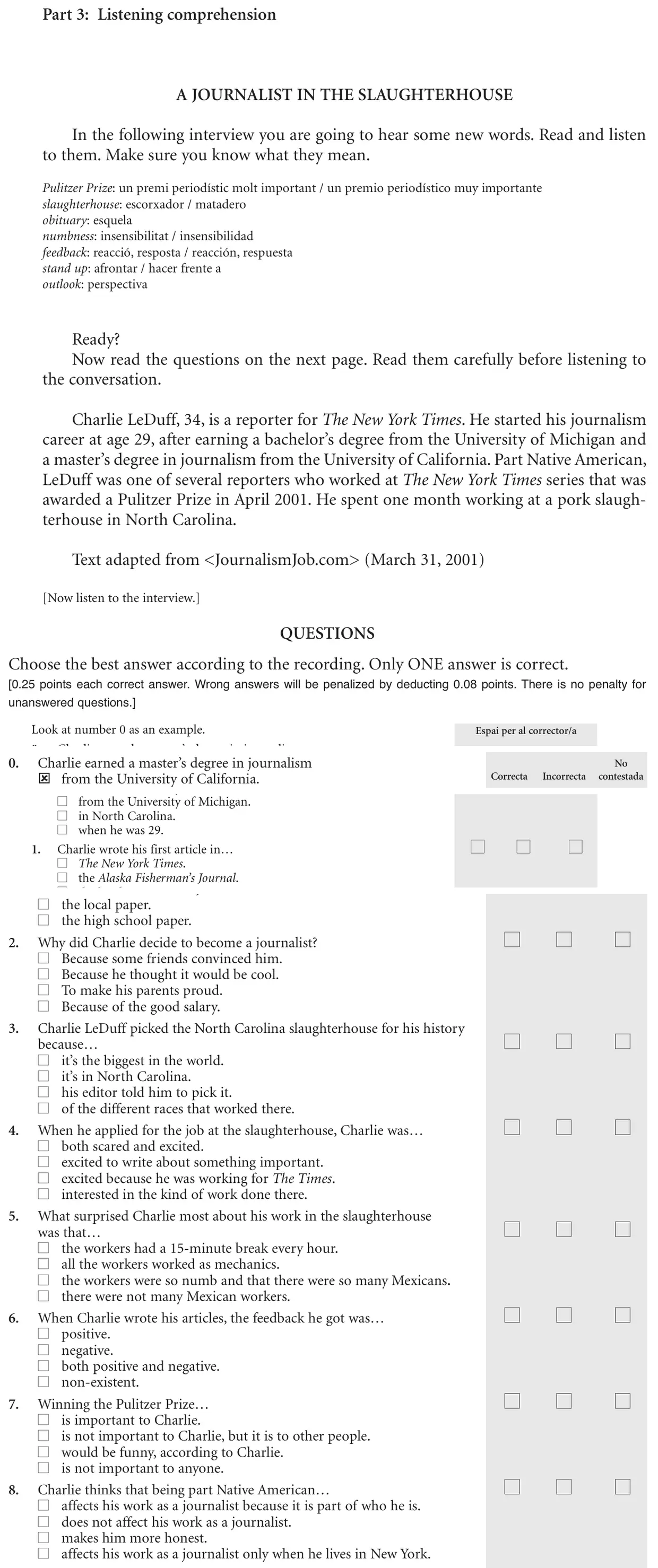
Part 3: Listening comprehension
A JOURNALIST IN THE SLAUGHTERHOUSE
In the following interview you are going to hear some new words. Read and listen
to them. Make sure you know what they mean.
Pulitzer Prize: un premi periodístic molt important / un premio periodístico muy importante
slaughterhouse: escorxador / matadero
obituary: esquela
numbness: insensibilitat / insensibilidad
feedback: reacció, resposta / reacción, respuesta
stand up: afrontar / hacer frente a
outlook: perspectiva
Ready?
Now read the questions on the next page. Read them carefully before listening to
the conversation.
Charlie LeDuff, 34, is a reporter for The New York Times. He started his journalism
career at age 29, after earning a bachelor’s degree from the University of Michigan and
a master’s degree in journalism from the University of California. Part Native American,
LeDuff was one of several reporters who worked at The New York Times series that was
awarded a Pulitzer Prize in April 2001. He spent one month working at a pork slaugh-
terhouse in North Carolina.
Text adapted from <JournalismJob.com> (March 31, 2001)
[Now listen to the interview.]
QUESTIONS
Choose the best answer according to the recording. Only ONE answer is correct.
[0.25 points each correct answer. Wrong answers will be penalized by deducting 0.08 points. There is no penalty for
unanswered questions.]
0. Charlie earned a master’s degree in journalism No
0. Charlie earned a master’s degree in journalism No
from the University of California. Correcta Incorrecta contestada
I the local paper.
I the local paper.
I the high school paper.
2. Why did Charlie decide to become a journalist?
I Because some friends convinced him.
I Because he thought it would be cool.
I To make his parents proud.
I Because of the good salary.
3. Charlie LeDuff picked the North Carolina slaughterhouse for his history
because…
I it’s the biggest in the world.
I it’s in North Carolina.
I his editor told him to pick it.
I of the different races that worked there.
4. When he applied for the job at the slaughterhouse, Charlie was…
I both scared and excited.
I excited to write about something important.
I excited because he was working for The Times.
I interested in the kind of work done there.
5. What surprised Charlie most about his work in the slaughterhouse
was that…
I the workers had a 15-minute break every hour.
I all the workers worked as mechanics.
I the workers were so numb and that there were so many Mexicans.
I there were not many Mexican workers.
6. When Charlie wrote his articles, the feedback he got was…
I positive.
I negative.
I both positive and negative.
I non-existent.
7. Winning the Pulitzer Prize…
I is important to Charlie.
I is not important to Charlie, but it is to other people.
I would be funny, according to Charlie.
I is not important to anyone.
8. Charlie thinks that being part Native American…
I affects his work as a journalist because it is part of who he is.
I does not affect his work as a journalist.
I makes him more honest.
I affects his work as a journalist only when he lives in New York.
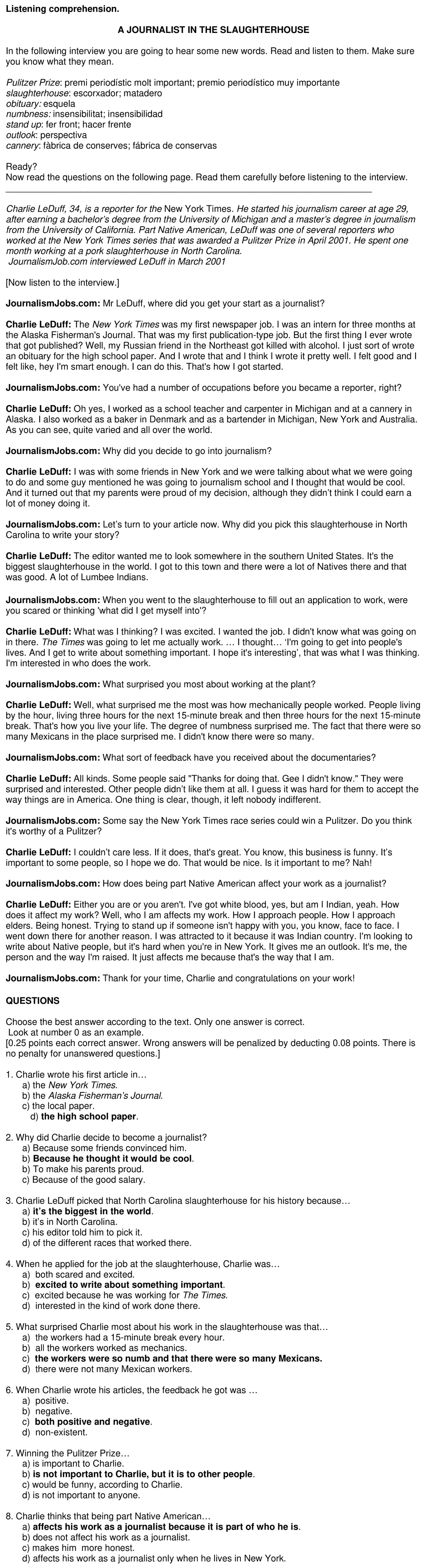
Criteris oficials de correcció
Resolució pas a pas
Aquest exercici no té una resolució escrita pas a pas (requereix l'àudio de la prova). Fes servir els criteris oficials de correcció.
Font: enunciat i criteris de correcció oficials de les PAU 2010 de Catalunya, publicats per la Generalitat de Catalunya (universitats.gencat.cat) i les universitats catalanes. La resolució pas a pas és pròpia de L'Acadèmia de Vic.
Altres exercicis d'aquest examen
- Part 1 · Reading comprehension Reading comprehension
- Part 2 · Writing Writing
Tots els exercicis de Listening comprehension · PAU de Anglès