
PAU Anglès 2007 · Juny · Sèrie 1 · Part 1 · Reading comprehension
Enunciat
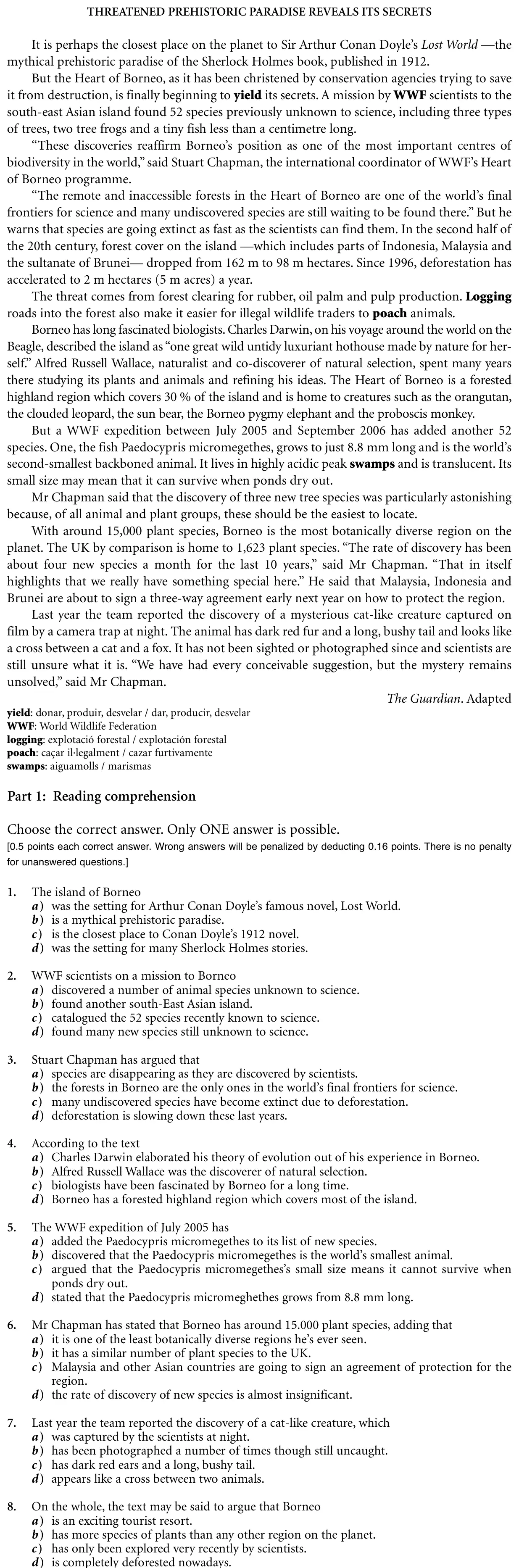
Text de l'enunciat (transcripció automàtica)
THREATENED PREHISTORIC PARADISE REVEALS ITS SECRETS
It is perhaps the closest place on the planet to Sir Arthur Conan Doyle’s Lost World —the
mythical prehistoric paradise of the Sherlock Holmes book, published in 1912.
But the Heart of Borneo, as it has been christened by conservation agencies trying to save
it from destruction, is finally beginning to yield its secrets. A mission by WWF scientists to the
south-east Asian island found 52 species previously unknown to science, including three types
of trees, two tree frogs and a tiny fish less than a centimetre long.
“These discoveries reaffirm Borneo’s position as one of the most important centres of
biodiversity in the world,” said Stuart Chapman, the international coordinator of WWF’s Heart
of Borneo programme.
“The remote and inaccessible forests in the Heart of Borneo are one of the world’s final
frontiers for science and many undiscovered species are still waiting to be found there.” But he
warns that species are going extinct as fast as the scientists can find them. In the second half of
the 20th century, forest cover on the island —which includes parts of Indonesia, Malaysia and
the sultanate of Brunei— dropped from 162 m to 98 m hectares. Since 1996, deforestation has
accelerated to 2 m hectares (5 m acres) a year.
The threat comes from forest clearing for rubber, oil palm and pulp production. Logging
roads into the forest also make it easier for illegal wildlife traders to poach animals.
Borneo has long fascinated biologists.Charles Darwin,on his voyage around the world on the
Beagle, described the island as“one great wild untidy luxuriant hothouse made by nature for her-
self.” Alfred Russell Wallace, naturalist and co-discoverer of natural selection, spent many years
there studying its plants and animals and refining his ideas. The Heart of Borneo is a forested
highland region which covers 30 % of the island and is home to creatures such as the orangutan,
the clouded leopard, the sun bear, the Borneo pygmy elephant and the proboscis monkey.
But a WWF expedition between July 2005 and September 2006 has added another 52
species. One, the fish Paedocypris micromegethes, grows to just 8.8 mm long and is the world’s
second-smallest backboned animal. It lives in highly acidic peak swamps and is translucent. Its
small size may mean that it can survive when ponds dry out.
Mr Chapman said that the discovery of three new tree species was particularly astonishing
because, of all animal and plant groups, these should be the easiest to locate.
With around 15,000 plant species, Borneo is the most botanically diverse region on the
planet. The UK by comparison is home to 1,623 plant species. “The rate of discovery has been
about four new species a month for the last 10 years,” said Mr Chapman. “That in itself
highlights that we really have something special here.” He said that Malaysia, Indonesia and
Brunei are about to sign a three-way agreement early next year on how to protect the region.
Last year the team reported the discovery of a mysterious cat-like creature captured on
film by a camera trap at night. The animal has dark red fur and a long, bushy tail and looks like
a cross between a cat and a fox. It has not been sighted or photographed since and scientists are
still unsure what it is. “We have had every conceivable suggestion, but the mystery remains
unsolved,” said Mr Chapman.
The Guardian. Adapted
yield: donar, produir, desvelar / dar, producir, desvelar
WWF: World Wildlife Federation
logging: explotació forestal / explotación forestal
poach: caçar il·legalment / cazar furtivamente
swamps: aiguamolls / marismas
Part 1: Reading comprehension
Choose the correct answer. Only ONE answer is possible.
[0.5 points each correct answer. Wrong answers will be penalized by deducting 0.16 points. There is no penalty
for unanswered questions.]
1. The island of Borneo
a) was the setting for Arthur Conan Doyle’s famous novel, Lost World.
b) is a mythical prehistoric paradise.
c) is t
Criteris oficials de correcció
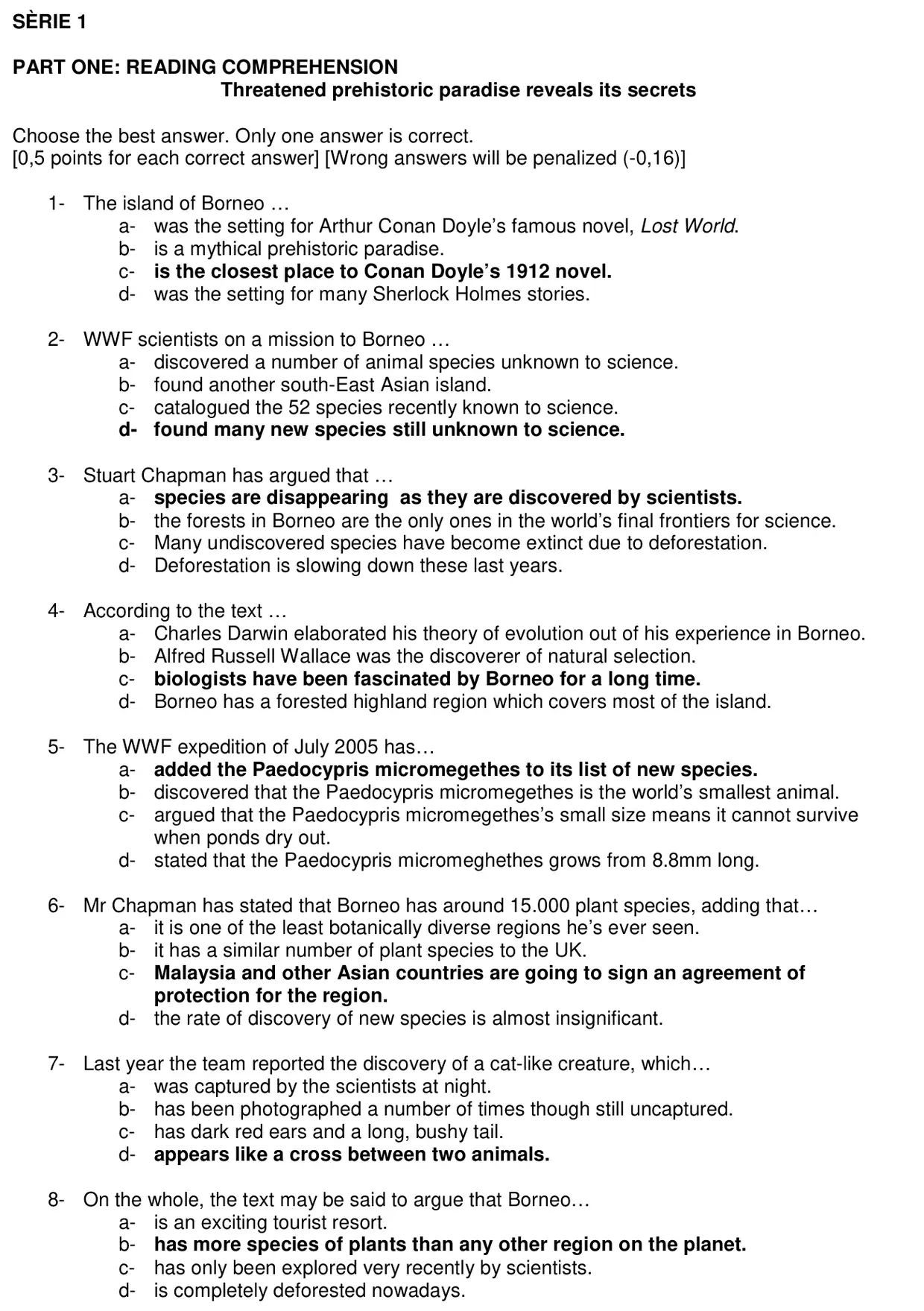
Text dels criteris (transcripció automàtica)
PART ONE: READING COMPREHENSION
Threatened prehistoric paradise reveals its secrets
Choose the best answer. Only one answer is correct.
[0,5 points for each correct answer] [Wrong answers will be penalized (-0,16)]
1- The island of Borneo …
a- was the setting for Arthur Conan Doyle’s famous novel, Lost World.
b- is a mythical prehistoric paradise.
c- is the closest place to Conan Doyle’s 1912 novel.
d- was the setting for many Sherlock Holmes stories.
2- WWF scientists on a mission to Borneo …
a- discovered a number of animal species unknown to science.
b- found another south-East Asian island.
c- catalogued the 52 species recently known to science.
d- found many new species still unknown to science.
3- Stuart Chapman has argued that …
a- species are disappearing as they are discovered by scientists.
b- the forests in Borneo are the only ones in the world’s final frontiers for science.
c- Many undiscovered species have become extinct due to deforestation.
d- Deforestation is slowing do […]
Resolució pas a pas
Encara no hi ha resolució pròpia verificada d'aquest exercici. Mentrestant, tens els criteris oficials de correcció a sobre. Si tens dubtes, pregunta'ls al xat de la Sala d'estudi.
Font: enunciat i criteris de correcció oficials de les PAU 2007 de Catalunya, publicats per la Generalitat de Catalunya (universitats.gencat.cat) i les universitats catalanes. La resolució pas a pas és pròpia de L'Acadèmia de Vic.
Altres exercicis d'aquest examen
- Part 2 · Writing Writing
- Part 3 · Listening comprehension Listening comprehension