
PAU Anglès 2007 · Juny · Sèrie 2 · Part 1 · Reading comprehension
Enunciat
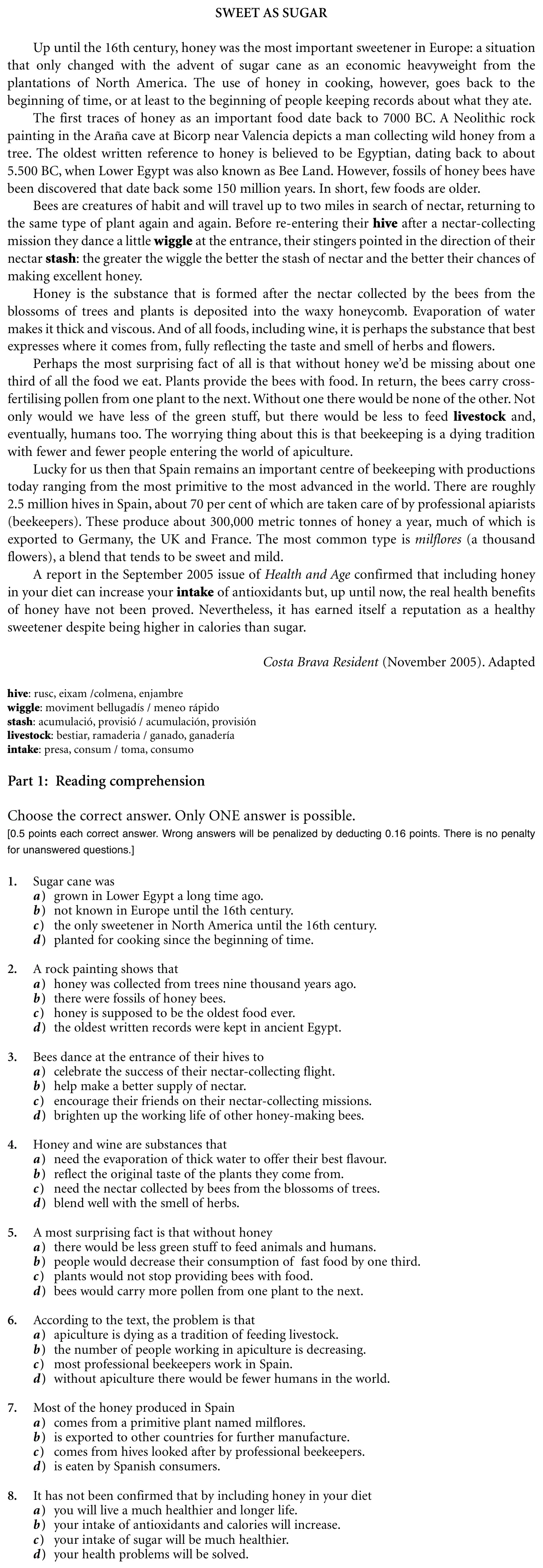
Text de l'enunciat (transcripció automàtica)
SWEET AS SUGAR
Up until the 16th century, honey was the most important sweetener in Europe: a situation
that only changed with the advent of sugar cane as an economic heavyweight from the
plantations of North America. The use of honey in cooking, however, goes back to the
beginning of time, or at least to the beginning of people keeping records about what they ate.
The first traces of honey as an important food date back to 7000 BC. A Neolithic rock
painting in the Araña cave at Bicorp near Valencia depicts a man collecting wild honey from a
tree. The oldest written reference to honey is believed to be Egyptian, dating back to about
5.500 BC, when Lower Egypt was also known as Bee Land. However, fossils of honey bees have
been discovered that date back some 150 million years. In short, few foods are older.
Bees are creatures of habit and will travel up to two miles in search of nectar, returning to
the same type of plant again and again. Before re-entering their hive after a nectar-collecting
mission they dance a little wiggle at the entrance, their stingers pointed in the direction of their
nectar stash: the greater the wiggle the better the stash of nectar and the better their chances of
making excellent honey.
Honey is the substance that is formed after the nectar collected by the bees from the
blossoms of trees and plants is deposited into the waxy honeycomb. Evaporation of water
makes it thick and viscous.And of all foods, including wine, it is perhaps the substance that best
expresses where it comes from, fully reflecting the taste and smell of herbs and flowers.
Perhaps the most surprising fact of all is that without honey we’d be missing about one
third of all the food we eat. Plants provide the bees with food. In return, the bees carry cross-
fertilising pollen from one plant to the next. Without one there would be none of the other. Not
only would we have less of the green stuff, but there would be less to feed livestock and,
eventually, humans too. The worrying thing about this is that beekeeping is a dying tradition
with fewer and fewer people entering the world of apiculture.
Lucky for us then that Spain remains an important centre of beekeeping with productions
today ranging from the most primitive to the most advanced in the world. There are roughly
2.5 million hives in Spain, about 70 per cent of which are taken care of by professional apiarists
(beekeepers). These produce about 300,000 metric tonnes of honey a year, much of which is
exported to Germany, the UK and France. The most common type is milflores (a thousand
flowers), a blend that tends to be sweet and mild.
A report in the September 2005 issue of Health and Age confirmed that including honey
in your diet can increase your intake of antioxidants but, up until now, the real health benefits
of honey have not been proved. Nevertheless, it has earned itself a reputation as a healthy
sweetener despite being higher in calories than sugar.
Costa Brava Resident (November 2005). Adapted
hive: rusc, eixam /colmena, enjambre
wiggle: moviment bellugadís / meneo rápido
stash: acumulació, provisió / acumulación, provisión
livestock: bestiar, ramaderia / ganado, ganadería
intake: presa, consum / toma, consumo
Part 1: Reading comprehension
Choose the correct answer. Only ONE answer is possible.
[0.5 points each correct answer. Wrong answers will be penalized by deducting 0.16 points. There is no penalty
for unanswered questions.]
1. Sugar cane was
a) grown in Lower Egypt a long time ago.
b) not known in Europe until the 16th century.
c) the only sweetener in North America until the 16th century.
d) planted for cooking since the beginning of time.
2. A rock painting shows that
a) honey was collected from trees nine thousand years ago.
b) there were fossils of honey bees.
c) honey is supposed to be the oldest food ever.
d) the oldest written records were kept in ancient Egypt.
3. Bees dance at the entrance of their hives to
a) celebrate the success of their nectar-coll
Criteris oficials de correcció
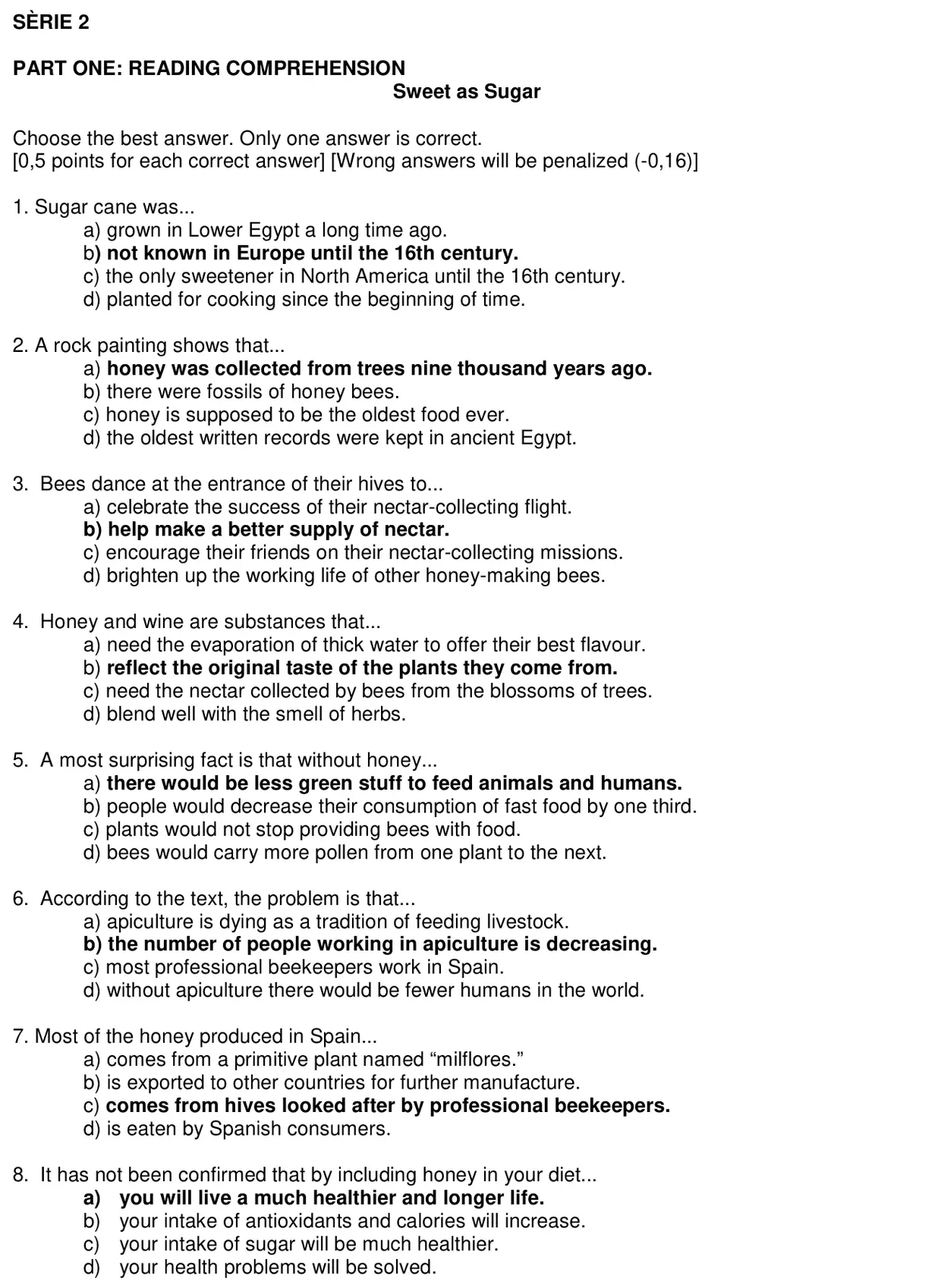
Text dels criteris (transcripció automàtica)
PART ONE: READING COMPREHENSION
Sweet as Sugar
Choose the best answer. Only one answer is correct.
[0,5 points for each correct answer] [Wrong answers will be penalized (-0,16)]
1. Sugar cane was...
a) grown in Lower Egypt a long time ago.
b) not known in Europe until the 16th century.
c) the only sweetener in North America until the 16th century.
d) planted for cooking since the beginning of time.
2. A rock painting shows that...
a) honey was collected from trees nine thousand years ago.
b) there were fossils of honey bees.
c) honey is supposed to be the oldest food ever.
d) the oldest written records were kept in ancient Egypt.
3. Bees dance at the entrance of their hives to...
a) celebrate the success of their nectar-collecting flight.
b) help make a better supply of nectar.
c) encourage their friends on their nectar-collecting missions.
d) brighten up the working life of other honey-making bees.
4. Honey and wine are substances that...
a) need the evaporation of thick water to offe […]
Resolució pas a pas
Encara no hi ha resolució pròpia verificada d'aquest exercici. Mentrestant, tens els criteris oficials de correcció a sobre. Si tens dubtes, pregunta'ls al xat de la Sala d'estudi.
Font: enunciat i criteris de correcció oficials de les PAU 2007 de Catalunya, publicats per la Generalitat de Catalunya (universitats.gencat.cat) i les universitats catalanes. La resolució pas a pas és pròpia de L'Acadèmia de Vic.
Altres exercicis d'aquest examen
- Part 2 · Writing Writing
- Part 3 · Listening comprehension Listening comprehension