
PAU Anglès 2006 · Juny · Sèrie 1 · Part 1 · Reading comprehension
Enunciat
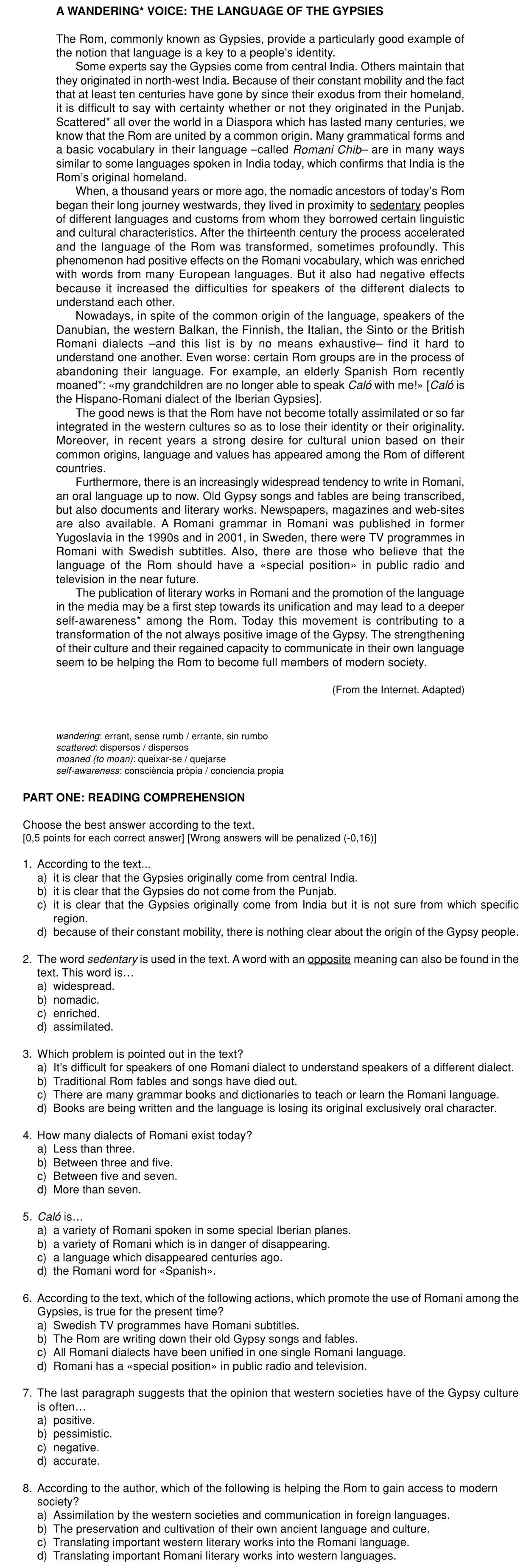
Text de l'enunciat (transcripció automàtica)
A WANDERING* VOICE: THE LANGUAGE OF THE GYPSIES
The Rom, commonly known as Gypsies, provide a particularly good example of
the notion that language is a key to a people’s identity.
Some experts say the Gypsies come from central India. Others maintain that
they originated in north-west India. Because of their constant mobility and the fact
that at least ten centuries have gone by since their exodus from their homeland,
it is difficult to say with certainty whether or not they originated in the Punjab.
Scattered* all over the world in a Diaspora which has lasted many centuries, we
know that the Rom are united by a common origin. Many grammatical forms and
a basic vocabulary in their language –called Romani Chib– are in many ways
similar to some languages spoken in India today, which confirms that India is the
Rom’s original homeland.
When, a thousand years or more ago, the nomadic ancestors of today’s Rom
began their long journey westwards, they lived in proximity to sedentary peoples
of different languages and customs from whom they borrowed certain linguistic
and cultural characteristics. After the thirteenth century the process accelerated
and the language of the Rom was transformed, sometimes profoundly. This
phenomenon had positive effects on the Romani vocabulary, which was enriched
with words from many European languages. But it also had negative effects
because it increased the difficulties for speakers of the different dialects to
understand each other.
Nowadays, in spite of the common origin of the language, speakers of the
Danubian, the western Balkan, the Finnish, the Italian, the Sinto or the British
Romani dialects –and this list is by no means exhaustive– find it hard to
understand one another. Even worse: certain Rom groups are in the process of
abandoning their language. For example, an elderly Spanish Rom recently
moaned*: «my grandchildren are no longer able to speak Caló with me!» [Caló is
the Hispano-Romani dialect of the Iberian Gypsies].
The good news is that the Rom have not become totally assimilated or so far
integrated in the western cultures so as to lose their identity or their originality.
Moreover, in recent years a strong desire for cultural union based on their
common origins, language and values has appeared among the Rom of different
countries.
Furthermore, there is an increasingly widespread tendency to write in Romani,
an oral language up to now. Old Gypsy songs and fables are being transcribed,
but also documents and literary works. Newspapers, magazines and web-sites
are also available. A Romani grammar in Romani was published in former
Yugoslavia in the 1990s and in 2001, in Sweden, there were TV programmes in
Romani with Swedish subtitles. Also, there are those who believe that the
language of the Rom should have a «special position» in public radio and
television in the near future.
The publication of literary works in Romani and the promotion of the language
in the media may be a first step towards its unification and may lead to a deeper
self-awareness* among the Rom. Today this movement is contributing to a
transformation of the not always positive image of the Gypsy. The strengthening
of their culture and their regained capacity to communicate in their own language
seem to be helping the Rom to become full members of modern society.
(From the Internet. Adapted)
wandering: errant, sense rumb / errante, sin rumbo
scattered: dispersos / dispersos
moaned (to moan): queixar-se / quejarse
self-awareness: consciència pròpia / conciencia propia
PART ONE: READING COMPREHENSION
Choose the best answer according to the text.
[0,5 points for each correct answer] [Wrong answers will be penalized (-0,16)]
1. According to the text...
a) it is clear that the Gypsies originally come from central India.
b) it is clear that the Gypsies do not come from the Punjab.
c) it is clear that the Gypsies originally come from India but it is not sure from which specific
region.
d) because of their constant mobili
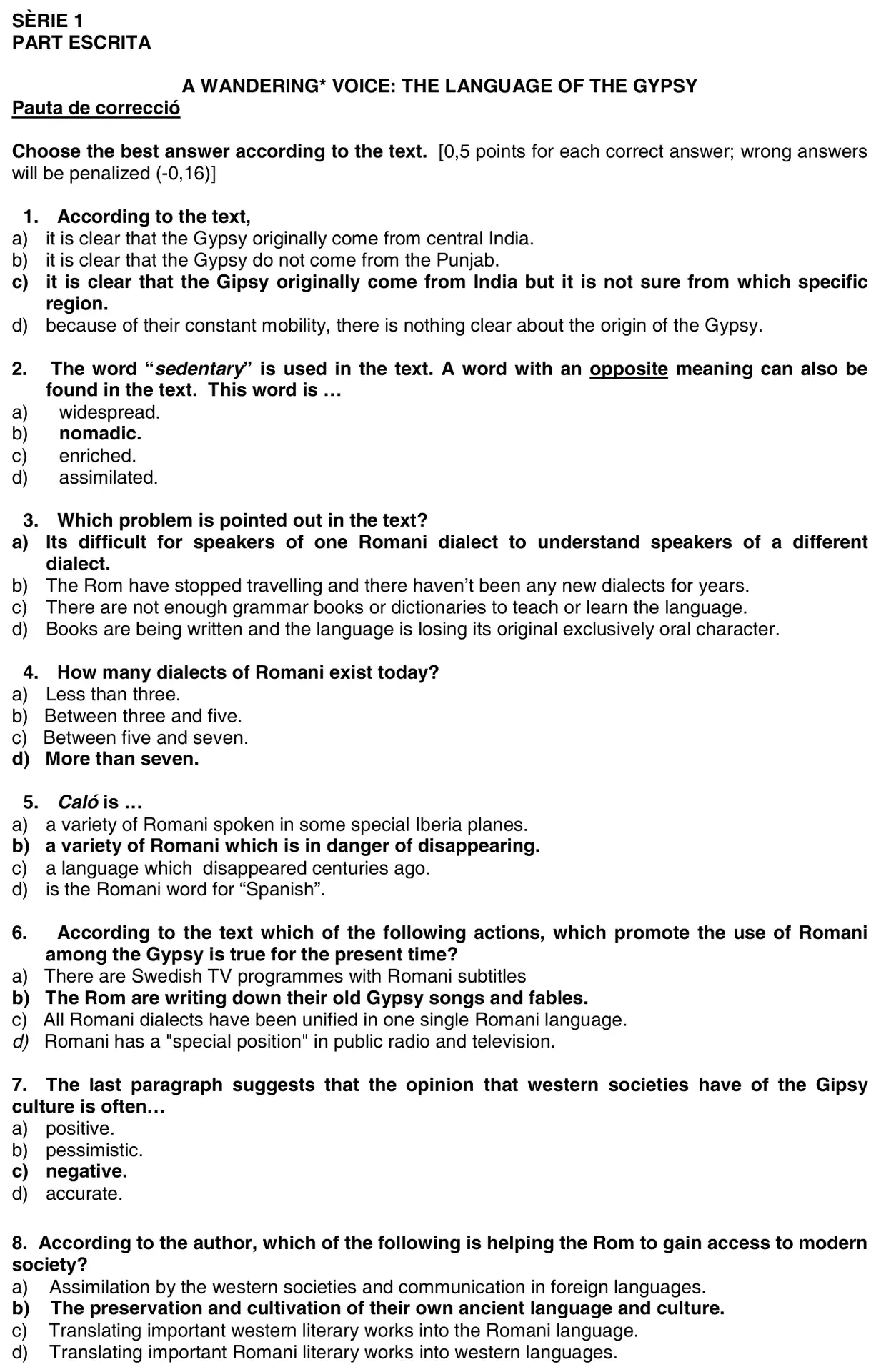
Criteris oficials de correcció
Resolució pas a pas
Encara no hi ha resolució pròpia verificada d'aquest exercici. Mentrestant, tens els criteris oficials de correcció a sobre. Si tens dubtes, pregunta'ls al xat de la Sala d'estudi.
Font: enunciat i criteris de correcció oficials de les PAU 2006 de Catalunya, publicats per la Generalitat de Catalunya (universitats.gencat.cat) i les universitats catalanes. La resolució pas a pas és pròpia de L'Acadèmia de Vic.
Altres exercicis d'aquest examen
- Part 2 · Writing Writing
- Part 3 · Listening comprehension Listening comprehension