
PAU Anglès 2001 · Juny · Sèrie 2 · Part 1 · Reading comprehension
Enunciat
Text de l'enunciat (transcripció automàtica)
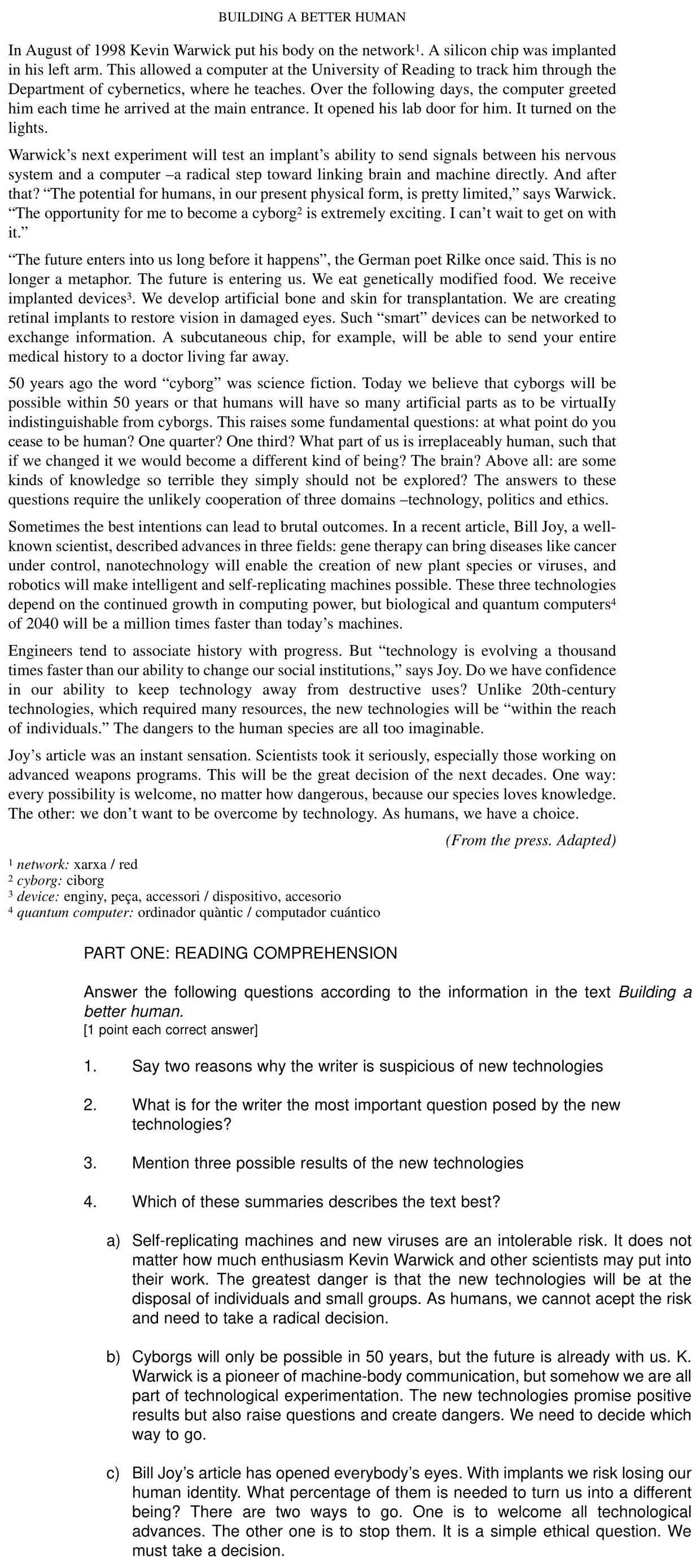
BUILDING A BETTER HUMAN
In August of 1998 Kevin Warwick put his body on the network1. A silicon chip was implanted
in his left arm. This allowed a computer at the University of Reading to track him through the
Department of cybernetics, where he teaches. Over the following days, the computer greeted
him each time he arrived at the main entrance. It opened his lab door for him. It turned on the
lights.
Warwick’s next experiment will test an implant’s ability to send signals between his nervous
system and a computer –a radical step toward linking brain and machine directly. And after
that? “The potential for humans, in our present physical form, is pretty limited,” says Warwick.
“The opportunity for me to become a cyborg2 is extremely exciting. I can’t wait to get on with
it.”
“The future enters into us long before it happens”, the German poet Rilke once said. This is no
longer a metaphor. The future is entering us. We eat genetically modified food. We receive
implanted devices3. We develop artificial bone and skin for transplantation. We are creating
retinal implants to restore vision in damaged eyes. Such “smart” devices can be networked to
exchange information. A subcutaneous chip, for example, will be able to send your entire
medical history to a doctor living far away.
50 years ago the word “cyborg” was science fiction. Today we believe that cyborgs will be
possible within 50 years or that humans will have so many artificial parts as to be virtualIy
indistinguishable from cyborgs. This raises some fundamental questions: at what point do you
cease to be human? One quarter? One third? What part of us is irreplaceably human, such that
if we changed it we would become a different kind of being? The brain? Above all: are some
kinds of knowledge so terrible they simply should not be explored? The answers to these
questions require the unlikely cooperation of three domains –technology, politics and ethics.
Sometimes the best intentions can lead to brutal outcomes. In a recent article, Bill Joy, a well-
known scientist, described advances in three fields: gene therapy can bring diseases like cancer
under control, nanotechnology will enable the creation of new plant species or viruses, and
robotics will make intelligent and self-replicating machines possible. These three technologies
depend on the continued growth in computing power, but biological and quantum computers4
of 2040 will be a million times faster than today’s machines.
Engineers tend to associate history with progress. But “technology is evolving a thousand
times faster than our ability to change our social institutions,” says Joy. Do we have confidence
in our ability to keep technology away from destructive uses? Unlike 20th-century
technologies, which required many resources, the new technologies will be “within the reach
of individuals.” The dangers to the human species are all too imaginable.
Joy’s article was an instant sensation. Scientists took it seriously, especially those working on
advanced weapons programs. This will be the great decision of the next decades. One way:
every possibility is welcome, no matter how dangerous, because our species loves knowledge.
The other: we don’t want to be overcome by technology. As humans, we have a choice.
(From the press. Adapted)
1 network: xarxa / red
2 cyborg: ciborg
3 device: enginy, peça, accessori / dispositivo, accesorio
4 quantum computer: ordinador quàntic / computador cuántico
PART ONE: READING COMPREHENSION
Answer the following questions according to the information in the text Building a
better human.
[1 point each correct answer]
1. Say two reasons why the writer is suspicious of new technologies
2. What is for the writer the most important question posed by the new
technologies?
3. Mention three possible results of the new technologies
4. Which of these summaries describes the text best?
a) Self-replicating machines and new viruses are an intolerable risk. It does not
matter how much enthusiasm Kevin Warwick
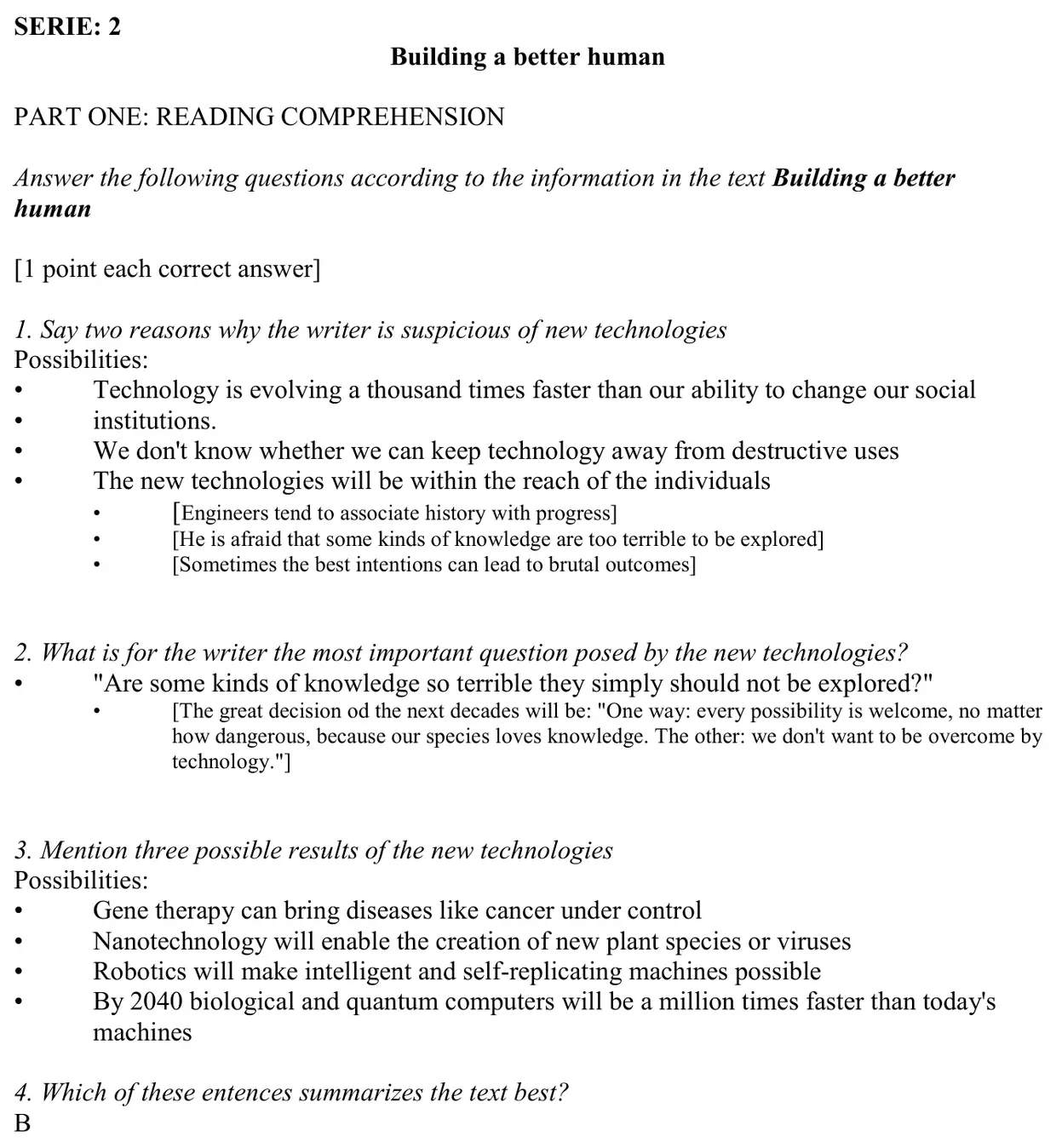
Criteris oficials de correcció
Resolució pas a pas
Encara no hi ha resolució pròpia verificada d'aquest exercici. Mentrestant, tens els criteris oficials de correcció a sobre. Si tens dubtes, pregunta'ls al xat de la Sala d'estudi.
Font: enunciat i criteris de correcció oficials de les PAU 2001 de Catalunya, publicats per la Generalitat de Catalunya (universitats.gencat.cat) i les universitats catalanes. La resolució pas a pas és pròpia de L'Acadèmia de Vic.
Altres exercicis d'aquest examen
- Part 2 · Writing Writing