
PAU Anglès 2001 · Juny · Sèrie 5 · Part 1 · Reading comprehension
Enunciat
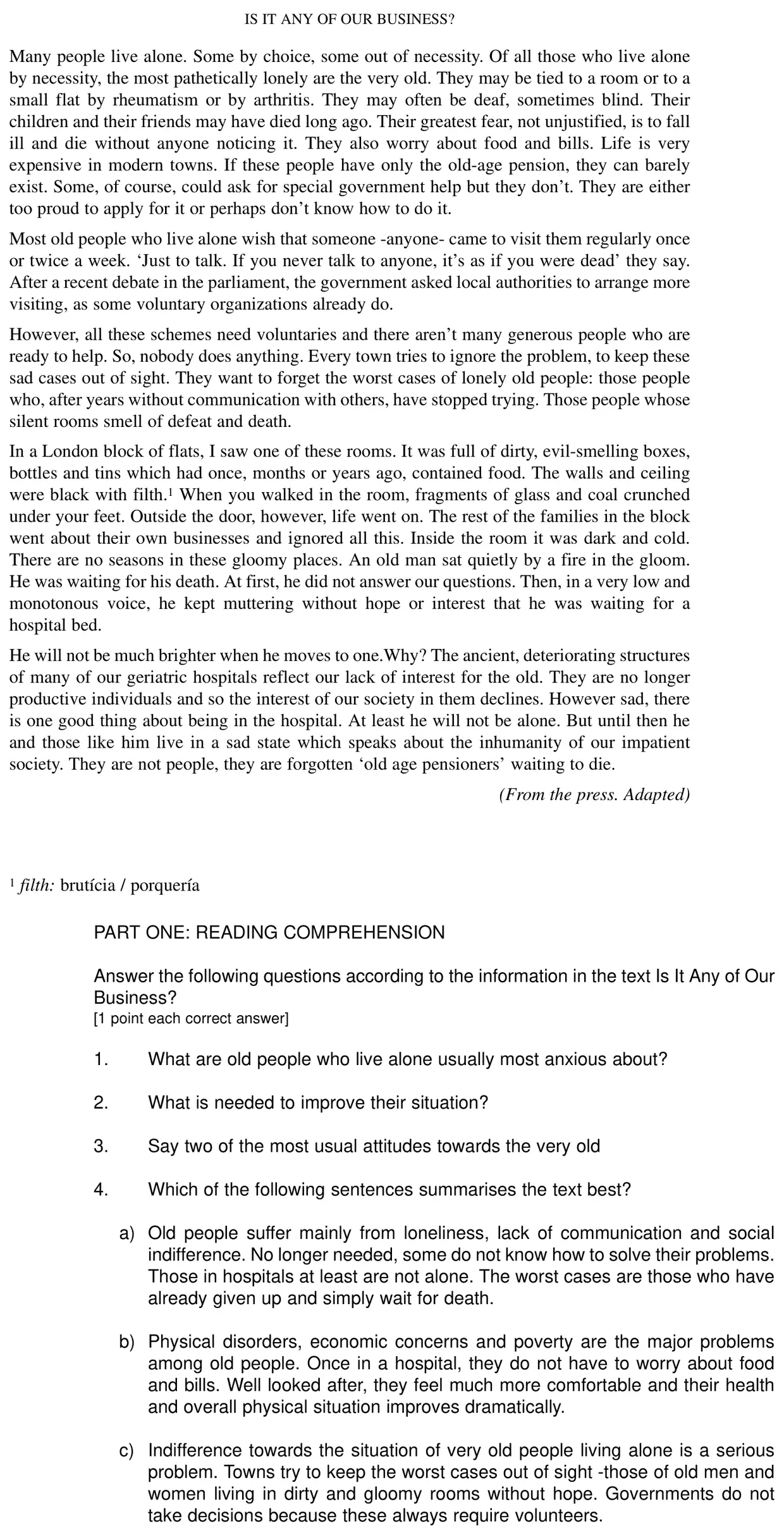
Text de l'enunciat (transcripció automàtica)
IS IT ANY OF OUR BUSINESS?
Many people live alone. Some by choice, some out of necessity. Of all those who live alone
by necessity, the most pathetically lonely are the very old. They may be tied to a room or to a
small flat by rheumatism or by arthritis. They may often be deaf, sometimes blind. Their
children and their friends may have died long ago. Their greatest fear, not unjustified, is to fall
ill and die without anyone noticing it. They also worry about food and bills. Life is very
expensive in modern towns. If these people have only the old-age pension, they can barely
exist. Some, of course, could ask for special government help but they don’t. They are either
too proud to apply for it or perhaps don’t know how to do it.
Most old people who live alone wish that someone -anyone- came to visit them regularly once
or twice a week. ‘Just to talk. If you never talk to anyone, it’s as if you were dead’ they say.
After a recent debate in the parliament, the government asked local authorities to arrange more
visiting, as some voluntary organizations already do.
However, all these schemes need voluntaries and there aren’t many generous people who are
ready to help. So, nobody does anything. Every town tries to ignore the problem, to keep these
sad cases out of sight. They want to forget the worst cases of lonely old people: those people
who, after years without communication with others, have stopped trying. Those people whose
silent rooms smell of defeat and death.
In a London block of flats, I saw one of these rooms. It was full of dirty, evil-smelling boxes,
bottles and tins which had once, months or years ago, contained food. The walls and ceiling
were black with filth.1 When you walked in the room, fragments of glass and coal crunched
under your feet. Outside the door, however, life went on. The rest of the families in the block
went about their own businesses and ignored all this. Inside the room it was dark and cold.
There are no seasons in these gloomy places. An old man sat quietly by a fire in the gloom.
He was waiting for his death. At first, he did not answer our questions. Then, in a very low and
monotonous voice, he kept muttering without hope or interest that he was waiting for a
hospital bed.
He will not be much brighter when he moves to one.Why? The ancient, deteriorating structures
of many of our geriatric hospitals reflect our lack of interest for the old. They are no longer
productive individuals and so the interest of our society in them declines. However sad, there
is one good thing about being in the hospital. At least he will not be alone. But until then he
and those like him live in a sad state which speaks about the inhumanity of our impatient
society. They are not people, they are forgotten ‘old age pensioners’ waiting to die.
(From the press. Adapted)
1 filth: brutícia / porquería
PART ONE: READING COMPREHENSION
Answer the following questions according to the information in the text Is It Any of Our
Business?
[1 point each correct answer]
1. What are old people who live alone usually most anxious about?
2. What is needed to improve their situation?
3. Say two of the most usual attitudes towards the very old
4. Which of the following sentences summarises the text best?
a) Old people suffer mainly from loneliness, lack of communication and social
indifference. No longer needed, some do not know how to solve their problems.
Those in hospitals at least are not alone. The worst cases are those who have
already given up and simply wait for death.
b) Physical disorders, economic concerns and poverty are the major problems
among old people. Once in a hospital, they do not have to worry about food
and bills. Well looked after, they feel much more comfortable and their health
and overall physical situation improves dramatically.
c) Indifference towards the situation of very old people living alone is a serious
problem. Towns try to keep the worst cases out of sight -those of old men and
women living in dirty
Criteris oficials de correcció
La pauta oficial d'aquesta convocatòria no inclou els criteris d'aquest exercici (sovint passa amb les redaccions de llengües estrangeres o les pautes antigues).
Resolució pas a pas
Encara no hi ha resolució pròpia verificada d'aquest exercici. Mentrestant, tens els criteris oficials de correcció a sobre. Si tens dubtes, pregunta'ls al xat de la Sala d'estudi.
Font: enunciat i criteris de correcció oficials de les PAU 2001 de Catalunya, publicats per la Generalitat de Catalunya (universitats.gencat.cat) i les universitats catalanes. La resolució pas a pas és pròpia de L'Acadèmia de Vic.
Altres exercicis d'aquest examen
- Part 2 · Writing Writing