
PAU Anglès 2000 · Setembre · Sèrie 2 · Part 1 · Reading comprehension
Enunciat
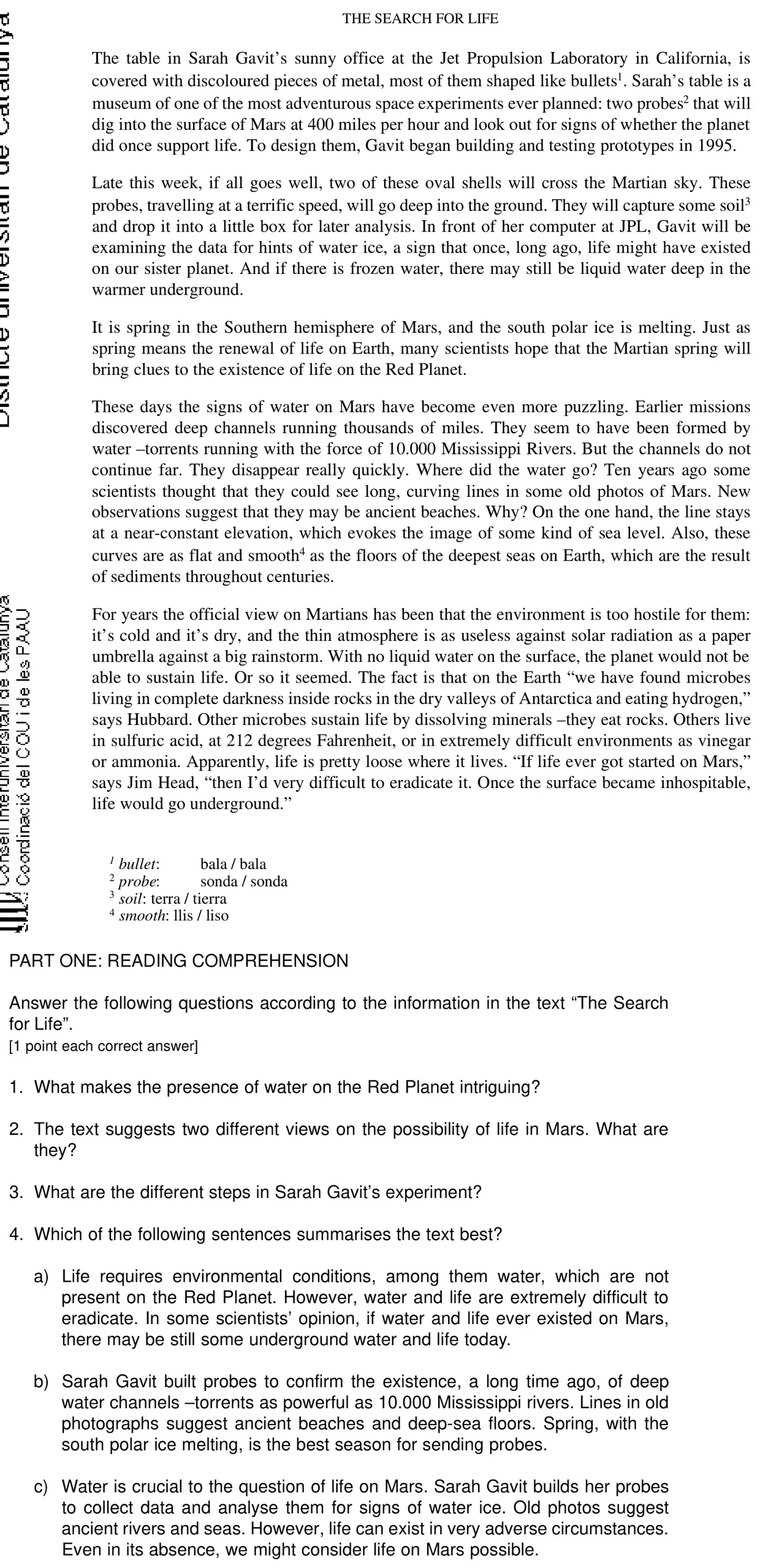
Text de l'enunciat (transcripció automàtica)
THE SEARCH FOR LIFE
The table in Sarah Gavit’s sunny office at the Jet Propulsion Laboratory in California, is
covered with discoloured pieces of metal, most of them shaped like bullets1. Sarah’s table is a
museum of one of the most adventurous space experiments ever planned: two probes2 that will
dig into the surface of Mars at 400 miles per hour and look out for signs of whether the planet
did once support life. To design them, Gavit began building and testing prototypes in 1995.
Late this week, if all goes well, two of these oval shells will cross the Martian sky. These
probes, travelling at a terrific speed, will go deep into the ground. They will capture some soil3
and drop it into a little box for later analysis. In front of her computer at JPL, Gavit will be
examining the data for hints of water ice, a sign that once, long ago, life might have existed
on our sister planet. And if there is frozen water, there may still be liquid water deep in the
warmer underground.
It is spring in the Southern hemisphere of Mars, and the south polar ice is melting. Just as
spring means the renewal of life on Earth, many scientists hope that the Martian spring will
bring clues to the existence of life on the Red Planet.
These days the signs of water on Mars have become even more puzzling. Earlier missions
discovered deep channels running thousands of miles. They seem to have been formed by
water –torrents running with the force of 10.000 Mississippi Rivers. But the channels do not
continue far. They disappear really quickly. Where did the water go? Ten years ago some
scientists thought that they could see long, curving lines in some old photos of Mars. New
observations suggest that they may be ancient beaches. Why? On the one hand, the line stays
at a near-constant elevation, which evokes the image of some kind of sea level. Also, these
curves are as flat and smooth4 as the floors of the deepest seas on Earth, which are the result
of sediments throughout centuries.
For years the official view on Martians has been that the environment is too hostile for them:
it’s cold and it’s dry, and the thin atmosphere is as useless against solar radiation as a paper
umbrella against a big rainstorm. With no liquid water on the surface, the planet would not be
able to sustain life. Or so it seemed. The fact is that on the Earth “we have found microbes
living in complete darkness inside rocks in the dry valleys of Antarctica and eating hydrogen,”
says Hubbard. Other microbes sustain life by dissolving minerals –they eat rocks. Others live
in sulfuric acid, at 212 degrees Fahrenheit, or in extremely difficult environments as vinegar
or ammonia. Apparently, life is pretty loose where it lives. “If life ever got started on Mars,”
says Jim Head, “then I’d very difficult to eradicate it. Once the surface became inhospitable,
life would go underground.”
1 bullet: bala / bala
2 probe:
sonda / sonda
3 soil: terra / tierra
4 smooth: llis / liso
PART ONE: READING COMPREHENSION
Answer the following questions according to the information in the text “The Search
for Life”.
[1 point each correct answer]
1. What makes the presence of water on the Red Planet intriguing?
2. The text suggests two different views on the possibility of life in Mars. What are
they?
3. What are the different steps in Sarah Gavit’s experiment?
4. Which of the following sentences summarises the text best?
a) Life requires environmental conditions, among them water, which are not
present on the Red Planet. However, water and life are extremely difficult to
eradicate. In some scientists’ opinion, if water and life ever existed on Mars,
there may be still some underground water and life today.
b) Sarah Gavit built probes to confirm the existence, a long time ago, of deep
water channels –torrents as powerful as 10.000 Mississippi rivers. Lines in old
photographs suggest ancient beaches and deep-sea floors. Spring, with the
south polar ice melting, is the best season for sending probes.
c) Water i
Criteris oficials de correcció
La pauta oficial d'aquesta convocatòria no inclou els criteris d'aquest exercici (sovint passa amb les redaccions de llengües estrangeres o les pautes antigues).
Resolució pas a pas
Encara no hi ha resolució pròpia verificada d'aquest exercici. Mentrestant, tens els criteris oficials de correcció a sobre. Si tens dubtes, pregunta'ls al xat de la Sala d'estudi.
Font: enunciat i criteris de correcció oficials de les PAU 2000 de Catalunya, publicats per la Generalitat de Catalunya (universitats.gencat.cat) i les universitats catalanes. La resolució pas a pas és pròpia de L'Acadèmia de Vic.
Altres exercicis d'aquest examen
- Part 2 · Writing Writing