
PAU Anglès 2000 · Setembre · Sèrie 6 · Part 1 · Reading comprehension
Enunciat
Text de l'enunciat (transcripció automàtica)
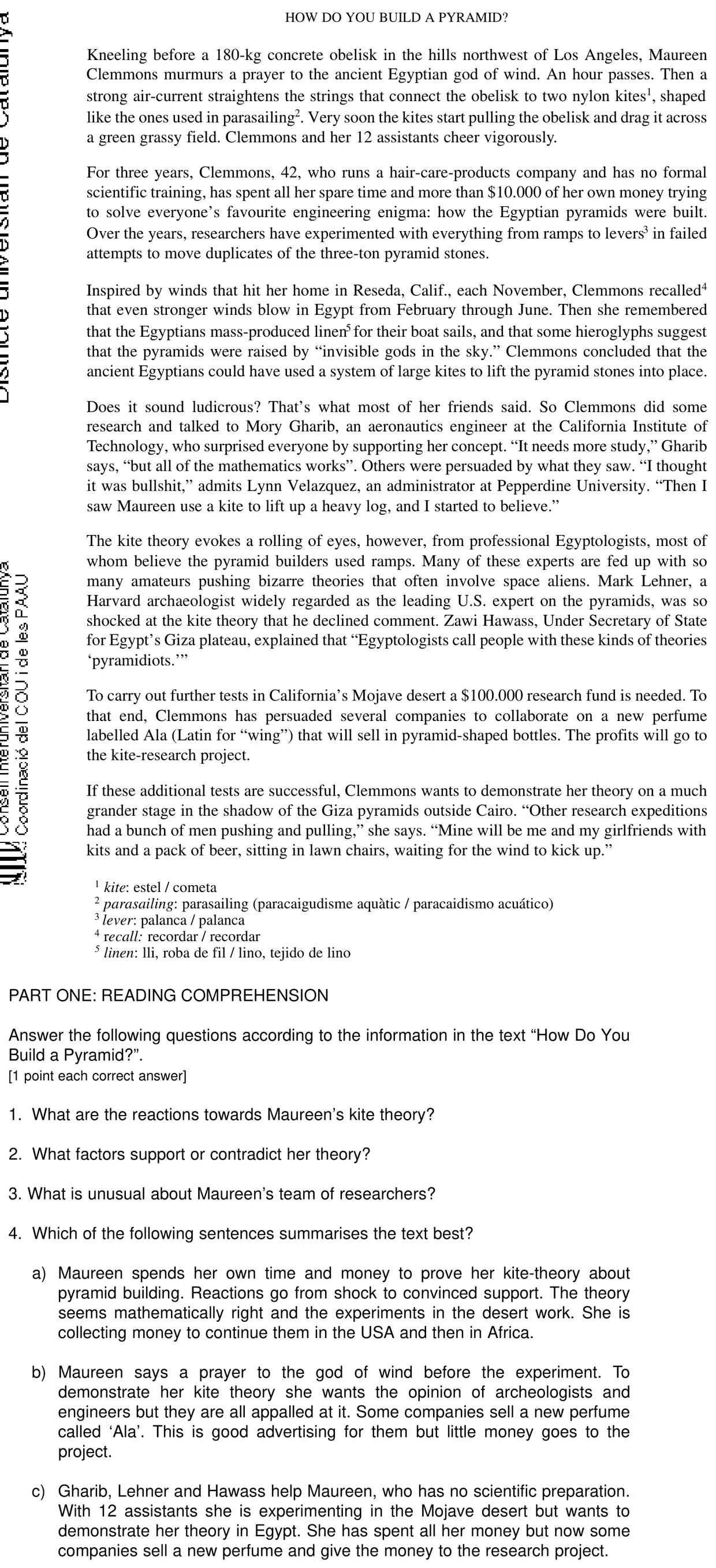
HOW DO YOU BUILD A PYRAMID?
Kneeling before a 180-kg concrete obelisk in the hills northwest of Los Angeles, Maureen
Clemmons murmurs a prayer to the ancient Egyptian god of wind. An hour passes. Then a
strong air-current straightens the strings that connect the obelisk to two nylon kites1, shaped
like the ones used in parasailing2. Very soon the kites start pulling the obelisk and drag it across
a green grassy field. Clemmons and her 12 assistants cheer vigorously.
For three years, Clemmons, 42, who runs a hair-care-products company and has no formal
scientific training, has spent all her spare time and more than $10.000 of her own money trying
to solve everyone’s favourite engineering enigma: how the Egyptian pyramids were built.
Over the years, researchers have experimented with everything from ramps to levers3 in failed
attempts to move duplicates of the three-ton pyramid stones.
Inspired by winds that hit her home in Reseda, Calif., each November, Clemmons recalled4
that even stronger winds blow in Egypt from February through June. Then she remembered
that the Egyptians mass-produced linen5for their boat sails, and that some hieroglyphs suggest
that the pyramids were raised by “invisible gods in the sky.” Clemmons concluded that the
ancient Egyptians could have used a system of large kites to lift the pyramid stones into place.
Does it sound ludicrous? That’s what most of her friends said. So Clemmons did some
research and talked to Mory Gharib, an aeronautics engineer at the California Institute of
Technology, who surprised everyone by supporting her concept. “It needs more study,” Gharib
says, “but all of the mathematics works”. Others were persuaded by what they saw. “I thought
it was bullshit,” admits Lynn Velazquez, an administrator at Pepperdine University. “Then I
saw Maureen use a kite to lift up a heavy log, and I started to believe.”
The kite theory evokes a rolling of eyes, however, from professional Egyptologists, most of
whom believe the pyramid builders used ramps. Many of these experts are fed up with so
many amateurs pushing bizarre theories that often involve space aliens. Mark Lehner, a
Harvard archaeologist widely regarded as the leading U.S. expert on the pyramids, was so
shocked at the kite theory that he declined comment. Zawi Hawass, Under Secretary of State
for Egypt’s Giza plateau, explained that “Egyptologists call people with these kinds of theories
‘pyramidiots.’”
To carry out further tests in California’s Mojave desert a $100.000 research fund is needed. To
that end, Clemmons has persuaded several companies to collaborate on a new perfume
labelled Ala (Latin for “wing”) that will sell in pyramid-shaped bottles. The profits will go to
the kite-research project.
If these additional tests are successful, Clemmons wants to demonstrate her theory on a much
grander stage in the shadow of the Giza pyramids outside Cairo. “Other research expeditions
had a bunch of men pushing and pulling,” she says. “Mine will be me and my girlfriends with
kits and a pack of beer, sitting in lawn chairs, waiting for the wind to kick up.”
1 kite: estel / cometa
2 parasailing: parasailing (paracaigudisme aquàtic / paracaidismo acuático)
3 lever: palanca / palanca
4 recall: recordar / recordar
5 linen: lli, roba de fil / lino, tejido de lino
PART ONE: READING COMPREHENSION
Answer the following questions according to the information in the text “How Do You
Build a Pyramid?”.
[1 point each correct answer]
1. What are the reactions towards Maureen’s kite theory?
2. What factors support or contradict her theory?
3. What is unusual about Maureen’s team of researchers?
4. Which of the following sentences summarises the text best?
a) Maureen spends her own time and money to prove her kite-theory about
pyramid building. Reactions go from shock to convinced support. The theory
seems mathematically right and the experiments in the desert work. She is
collecting money to continue them in the USA and then in Africa.
b) Maureen says
Criteris oficials de correcció
Resolució pas a pas
Encara no hi ha resolució pròpia verificada d'aquest exercici. Mentrestant, tens els criteris oficials de correcció a sobre. Si tens dubtes, pregunta'ls al xat de la Sala d'estudi.
Font: enunciat i criteris de correcció oficials de les PAU 2000 de Catalunya, publicats per la Generalitat de Catalunya (universitats.gencat.cat) i les universitats catalanes. La resolució pas a pas és pròpia de L'Acadèmia de Vic.
Altres exercicis d'aquest examen
- Part 2 · Writing Writing