
PAU Anglès 2009 · Juny · Sèrie 4 · Part 3 · Listening comprehension
Enunciat
Text de l'enunciat (transcripció automàtica)
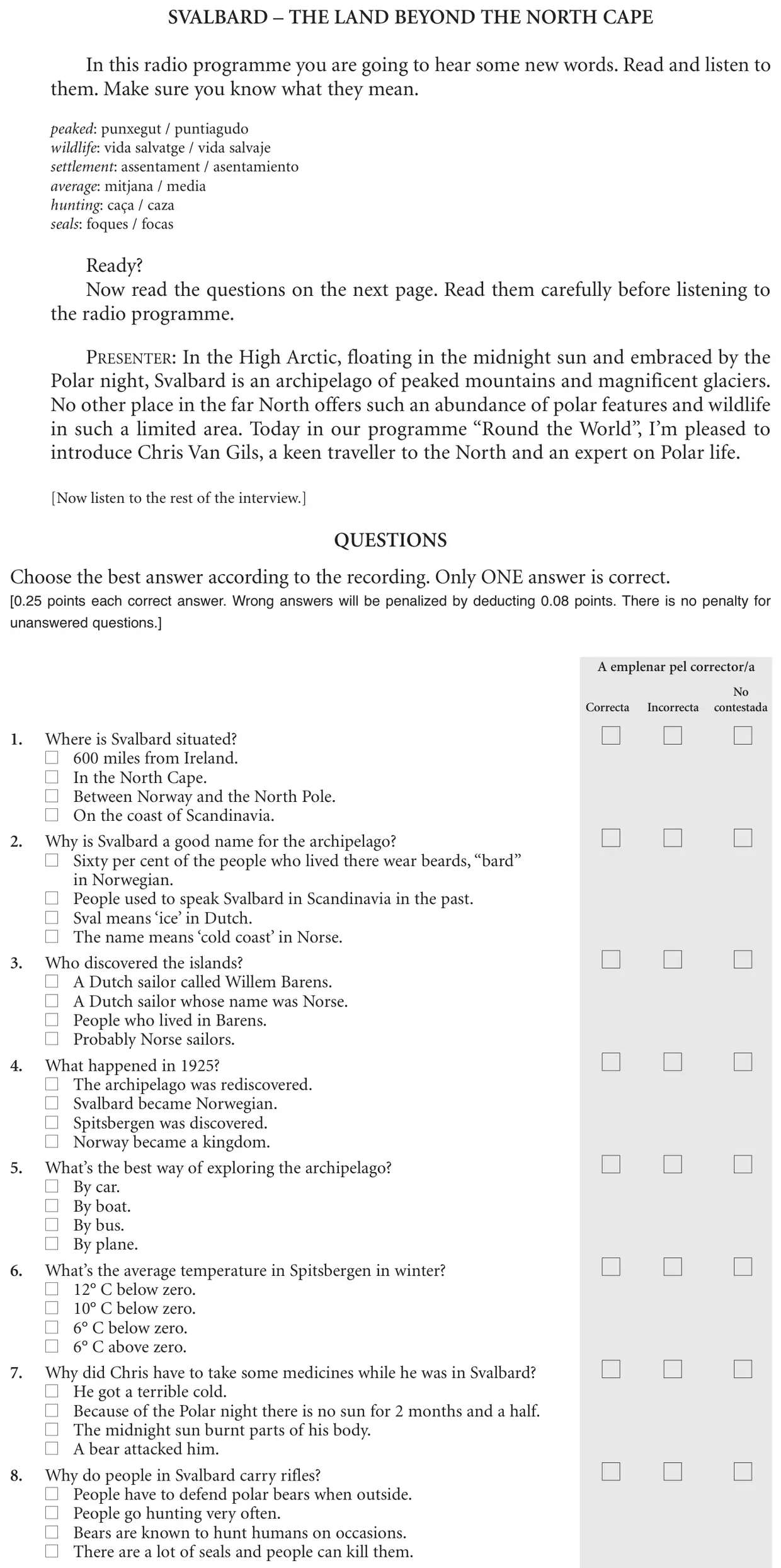
SVALBARD – THE LAND BEYOND THE NORTH CAPE
In this radio programme you are going to hear some new words. Read and listen to
them. Make sure you know what they mean.
peaked: punxegut / puntiagudo
wildlife: vida salvatge / vida salvaje
settlement: assentament / asentamiento
average: mitjana / media
hunting: caça / caza
seals: foques / focas
Ready?
Now read the questions on the next page. Read them carefully before listening to
the radio programme.
PRESENTER: In the High Arctic, floating in the midnight sun and embraced by the
Polar night, Svalbard is an archipelago of peaked mountains and magnificent glaciers.
No other place in the far North offers such an abundance of polar features and wildlife
in such a limited area. Today in our programme “Round the World”, I’m pleased to
introduce Chris Van Gils, a keen traveller to the North and an expert on Polar life.
[Now listen to the rest of the interview.]
QUESTIONS
Choose the best answer according to the recording. Only ONE answer is correct.
[0.25 points each correct answer. Wrong answers will be penalized by deducting 0.08 points. There is no penalty for
unanswered questions.]
A emplenar pel corrector/a
No
Correcta Incorrecta contestada
1. Where is Svalbard situated?
I 600 miles from Ireland.
I In the North Cape.
I Between Norway and the North Pole.
I On the coast of Scandinavia.
2. Why is Svalbard a good name for the archipelago?
I Sixty per cent of the people who lived there wear beards, “bard”
in Norwegian.
I People used to speak Svalbard in Scandinavia in the past.
I Sval means ‘ice’ in Dutch.
I The name means ‘cold coast’ in Norse.
3. Who discovered the islands?
I A Dutch sailor called Willem Barens.
I A Dutch sailor whose name was Norse.
I People who lived in Barens.
I Probably Norse sailors.
4. What happened in 1925?
I The archipelago was rediscovered.
I Svalbard became Norwegian.
I Spitsbergen was discovered.
I Norway became a kingdom.
5. What’s the best way of exploring the archipelago?
I By car.
I By boat.
I By bus.
I By plane.
6. What’s the average temperature in Spitsbergen in winter?
I 12° C below zero.
I 10° C below zero.
I 6° C below zero.
I 6° C above zero.
7. Why did Chris have to take some medicines while he was in Svalbard?
I He got a terrible cold.
I Because of the Polar night there is no sun for 2 months and a half.
I The midnight sun burnt parts of his body.
I A bear attacked him.
8. Why do people in Svalbard carry rifles?
I People have to defend polar bears when outside.
I People go hunting very often.
I Bears are known to hunt humans on occasions.
I There are a lot of seals and people can kill them.
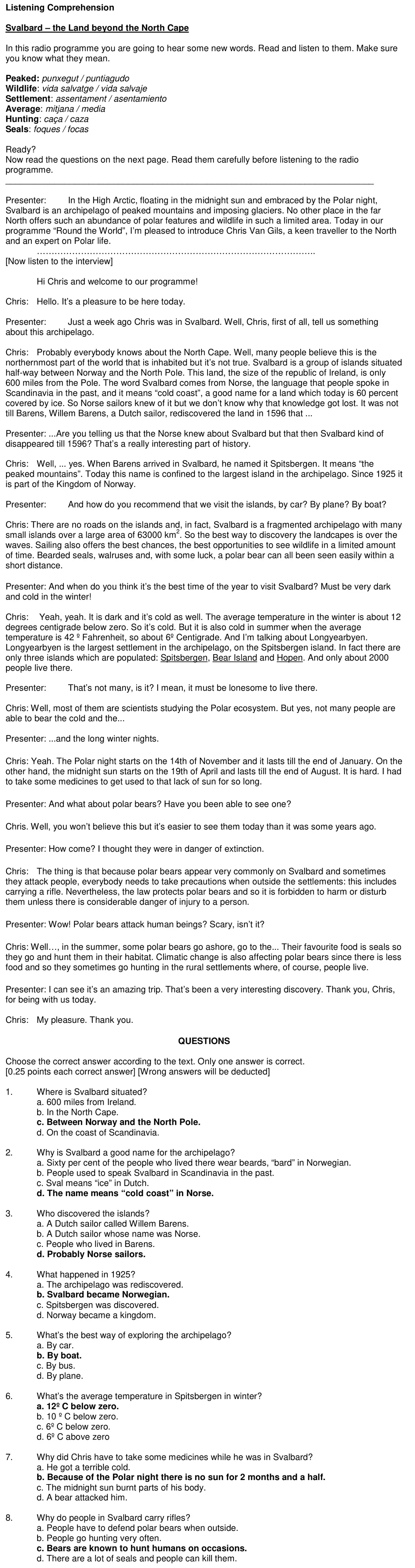
Criteris oficials de correcció
Resolució pas a pas
Aquest exercici no té una resolució escrita pas a pas (requereix l'àudio de la prova). Fes servir els criteris oficials de correcció.
Font: enunciat i criteris de correcció oficials de les PAU 2009 de Catalunya, publicats per la Generalitat de Catalunya (universitats.gencat.cat) i les universitats catalanes. La resolució pas a pas és pròpia de L'Acadèmia de Vic.
Altres exercicis d'aquest examen
- Part 1 · Reading comprehension Reading comprehension
- Part 2 · Writing Writing
Tots els exercicis de Listening comprehension · PAU de Anglès