
PAU Anglès 2008 · Setembre · Sèrie 4 · Part 3 · Listening comprehension
Enunciat
Text de l'enunciat (transcripció automàtica)
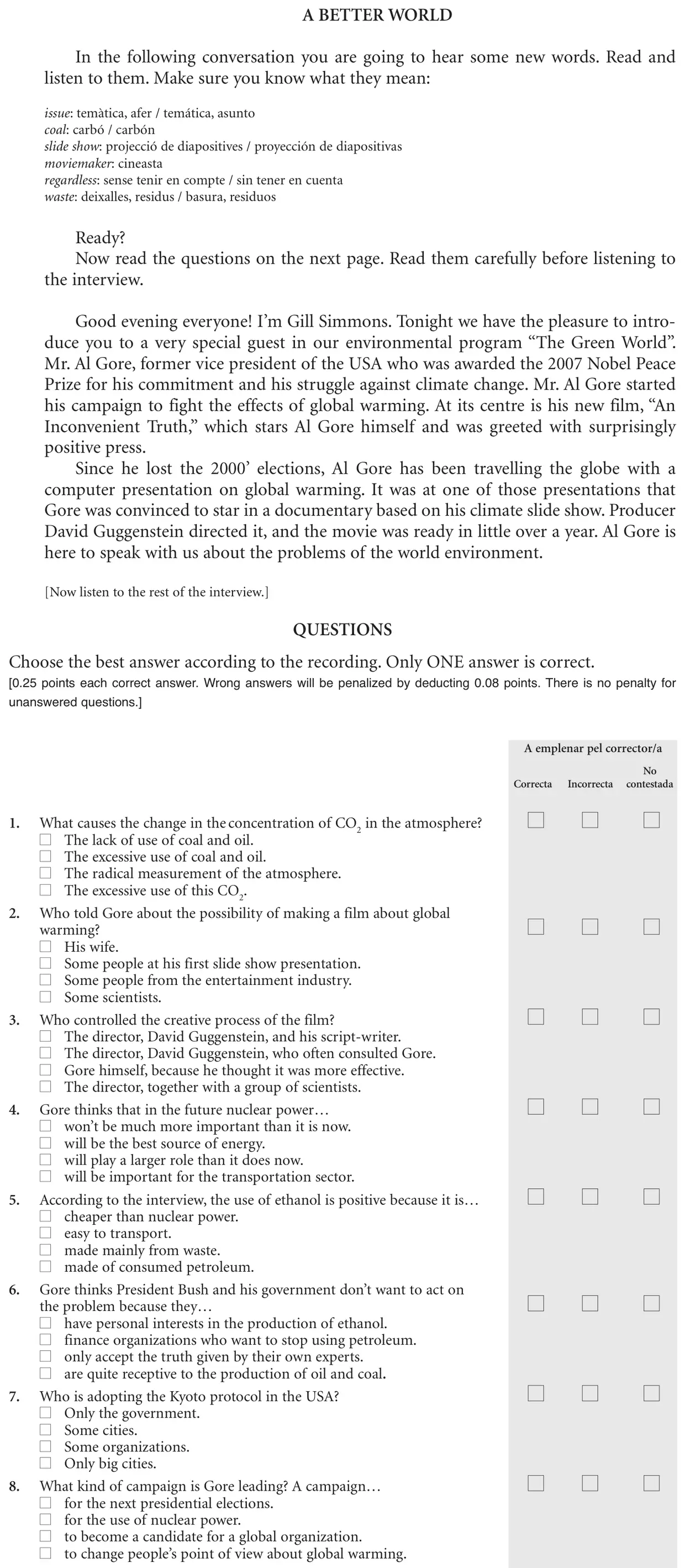
A BETTER WORLD
In the following conversation you are going to hear some new words. Read and
listen to them. Make sure you know what they mean:
issue: temàtica, afer / temática, asunto
coal: carbó / carbón
slide show: projecció de diapositives / proyección de diapositivas
moviemaker: cineasta
regardless: sense tenir en compte / sin tener en cuenta
waste: deixalles, residus / basura, residuos
Ready?
Now read the questions on the next page. Read them carefully before listening to
the interview.
Good evening everyone! I’m Gill Simmons. Tonight we have the pleasure to intro-
duce you to a very special guest in our environmental program “The Green World”.
Mr. Al Gore, former vice president of the USA who was awarded the 2007 Nobel Peace
Prize for his commitment and his struggle against climate change. Mr. Al Gore started
his campaign to fight the effects of global warming. At its centre is his new film, “An
Inconvenient Truth,” which stars Al Gore himself and was greeted with surprisingly
positive press.
Since he lost the 2000’ elections, Al Gore has been travelling the globe with a
computer presentation on global warming. It was at one of those presentations that
Gore was convinced to star in a documentary based on his climate slide show. Producer
David Guggenstein directed it, and the movie was ready in little over a year. Al Gore is
here to speak with us about the problems of the world environment.
[Now listen to the rest of the interview.]
QUESTIONS
Choose the best answer according to the recording. Only ONE answer is correct.
[0.25 points each correct answer. Wrong answers will be penalized by deducting 0.08 points. There is no penalty for
unanswered questions.]
A emplenar pel corrector/a
No
Correcta Incorrecta contestada
1. What causes the change in the concentration of CO2 in the atmosphere?
I The lack of use of coal and oil.
I The excessive use of coal and oil.
I The radical measurement of the atmosphere.
I The excessive use of this CO2.
2. Who told Gore about the possibility of making a film about global
warming?
I His wife.
I Some people at his first slide show presentation.
I Some people from the entertainment industry.
I Some scientists.
3. Who controlled the creative process of the film?
I The director, David Guggenstein, and his script-writer.
I The director, David Guggenstein, who often consulted Gore.
I Gore himself, because he thought it was more effective.
I The director, together with a group of scientists.
4. Gore thinks that in the future nuclear power…
I won’t be much more important than it is now.
I will be the best source of energy.
I will play a larger role than it does now.
I will be important for the transportation sector.
5. According to the interview, the use of ethanol is positive because it is…
I cheaper than nuclear power.
I easy to transport.
I made mainly from waste.
I made of consumed petroleum.
6. Gore thinks President Bush and his government don’t want to act on
the problem because they…
I have personal interests in the production of ethanol.
I finance organizations who want to stop using petroleum.
I only accept the truth given by their own experts.
I are quite receptive to the production of oil and coal.
7. Who is adopting the Kyoto protocol in the USA?
I Only the government.
I Some cities.
I Some organizations.
I Only big cities.
8. What kind of campaign is Gore leading? A campaign…
I for the next presidential elections.
I for the use of nuclear power.
I to become a candidate for a global organization.
I to change people’s point of view about global warming.
Criteris oficials de correcció
Resolució pas a pas
Aquest exercici no té una resolució escrita pas a pas (requereix l'àudio de la prova). Fes servir els criteris oficials de correcció.
Font: enunciat i criteris de correcció oficials de les PAU 2008 de Catalunya, publicats per la Generalitat de Catalunya (universitats.gencat.cat) i les universitats catalanes. La resolució pas a pas és pròpia de L'Acadèmia de Vic.
Altres exercicis d'aquest examen
- Part 1 · Reading comprehension Reading comprehension
- Part 2 · Writing Writing
Tots els exercicis de Listening comprehension · PAU de Anglès