
PAU Anglès 2009 · Juny · Sèrie 4 · Part 1 · Reading comprehension
Enunciat
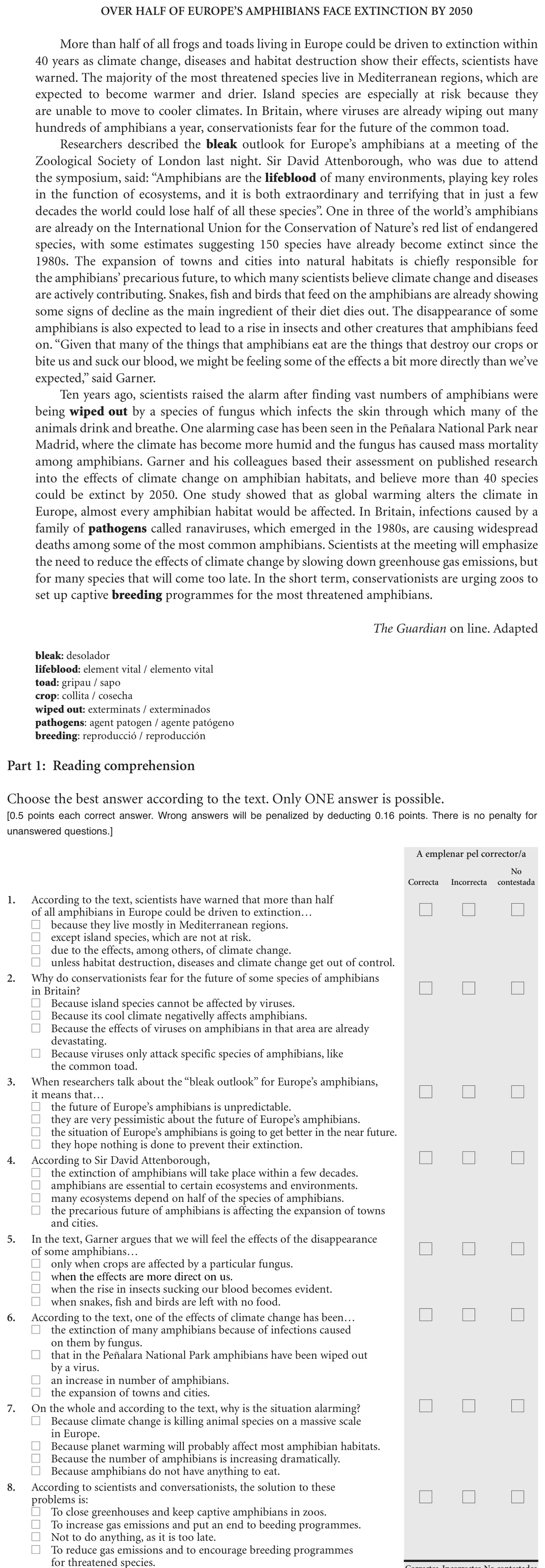
Text de l'enunciat (transcripció automàtica)
OVER HALF OF EUROPE’S AMPHIBIANS FACE EXTINCTION BY 2050
More than half of all frogs and toads living in Europe could be driven to extinction within
40 years as climate change, diseases and habitat destruction show their effects, scientists have
warned. The majority of the most threatened species live in Mediterranean regions, which are
expected to become warmer and drier. Island species are especially at risk because they
are unable to move to cooler climates. In Britain, where viruses are already wiping out many
hundreds of amphibians a year, conservationists fear for the future of the common toad.
Researchers described the bleak outlook for Europe’s amphibians at a meeting of the
Zoological Society of London last night. Sir David Attenborough, who was due to attend
the symposium, said: “Amphibians are the lifeblood of many environments, playing key roles
in the function of ecosystems, and it is both extraordinary and terrifying that in just a few
decades the world could lose half of all these species”. One in three of the world’s amphibians
are already on the International Union for the Conservation of Nature’s red list of endangered
species, with some estimates suggesting 150 species have already become extinct since the
1980s. The expansion of towns and cities into natural habitats is chiefly responsible for
the amphibians’ precarious future, to which many scientists believe climate change and diseases
are actively contributing. Snakes, fish and birds that feed on the amphibians are already showing
some signs of decline as the main ingredient of their diet dies out. The disappearance of some
amphibians is also expected to lead to a rise in insects and other creatures that amphibians feed
on. “Given that many of the things that amphibians eat are the things that destroy our crops or
bite us and suck our blood, we might be feeling some of the effects a bit more directly than we’ve
expected,” said Garner.
Ten years ago, scientists raised the alarm after finding vast numbers of amphibians were
being wiped out by a species of fungus which infects the skin through which many of the
animals drink and breathe. One alarming case has been seen in the Peñalara National Park near
Madrid, where the climate has become more humid and the fungus has caused mass mortality
among amphibians. Garner and his colleagues based their assessment on published research
into the effects of climate change on amphibian habitats, and believe more than 40 species
could be extinct by 2050. One study showed that as global warming alters the climate in
Europe, almost every amphibian habitat would be affected. In Britain, infections caused by a
family of pathogens called ranaviruses, which emerged in the 1980s, are causing widespread
deaths among some of the most common amphibians. Scientists at the meeting will emphasize
the need to reduce the effects of climate change by slowing down greenhouse gas emissions, but
for many species that will come too late. In the short term, conservationists are urging zoos to
set up captive breeding programmes for the most threatened amphibians.
The Guardian on line. Adapted
bleak: desolador
lifeblood: element vital / elemento vital
toad: gripau / sapo
crop: collita / cosecha
wiped out: exterminats / exterminados
pathogens: agent patogen / agente patógeno
breeding: reproducció / reproducción
Part 1: Reading comprehension
Choose the best answer according to the text. Only ONE answer is possible.
[0.5 points each correct answer. Wrong answers will be penalized by deducting 0.16 points. There is no penalty for
unanswered questions.]
A emplenar pel corrector/a
No
Correcta Incorrecta contestada
1. According to the text, scientists have warned that more than half
of all amphibians in Europe could be driven to extinction…
I because they live mostly in Mediterranean regions.
I except island species, which are not at risk.
I due to the effects, among others, of climate change.
I unless habitat destruction, diseases and climate c
Criteris oficials de correcció
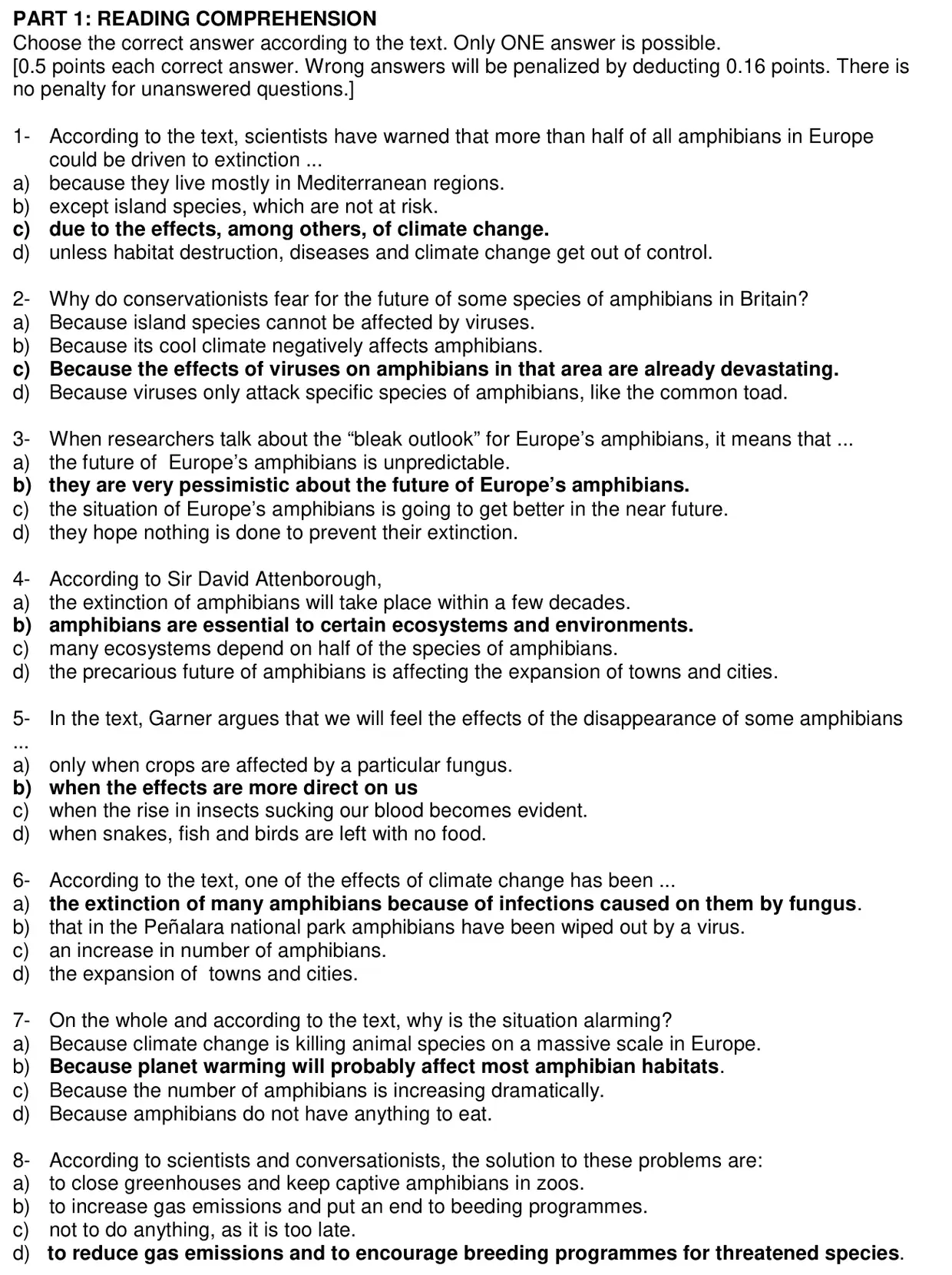
Text dels criteris (transcripció automàtica)
PART 1: READING COMPREHENSION
Choose the correct answer according to the text. Only ONE answer is possible.
[0.5 points each correct answer. Wrong answers will be penalized by deducting 0.16 points. There is
no penalty for unanswered questions.]
1- According to the text, scientists have warned that more than half of all amphibians in Europe
could be driven to extinction ...
a) because they live mostly in Mediterranean regions.
b) except island species, which are not at risk.
c) due to the effects, among others, of climate change.
d) unless habitat destruction, diseases and climate change get out of control.
2- Why do conservationists fear for the future of some species of amphibians in Britain?
a) Because island species cannot be affected by viruses.
b) Because its cool climate negatively affects amphibians.
c) Because the effects of viruses on amphibians in that area are already devastating.
d) Because viruses only attack specific species of amphibians, like the common toad.
3- When r […]
Resolució pas a pas
Encara no hi ha resolució pròpia verificada d'aquest exercici. Mentrestant, tens els criteris oficials de correcció a sobre. Si tens dubtes, pregunta'ls al xat de la Sala d'estudi.
Font: enunciat i criteris de correcció oficials de les PAU 2009 de Catalunya, publicats per la Generalitat de Catalunya (universitats.gencat.cat) i les universitats catalanes. La resolució pas a pas és pròpia de L'Acadèmia de Vic.
Altres exercicis d'aquest examen
- Part 2 · Writing Writing
- Part 3 · Listening comprehension Listening comprehension