
PAU Anglès 2026 · Juny · Sèrie 1 · Part 2 · Reading comprehension
Enunciat
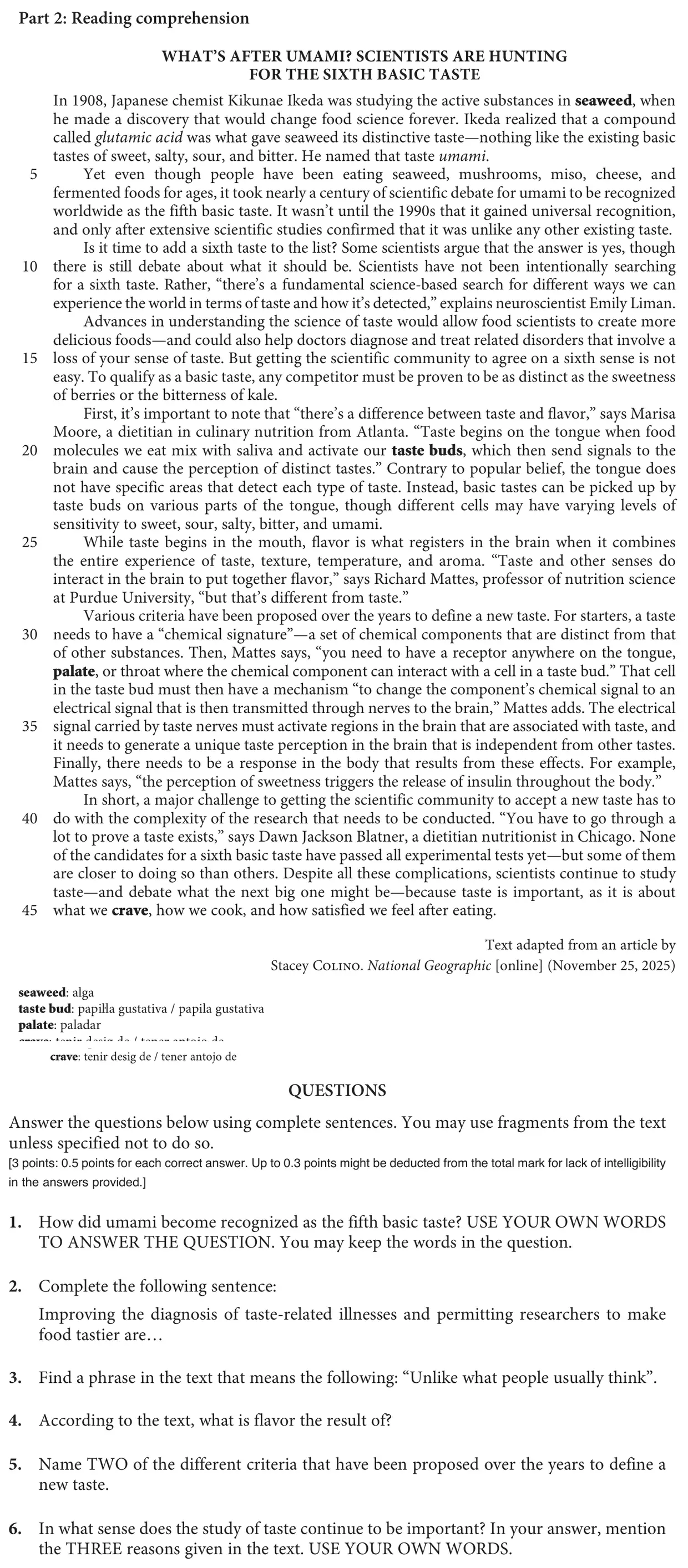
Text de l'enunciat (transcripció automàtica)
Part 2: Reading comprehension
WHAT’S AFTER UMAMI? SCIENTISTS ARE HUNTING
FOR THE SIXTH BASIC TASTE
In 1908, Japanese chemist Kikunae Ikeda was studying the active substances in seaweed, when
he made a discovery that would change food science forever. Ikeda realized that a compound
called glutamic acid was what gave seaweed its distinctive taste—nothing like the existing basic
tastes of sweet, salty, sour, and bitter. He named that taste umami.
5 Yet even though people have been eating seaweed, mushrooms, miso, cheese, and
fermented foods for ages, it took nearly a century of scientific debate for umami to be recognized
worldwide as the fifth basic taste. It wasn’t until the 1990s that it gained universal recognition,
and only after extensive scientific studies confirmed that it was unlike any other existing taste.
Is it time to add a sixth taste to the list? Some scientists argue that the answer is yes, though
10 there is still debate about what it should be. Scientists have not been intentionally searching
for a sixth taste. Rather, “there’s a fundamental science-based search for different ways we can
experience the world in terms of taste and how it’s detected,” explains neuroscientist Emily Liman.
Advances in understanding the science of taste would allow food scientists to create more
delicious foods—and could also help doctors diagnose and treat related disorders that involve a
15 loss of your sense of taste. But getting the scientific community to agree on a sixth sense is not
easy. To qualify as a basic taste, any competitor must be proven to be as distinct as the sweetness
of berries or the bitterness of kale.
First, it’s important to note that “there’s a difference between taste and flavor,” says Marisa
Moore, a dietitian in culinary nutrition from Atlanta. “Taste begins on the tongue when food
20 molecules we eat mix with saliva and activate our taste buds, which then send signals to the
brain and cause the perception of distinct tastes.” Contrary to popular belief, the tongue does
not have specific areas that detect each type of taste. Instead, basic tastes can be picked up by
taste buds on various parts of the tongue, though different cells may have varying levels of
sensitivity to sweet, sour, salty, bitter, and umami.
25 While taste begins in the mouth, flavor is what registers in the brain when it combines
the entire experience of taste, texture, temperature, and aroma. “Taste and other senses do
interact in the brain to put together flavor,” says Richard Mattes, professor of nutrition science
at Purdue University, “but that’s different from taste.”
Various criteria have been proposed over the years to define a new taste. For starters, a taste
30 needs to have a “chemical signature”—a set of chemical components that are distinct from that
of other substances. Then, Mattes says, “you need to have a receptor anywhere on the tongue,
palate, or throat where the chemical component can interact with a cell in a taste bud.” That cell
in the taste bud must then have a mechanism “to change the component’s chemical signal to an
electrical signal that is then transmitted through nerves to the brain,” Mattes adds. The electrical
35 signal carried by taste nerves must activate regions in the brain that are associated with taste, and
it needs to generate a unique taste perception in the brain that is independent from other tastes.
Finally, there needs to be a response in the body that results from these effects. For example,
Mattes says, “the perception of sweetness triggers the release of insulin throughout the body.”
In short, a major challenge to getting the scientific community to accept a new taste has to
40 do with the complexity of the research that needs to be conducted. “You have to go through a
lot to prove a taste exists,” says Dawn Jackson Blatner, a dietitian nutritionist in Chicago. None
of the candidates for a sixth basic taste have passed all experimental tests yet—but some of them
are closer to doing so than
Criteris oficials de correcció
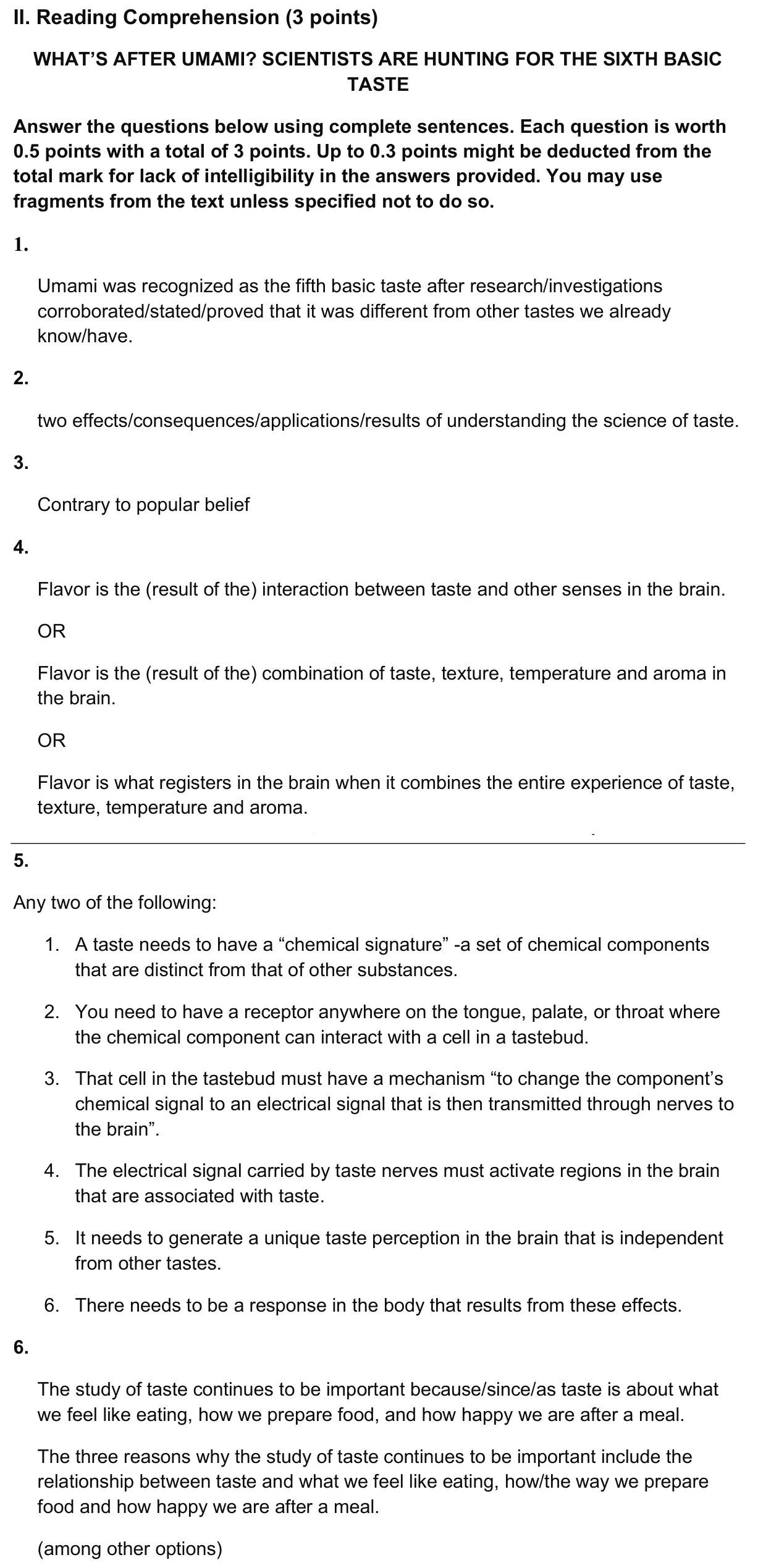
Text dels criteris (transcripció automàtica)
II. Reading Comprehension (3 points)
WHAT’S AFTER UMAMI? SCIENTISTS ARE HUNTING FOR THE SIXTH BASIC
TASTE
Answer the questions below using complete sentences. Each question is worth
0.5 points with a total of 3 points. Up to 0.3 points might be deducted from the
total mark for lack of intelligibility in the answers provided. You may use
fragments from the text unless specified not to do so.
1.
Umami was recognized as the fifth basic taste after research/investigations
corroborated/stated/proved that it was different from other tastes we already
know/have.
2.
two effects/consequences/applications/results of understanding the science of taste.
3.
Contrary to popular belief
4.
Flavor is the (result of the) interaction between taste and other senses in the brain.
OR
Flavor is the (result of the) combination of taste, texture, temperature and aroma in
the brain.
OR
Flavor is what registers in the brain when it combines the entire experience of taste,
texture, temperature and aroma.
5.
Any t […]
Resolució pas a pas
Encara no hi ha resolució pròpia verificada d'aquest exercici. Mentrestant, tens els criteris oficials de correcció a sobre. Si tens dubtes, pregunta'ls al xat de la Sala d'estudi.
Font: enunciat i criteris de correcció oficials de les PAU 2026 de Catalunya, publicats per la Generalitat de Catalunya (universitats.gencat.cat) i les universitats catalanes. La resolució pas a pas és pròpia de L'Acadèmia de Vic.
Altres exercicis d'aquest examen
- Part 1 · Listening comprehension Listening comprehension
- Part 3 · Writing Writing