
PAU Anglès 2024 · Juny · Sèrie 1 · Part 2 · Reading comprehension
Enunciat
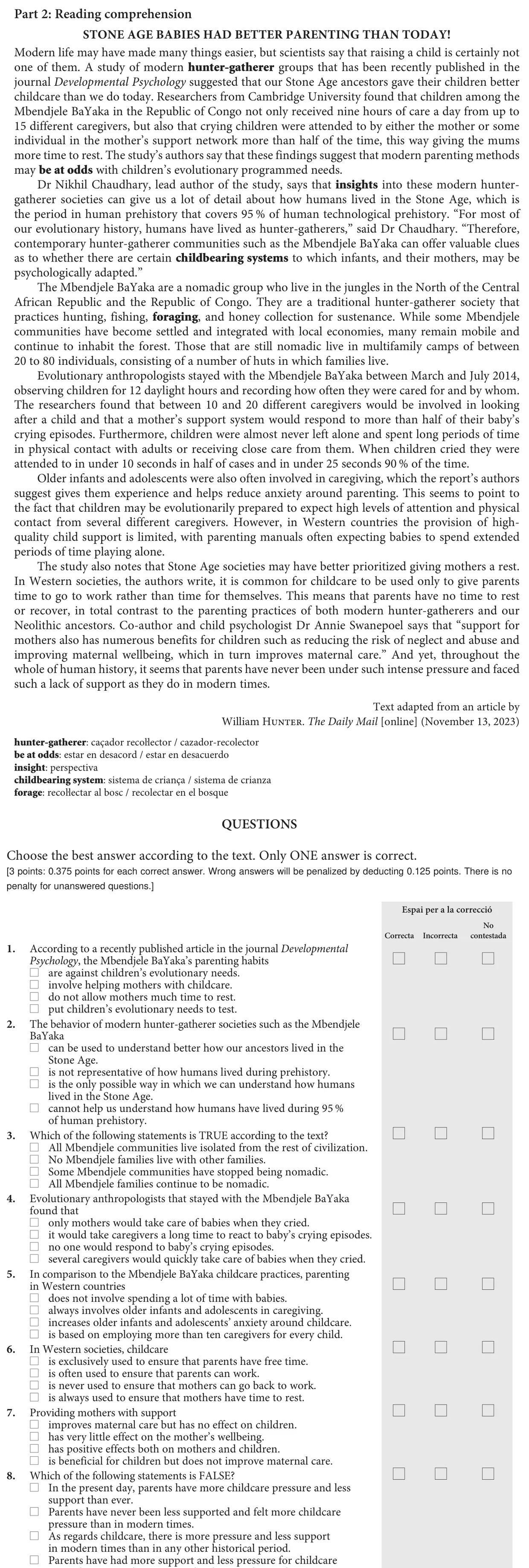
Text de l'enunciat (transcripció automàtica)
Part 2: Reading comprehension
STONE AGE BABIES HAD BETTER PARENTING THAN TODAY!
Modern life may have made many things easier, but scientists say that raising a child is certainly not
one of them. A study of modern hunter-gatherer groups that has been recently published in the
journal Developmental Psychology suggested that our Stone Age ancestors gave their children better
childcare than we do today. Researchers from Cambridge University found that children among the
Mbendjele BaYaka in the Republic of Congo not only received nine hours of care a day from up to
15 different caregivers, but also that crying children were attended to by either the mother or some
individual in the mother’s support network more than half of the time, this way giving the mums
more time to rest. The study’s authors say that these findings suggest that modern parenting methods
may be at odds with children’s evolutionary programmed needs.
Dr Nikhil Chaudhary, lead author of the study, says that insights into these modern hunter-
gatherer societies can give us a lot of detail about how humans lived in the Stone Age, which is
the period in human prehistory that covers 95 % of human technological prehistory. “For most of
our evolutionary history, humans have lived as hunter-gatherers,” said Dr Chaudhary. “Therefore,
contemporary hunter-gatherer communities such as the Mbendjele BaYaka can offer valuable clues
as to whether there are certain childbearing systems to which infants, and their mothers, may be
psychologically adapted.”
The Mbendjele BaYaka are a nomadic group who live in the jungles in the North of the Central
African Republic and the Republic of Congo. They are a traditional hunter-gatherer society that
practices hunting, fishing, foraging, and honey collection for sustenance. While some Mbendjele
communities have become settled and integrated with local economies, many remain mobile and
continue to inhabit the forest. Those that are still nomadic live in multifamily camps of between
20 to 80 individuals, consisting of a number of huts in which families live.
Evolutionary anthropologists stayed with the Mbendjele BaYaka between March and July 2014,
observing children for 12 daylight hours and recording how often they were cared for and by whom.
The researchers found that between 10 and 20 different caregivers would be involved in looking
after a child and that a mother’s support system would respond to more than half of their baby’s
crying episodes. Furthermore, children were almost never left alone and spent long periods of time
in physical contact with adults or receiving close care from them. When children cried they were
attended to in under 10 seconds in half of cases and in under 25 seconds 90 % of the time.
Older infants and adolescents were also often involved in caregiving, which the report’s authors
suggest gives them experience and helps reduce anxiety around parenting. This seems to point to
the fact that children may be evolutionarily prepared to expect high levels of attention and physical
contact from several different caregivers. However, in Western countries the provision of high-
quality child support is limited, with parenting manuals often expecting babies to spend extended
periods of time playing alone.
The study also notes that Stone Age societies may have better prioritized giving mothers a rest.
In Western societies, the authors write, it is common for childcare to be used only to give parents
time to go to work rather than time for themselves. This means that parents have no time to rest
or recover, in total contrast to the parenting practices of both modern hunter-gatherers and our
Neolithic ancestors. Co-author and child psychologist Dr Annie Swanepoel says that “support for
mothers also has numerous benefits for children such as reducing the risk of neglect and abuse and
improving maternal wellbeing, which in turn improves maternal care.” And yet, throughout the
whole of human history, it seems that parents have ne
Criteris oficials de correcció
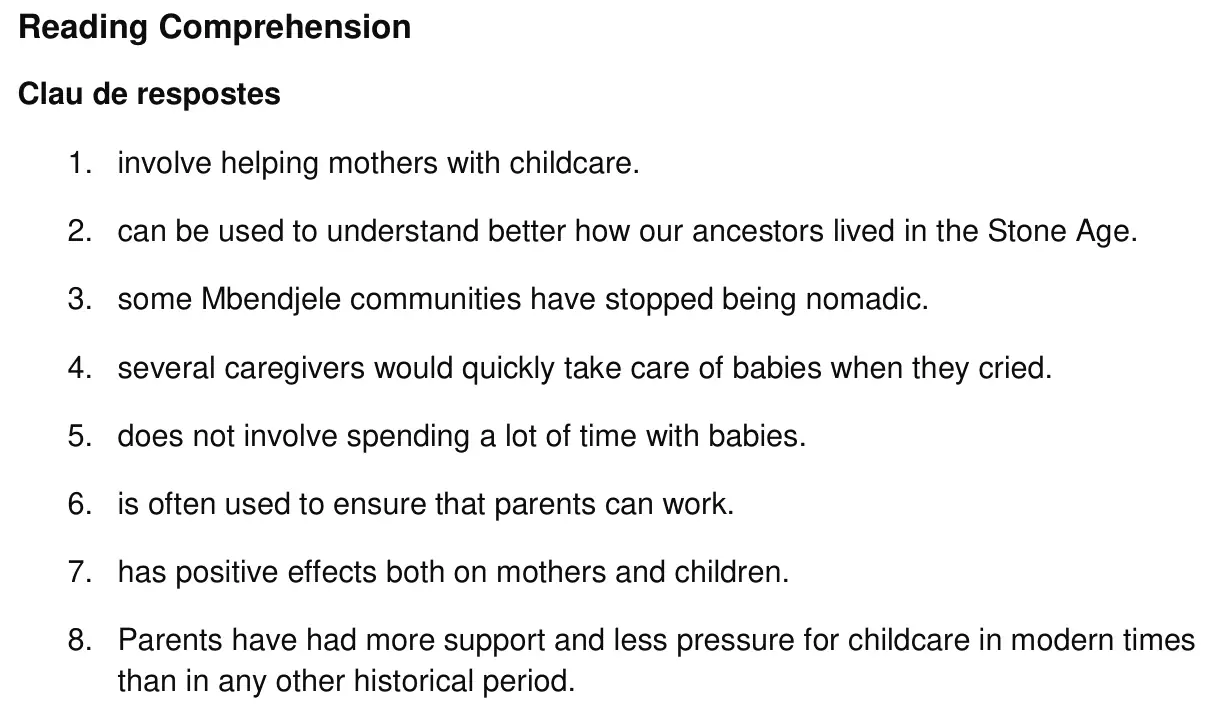
Text dels criteris (transcripció automàtica)
Reading Comprehension
Clau de respostes
1. involve helping mothers with childcare.
2. can be used to understand better how our ancestors lived in the Stone Age.
3. some Mbendjele communities have stopped being nomadic.
4. several caregivers would quickly take care of babies when they cried.
5. does not involve spending a lot of time with babies.
6. is often used to ensure that parents can work.
7. has positive effects both on mothers and children.
8. Parents have had more support and less pressure for childcare in modern times
than in any other historical period.
Resolució pas a pas
Encara no hi ha resolució pròpia verificada d'aquest exercici. Mentrestant, tens els criteris oficials de correcció a sobre. Si tens dubtes, pregunta'ls al xat de la Sala d'estudi.
Font: enunciat i criteris de correcció oficials de les PAU 2024 de Catalunya, publicats per la Generalitat de Catalunya (universitats.gencat.cat) i les universitats catalanes. La resolució pas a pas és pròpia de L'Acadèmia de Vic.
Altres exercicis d'aquest examen
- Part 1 · Listening comprehension Listening comprehension
- Part 3 · Writing Writing