
PAU Anglès 2009 · Setembre · Sèrie 1 · Part 1 · Reading comprehension
Enunciat
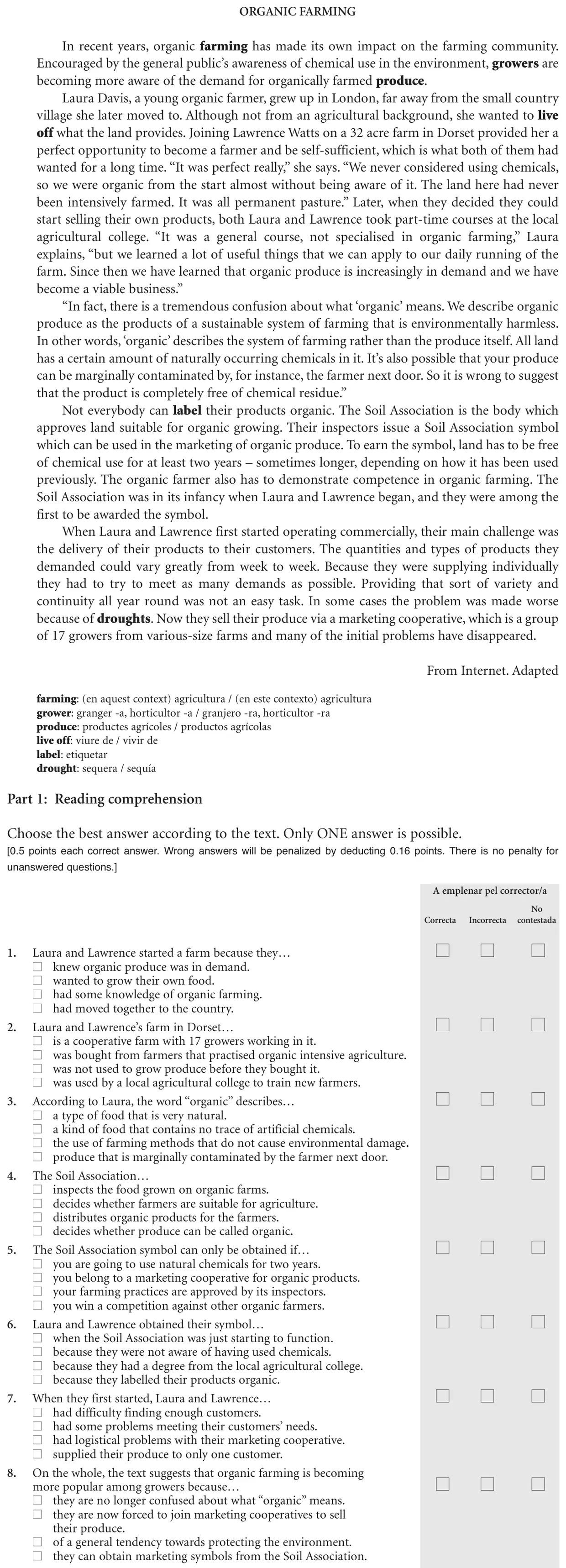
Text de l'enunciat (transcripció automàtica)
ORGANIC FARMING
In recent years, organic farming has made its own impact on the farming community.
Encouraged by the general public’s awareness of chemical use in the environment, growers are
becoming more aware of the demand for organically farmed produce.
Laura Davis, a young organic farmer, grew up in London, far away from the small country
village she later moved to. Although not from an agricultural background, she wanted to live
off what the land provides. Joining Lawrence Watts on a 32 acre farm in Dorset provided her a
perfect opportunity to become a farmer and be self-sufficient, which is what both of them had
wanted for a long time. “It was perfect really,” she says. “We never considered using chemicals,
so we were organic from the start almost without being aware of it. The land here had never
been intensively farmed. It was all permanent pasture.” Later, when they decided they could
start selling their own products, both Laura and Lawrence took part-time courses at the local
agricultural college. “It was a general course, not specialised in organic farming,” Laura
explains, “but we learned a lot of useful things that we can apply to our daily running of the
farm. Since then we have learned that organic produce is increasingly in demand and we have
become a viable business.”
“In fact, there is a tremendous confusion about what ‘organic’ means. We describe organic
produce as the products of a sustainable system of farming that is environmentally harmless.
In other words, ‘organic’ describes the system of farming rather than the produce itself. All land
has a certain amount of naturally occurring chemicals in it. It’s also possible that your produce
can be marginally contaminated by, for instance, the farmer next door. So it is wrong to suggest
that the product is completely free of chemical residue.”
Not everybody can label their products organic. The Soil Association is the body which
approves land suitable for organic growing. Their inspectors issue a Soil Association symbol
which can be used in the marketing of organic produce. To earn the symbol, land has to be free
of chemical use for at least two years – sometimes longer, depending on how it has been used
previously. The organic farmer also has to demonstrate competence in organic farming. The
Soil Association was in its infancy when Laura and Lawrence began, and they were among the
first to be awarded the symbol.
When Laura and Lawrence first started operating commercially, their main challenge was
the delivery of their products to their customers. The quantities and types of products they
demanded could vary greatly from week to week. Because they were supplying individually
they had to try to meet as many demands as possible. Providing that sort of variety and
continuity all year round was not an easy task. In some cases the problem was made worse
because of droughts. Now they sell their produce via a marketing cooperative, which is a group
of 17 growers from various-size farms and many of the initial problems have disappeared.
From Internet. Adapted
farming: (en aquest context) agricultura / (en este contexto) agricultura
grower: granger -a, horticultor -a / granjero -ra, horticultor -ra
produce: productes agrícoles / productos agrícolas
live off: viure de / vivir de
label: etiquetar
drought: sequera / sequía
Part 1: Reading comprehension
Choose the best answer according to the text. Only ONE answer is possible.
[0.5 points each correct answer. Wrong answers will be penalized by deducting 0.16 points. There is no penalty for
unanswered questions.]
A emplenar pel corrector/a
No
Correcta Incorrecta contestada
1. Laura and Lawrence started a farm because they…
I knew organic produce was in demand.
I wanted to grow their own food.
I had some knowledge of organic farming.
I had moved together to the country.
2. Laura and Lawrence’s farm in Dorset…
I is a cooperative farm with 17 growers working in it.
I was bought from farmers that practised organic intensive
Criteris oficials de correcció
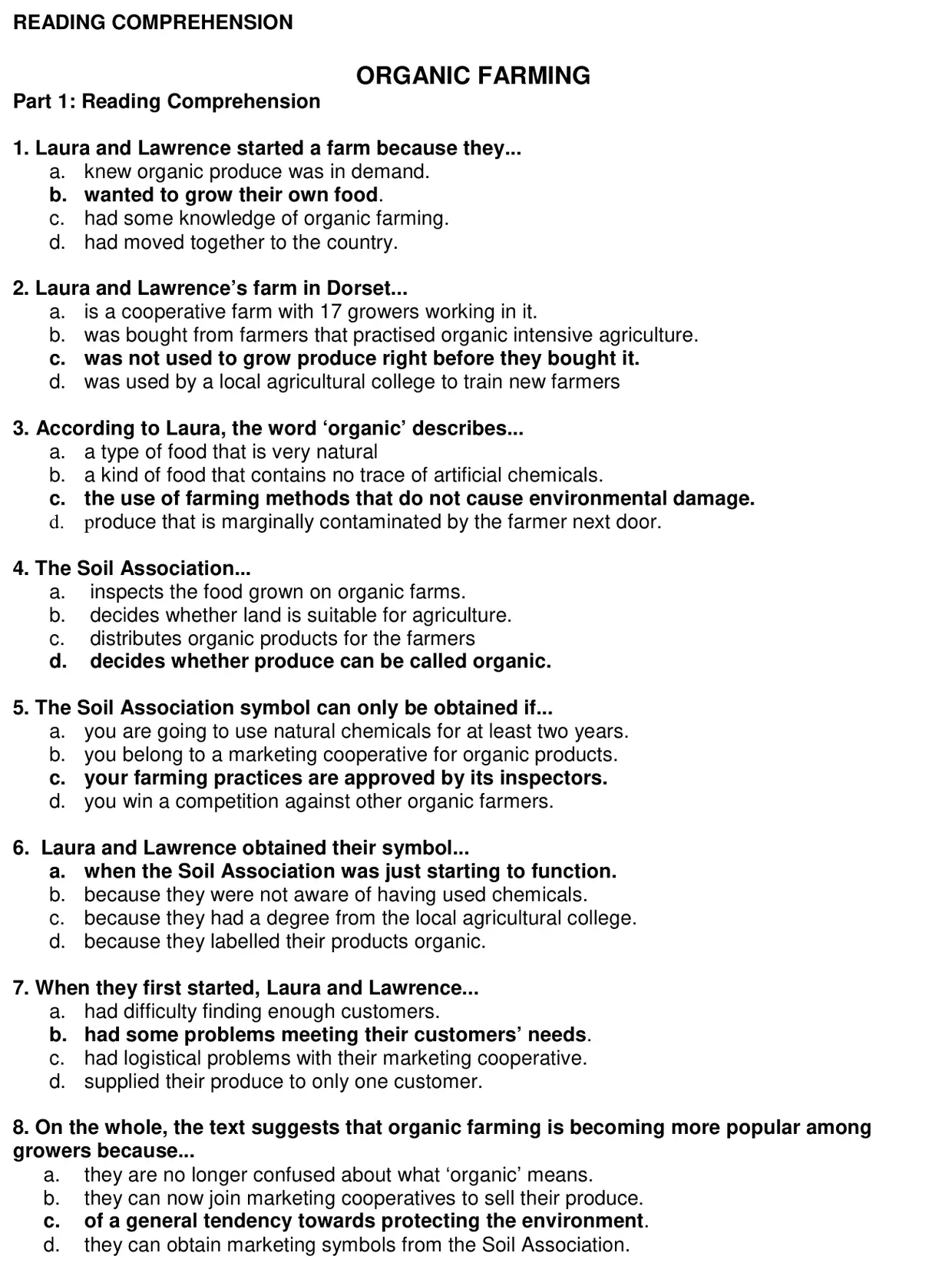
Text dels criteris (transcripció automàtica)
1. Laura and Lawrence started a farm because they...
a. knew organic produce was in demand.
b. wanted to grow their own food.
c. had some knowledge of organic farming.
d. had moved together to the country.
2. Laura and Lawrence’s farm in Dorset...
a. is a cooperative farm with 17 growers working in it.
b. was bought from farmers that practised organic intensive agriculture.
c. was not used to grow produce right before they bought it.
d. was used by a local agricultural college to train new farmers
3. According to Laura, the word ‘organic’ describes...
a. a type of food that is very natural
b. a kind of food that contains no trace of artificial chemicals.
c. the use of farming methods that do not cause environmental damage.
d. produce that is marginally contaminated by the farmer next door.
4. The Soil Association...
a. inspects the food grown on organic farms.
b. decides whether land is suitable for agriculture.
c. distributes organic products for the farmers
d. decides whether produce […]
Resolució pas a pas
Encara no hi ha resolució pròpia verificada d'aquest exercici. Mentrestant, tens els criteris oficials de correcció a sobre. Si tens dubtes, pregunta'ls al xat de la Sala d'estudi.
Font: enunciat i criteris de correcció oficials de les PAU 2009 de Catalunya, publicats per la Generalitat de Catalunya (universitats.gencat.cat) i les universitats catalanes. La resolució pas a pas és pròpia de L'Acadèmia de Vic.
Altres exercicis d'aquest examen
- Part 2 · Writing Writing
- Part 3 · Listening comprehension Listening comprehension