
PAU Anglès 2000 · Juny · Sèrie 3 · Part 1 · Reading comprehension
Enunciat
Text de l'enunciat (transcripció automàtica)
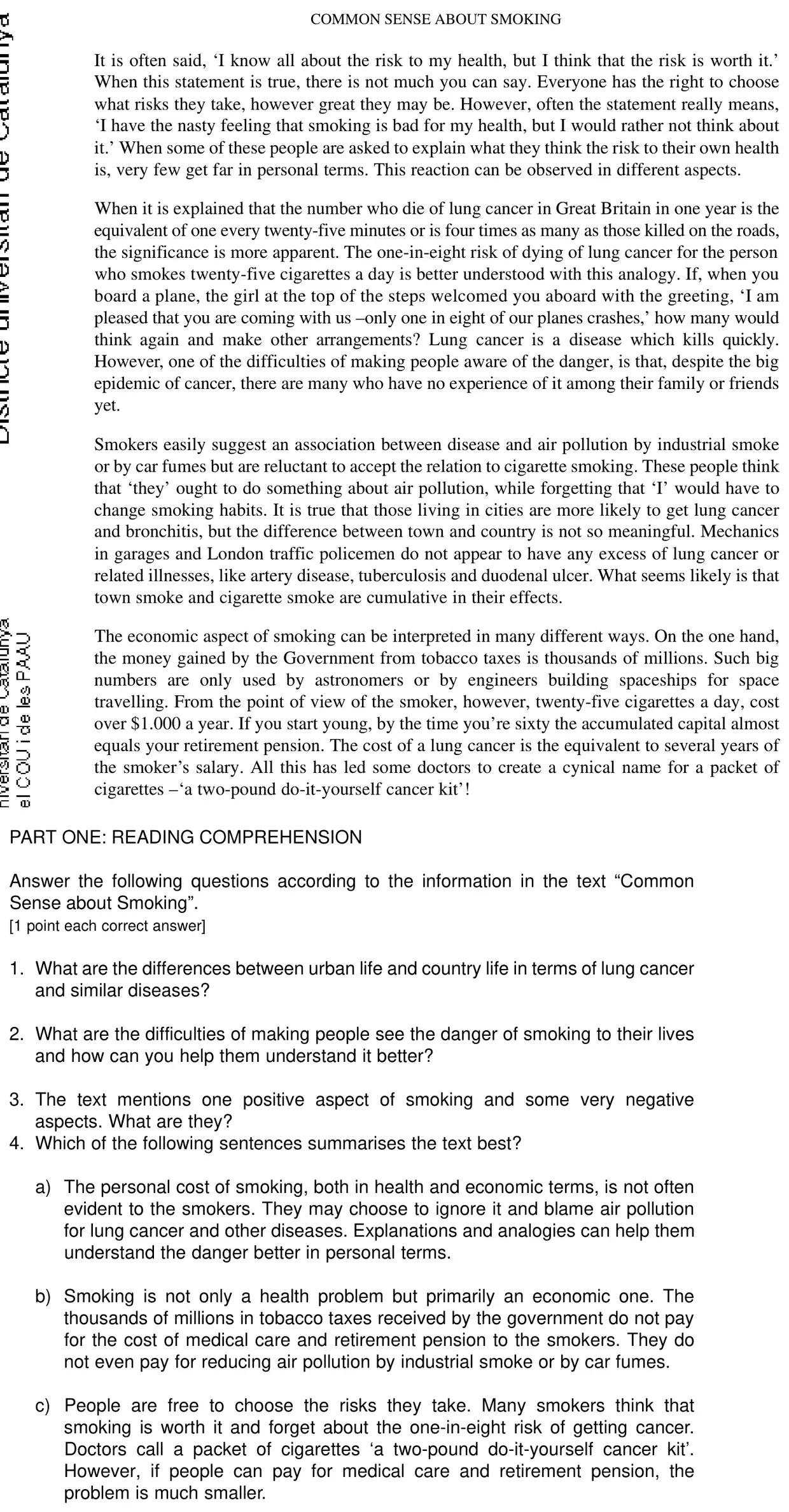
COMMON SENSE ABOUT SMOKING
It is often said, ‘I know all about the risk to my health, but I think that the risk is worth it.’
When this statement is true, there is not much you can say. Everyone has the right to choose
what risks they take, however great they may be. However, often the statement really means,
‘I have the nasty feeling that smoking is bad for my health, but I would rather not think about
it.’ When some of these people are asked to explain what they think the risk to their own health
is, very few get far in personal terms. This reaction can be observed in different aspects.
When it is explained that the number who die of lung cancer in Great Britain in one year is the
equivalent of one every twenty-five minutes or is four times as many as those killed on the roads,
the significance is more apparent. The one-in-eight risk of dying of lung cancer for the person
who smokes twenty-five cigarettes a day is better understood with this analogy. If, when you
board a plane, the girl at the top of the steps welcomed you aboard with the greeting, ‘I am
pleased that you are coming with us –only one in eight of our planes crashes,’ how many would
think again and make other arrangements? Lung cancer is a disease which kills quickly.
H o w e v e r, one of the difficulties of making people aware of the danger, is that, despite the big
epidemic of cancer, there are many who have no experience of it among their family or friends
y e t .
Smokers easily suggest an association between disease and air pollution by industrial smoke
or by car fumes but are reluctant to accept the relation to cigarette smoking. These people think
that ‘they’ ought to do something about air pollution, while forgetting that ‘I’ would have to
change smoking habits. It is true that those living in cities are more likely to get lung cancer
and bronchitis, but the difference between town and country is not so meaningful. Mechanics
in garages and London traffic policemen do not appear to have any excess of lung cancer or
related illnesses, like artery disease, tuberculosis and duodenal ulcer. What seems likely is that
town smoke and cigarette smoke are cumulative in their effects.
The economic aspect of smoking can be interpreted in many different ways. On the one hand,
the money gained by the Government from tobacco taxes is thousands of millions. Such big
numbers are only used by astronomers or by engineers building spaceships for space
travelling. From the point of view of the smoker, however, twenty-five cigarettes a day, cost
over $1.000 a year. If you start young, by the time you’re sixty the accumulated capital almost
equals your retirement pension. The cost of a lung cancer is the equivalent to several years of
the smoker’s salary. All this has led some doctors to create a cynical name for a packet of
cigarettes –‘a two-pound do-it-yourself cancer kit’!
PART ONE: READING COMPREHENSION
Answer the following questions according to the information in the text “Common
Sense about Smoking”.
[1 point each correct answer]
1. What are the differences between urban life and country life in terms of lung cancer
and similar diseases?
2. What are the difficulties of making people see the danger of smoking to their lives
and how can you help them understand it better?
3. The text mentions one positive aspect of smoking and some very negative
aspects. What are they?
4. Which of the following sentences summarises the text best?
a) The personal cost of smoking, both in health and economic terms, is not often
evident to the smokers. They may choose to ignore it and blame air pollution
for lung cancer and other diseases. Explanations and analogies can help them
understand the danger better in personal terms.
b) Smoking is not only a health problem but primarily an economic one. The
thousands of millions in tobacco taxes received by the government do not pay
for the cost of medical care and retirement pension to the smokers. They do
not even pay for reducing air pollution
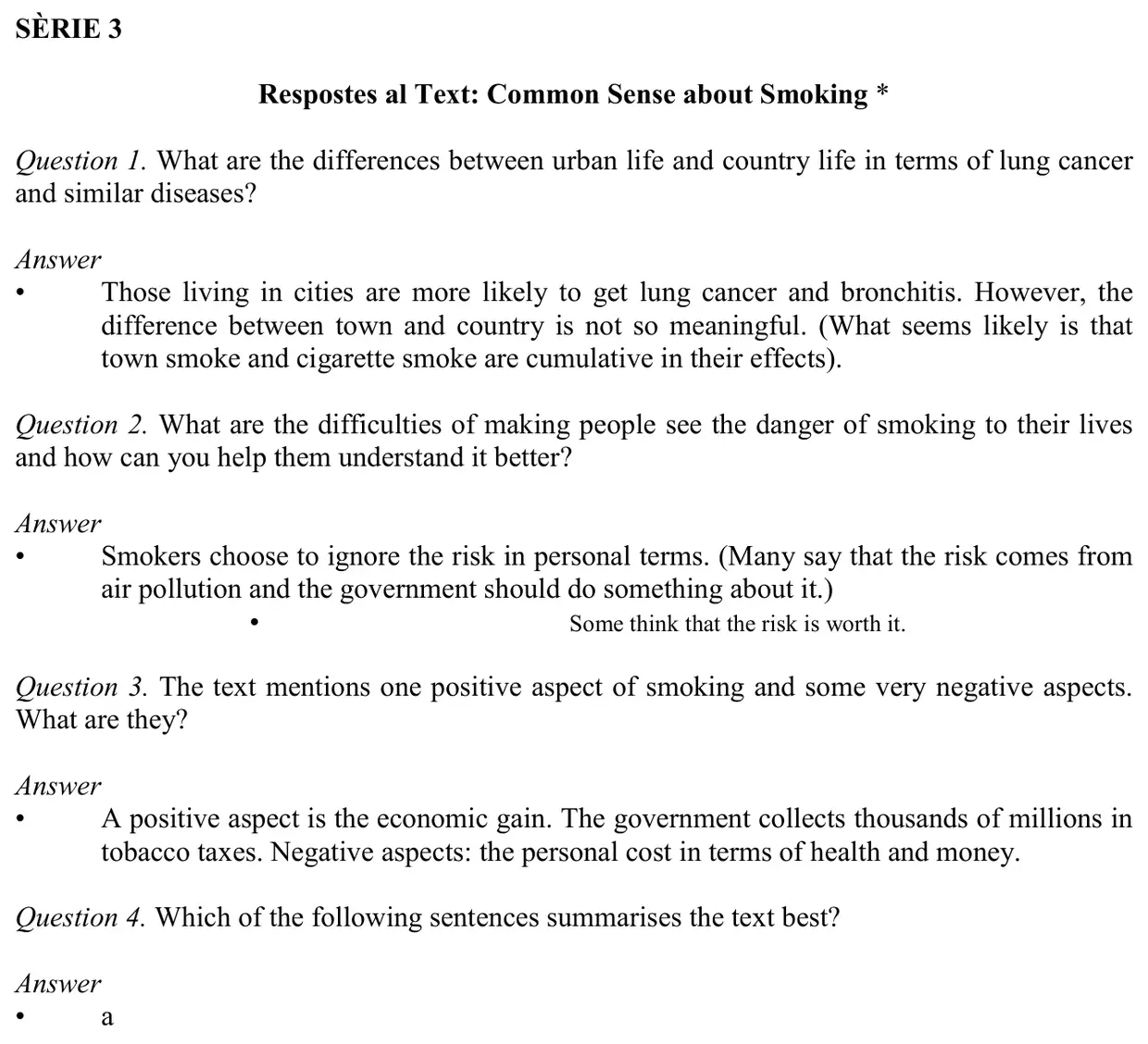
Criteris oficials de correcció
Resolució pas a pas
Encara no hi ha resolució pròpia verificada d'aquest exercici. Mentrestant, tens els criteris oficials de correcció a sobre. Si tens dubtes, pregunta'ls al xat de la Sala d'estudi.
Font: enunciat i criteris de correcció oficials de les PAU 2000 de Catalunya, publicats per la Generalitat de Catalunya (universitats.gencat.cat) i les universitats catalanes. La resolució pas a pas és pròpia de L'Acadèmia de Vic.
Altres exercicis d'aquest examen
- Part 2 · Writing Writing