
PAU Anglès 2026 · Setembre · Sèrie 2 · Part 1 · Listening comprehension
Enunciat
Text de l'enunciat (transcripció automàtica)
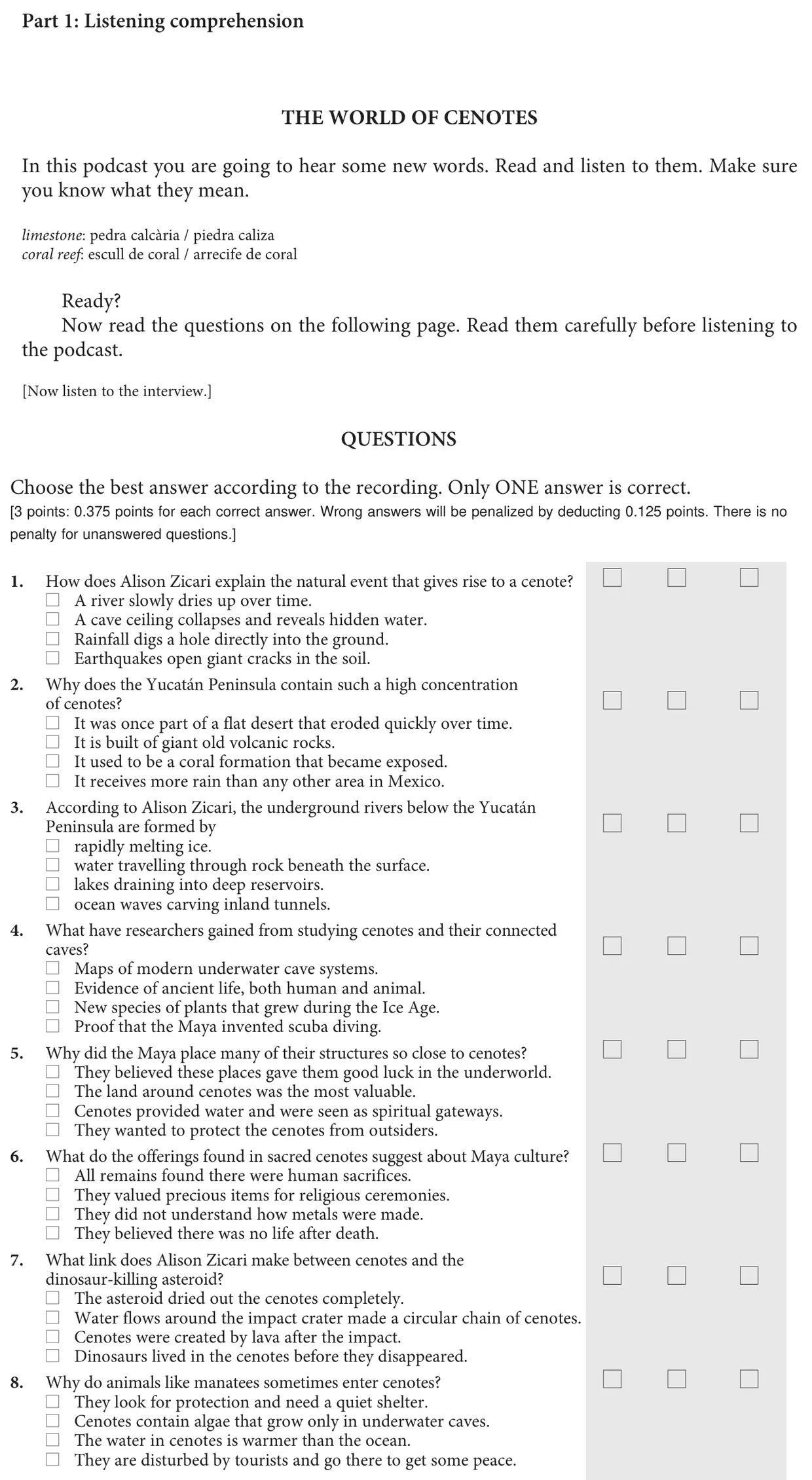
Part 1: Listening comprehension
THE WORLD OF CENOTES
In this podcast you are going to hear some new words. Read and listen to them. Make sure
you know what they mean.
limestone: pedra calcària / piedra caliza
coral reef: escull de coral / arrecife de coral
Ready?
Now read the questions on the following page. Read them carefully before listening to
the podcast.
[Now listen to the interview.]
QUESTIONS
Choose the best answer according to the recording. Only ONE answer is correct.
[3 points: 0.375 points for each correct answer. Wrong answers will be penalized by deducting 0.125 points. There is no
penalty for unanswered questions.]
1. How does Alison Zicari explain the natural event that gives rise to a cenote?
■ A river slowly dries up over time.
■ A cave ceiling collapses and reveals hidden water.
■ Rainfall digs a hole directly into the ground.
■ Earthquakes open giant cracks in the soil.
2. Why does the Yucatán Peninsula contain such a high concentration
of cenotes?
■ It was once part of a flat desert that eroded quickly over time.
■ It is built of giant old volcanic rocks.
■ It used to be a coral formation that became exposed.
■ It receives more rain than any other area in Mexico.
3. According to Alison Zicari, the underground rivers below the Yucatán
Peninsula are formed by
■ rapidly melting ice.
■ water travelling through rock beneath the surface.
■ lakes draining into deep reservoirs.
■ ocean waves carving inland tunnels.
4. What have researchers gained from studying cenotes and their connected
caves?
■ Maps of modern underwater cave systems.
■ Evidence of ancient life, both human and animal.
■ New species of plants that grew during the Ice Age.
■ Proof that the Maya invented scuba diving.
5. Why did the Maya place many of their structures so close to cenotes?
■ They believed these places gave them good luck in the underworld.
■ The land around cenotes was the most valuable.
■ Cenotes provided water and were seen as spiritual gateways.
■ They wanted to protect the cenotes from outsiders.
6. What do the offerings found in sacred cenotes suggest about Maya culture?
■ All remains found there were human sacrifices.
■ They valued precious items for religious ceremonies.
■ They did not understand how metals were made.
■ They believed there was no life after death.
7. What link does Alison Zicari make between cenotes and the
dinosaur-killing asteroid?
■ The asteroid dried out the cenotes completely.
■ Water flows around the impact crater made a circular chain of cenotes.
■ Cenotes were created by lava after the impact.
■ Dinosaurs lived in the cenotes before they disappeared.
8. Why do animals like manatees sometimes enter cenotes?
■ They look for protection and need a quiet shelter.
■ Cenotes contain algae that grow only in underwater caves.
■ The water in cenotes is warmer than the ocean.
■ They are disturbed by tourists and go there to get some peace.
Criteris oficials de correcció
Text dels criteris (transcripció automàtica)
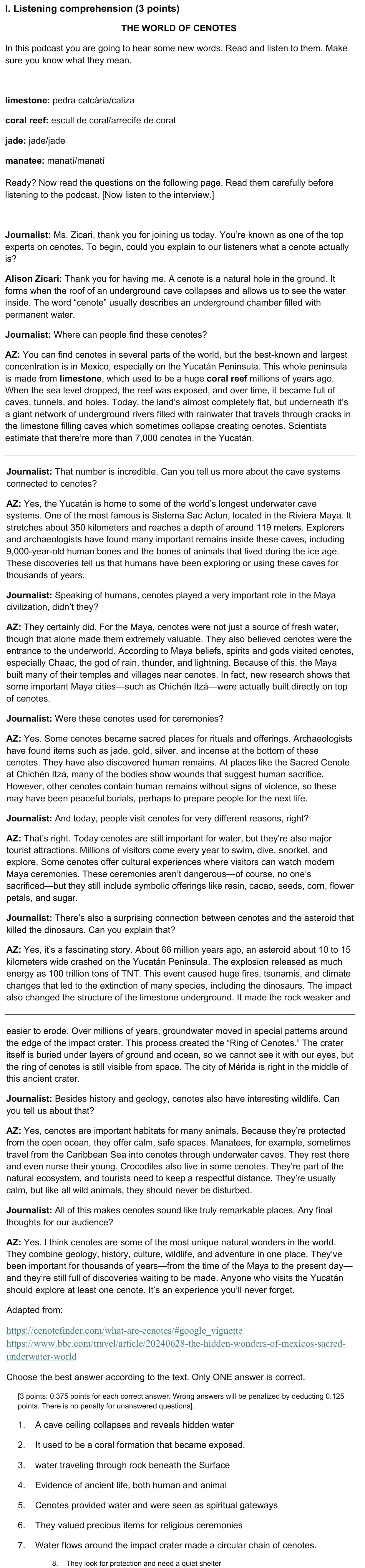
I. Listening comprehension (3 points)
THE WORLD OF CENOTES
In this podcast you are going to hear some new words. Read and listen to them. Make
sure you know what they mean.
limestone: pedra calcària/caliza
coral reef: escull de coral/arrecife de coral
jade: jade/jade
manatee: manatí/manatí
Ready? Now read the questions on the following page. Read them carefully before
listening to the podcast. [Now listen to the interview.]
Journalist: Ms. Zicari, thank you for joining us today. You’re known as one of the top
experts on cenotes. To begin, could you explain to our listeners what a cenote actually
is?
Alison Zicari: Thank you for having me. A cenote is a natural hole in the ground. It
forms when the roof of an underground cave collapses and allows us to see the water
inside. The word “cenote” usually describes an underground chamber filled with
permanent water.
Journalist: Where can people find these cenotes?
AZ: You can find cenotes in several parts of the world, but the best-known and […]
Resolució pas a pas
Aquest exercici no té una resolució escrita pas a pas (requereix l'àudio de la prova). Fes servir els criteris oficials de correcció.
Font: enunciat i criteris de correcció oficials de les PAU 2026 de Catalunya, publicats per la Generalitat de Catalunya (universitats.gencat.cat) i les universitats catalanes. La resolució pas a pas és pròpia de L'Acadèmia de Vic.
Altres exercicis d'aquest examen
- Part 2 · Reading comprehension Reading comprehension
- Part 3 · Writing Writing
Tots els exercicis de Listening comprehension · PAU de Anglès