
PAU Anglès 2022 · Setembre · Sèrie 3 · Part 1 · Listening comprehension
Enunciat
Text de l'enunciat (transcripció automàtica)
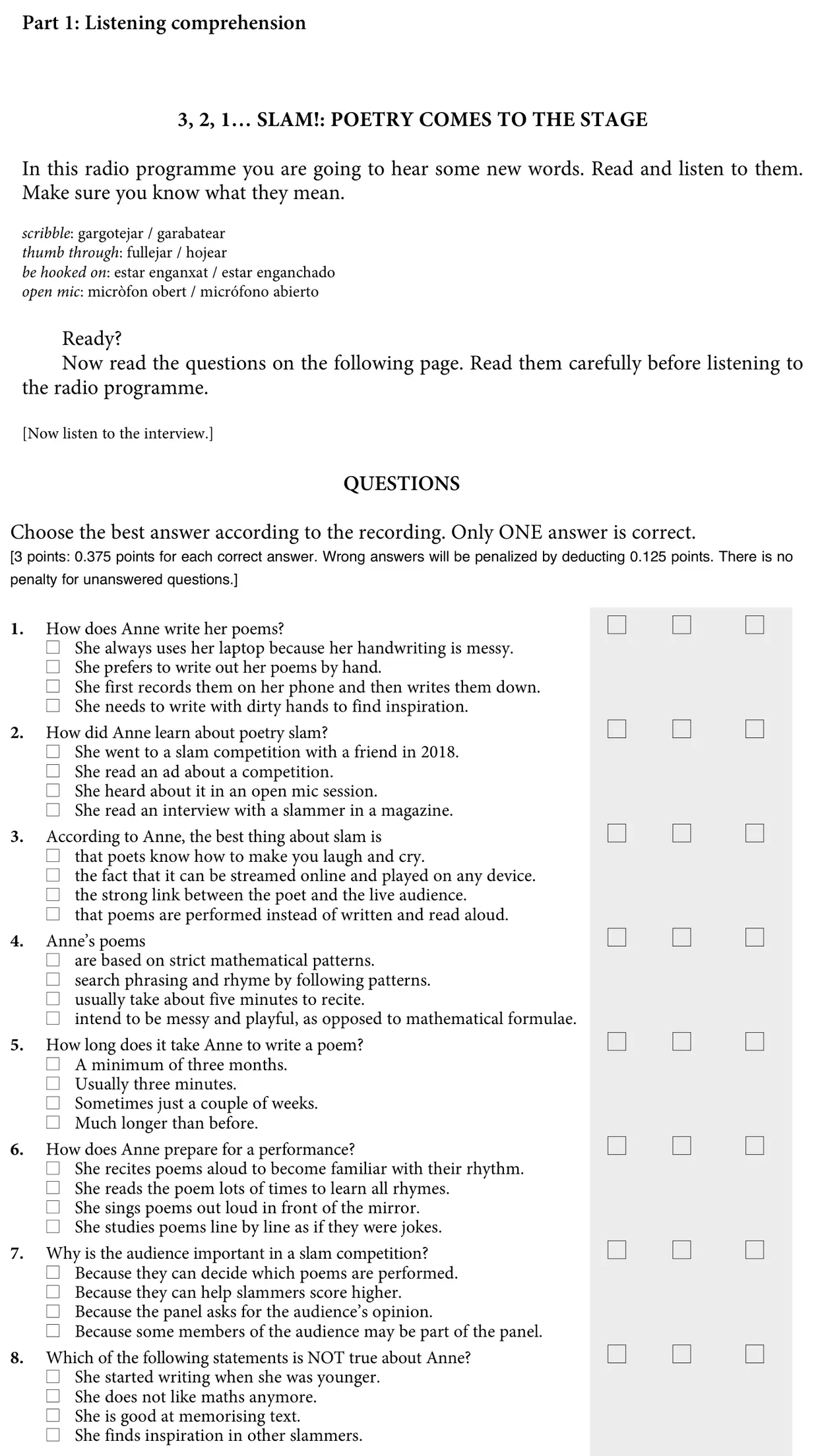
Part 1: Listening comprehension
3, 2, 1… SLAM!: POETRY COMES TO THE STAGE
In this radio programme you are going to hear some new words. Read and listen to them.
Make sure you know what they mean.
scribble: gargotejar / garabatear
thumb through: fullejar / hojear
be hooked on: estar enganxat / estar enganchado
open mic: micròfon obert / micrófono abierto
Ready?
Now read the questions on the following page. Read them carefully before listening to
the radio programme.
[Now listen to the interview.]
QUESTIONS
Choose the best answer according to the recording. Only ONE answer is correct.
[3 points: 0.375 points for each correct answer. Wrong answers will be penalized by deducting 0.125 points. There is no
penalty for unanswered questions.]
1. How does Anne write her poems?
She always uses her laptop because her handwriting is messy.
She prefers to write out her poems by hand.
She first records them on her phone and then writes them down.
She needs to write with dirty hands to find inspiration.
2. How did Anne learn about poetry slam?
She went to a slam competition with a friend in 2018.
She read an ad about a competition.
She heard about it in an open mic session.
She read an interview with a slammer in a magazine.
3. According to Anne, the best thing about slam is
that poets know how to make you laugh and cry.
the fact that it can be streamed online and played on any device.
the strong link between the poet and the live audience.
that poems are performed instead of written and read aloud.
4. Anne’s poems
are based on strict mathematical patterns.
search phrasing and rhyme by following patterns.
usually take about five minutes to recite.
intend to be messy and playful, as opposed to mathematical formulae.
5. How long does it take Anne to write a poem?
A minimum of three months.
Usually three minutes.
Sometimes just a couple of weeks.
Much longer than before.
6. How does Anne prepare for a performance?
She recites poems aloud to become familiar with their rhythm.
She reads the poem lots of times to learn all rhymes.
She sings poems out loud in front of the mirror.
She studies poems line by line as if they were jokes.
7. Why is the audience important in a slam competition?
Because they can decide which poems are performed.
Because they can help slammers score higher.
Because the panel asks for the audience’s opinion.
Because some members of the audience may be part of the panel.
8. Which of the following statements is NOT true about Anne?
She started writing when she was younger.
She does not like maths anymore.
She is good at memorising text.
She finds inspiration in other slammers.
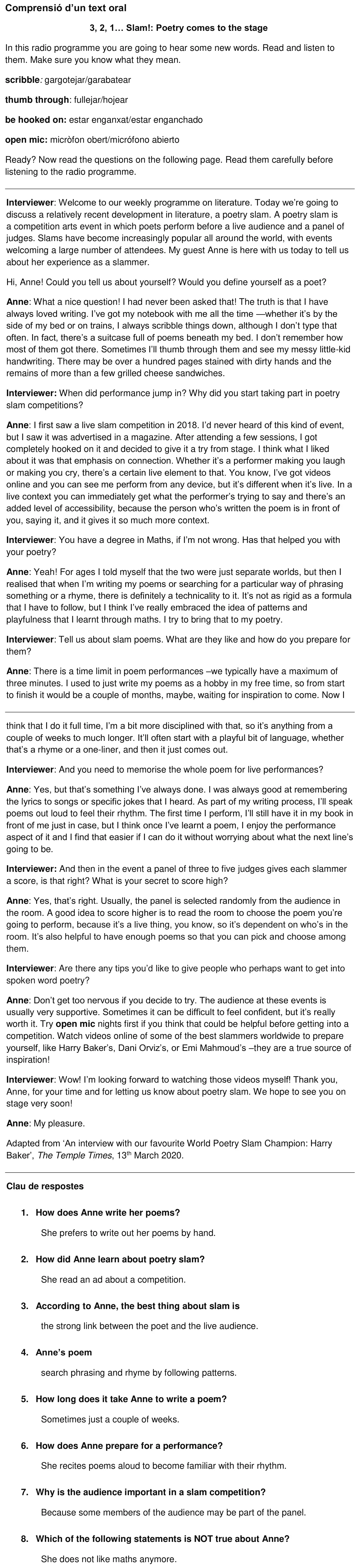
Criteris oficials de correcció
Text dels criteris (transcripció automàtica)
listening to the radio programme.
Interviewer: Welcome to our weekly programme on literature. Today we’re going to
discuss a relatively recent development in literature, a poetry slam. A poetry slam is
a competition arts event in which poets perform before a live audience and a panel of
judges. Slams have become increasingly popular all around the world, with events
welcoming a large number of attendees. My guest Anne is here with us today to tell us
about her experience as a slammer.
Hi, Anne! Could you tell us about yourself? Would you define yourself as a poet?
Anne: What a nice question! I had never been asked that! The truth is that I have
always loved writing. I’ve got my notebook with me all the time —whether it’s by the
side of my bed or on trains, I always scribble things down, although I don’t type that
often. In fact, there’s a suitcase full of poems beneath my bed. I don’t remember how
most of them got there. Sometimes I’ll thumb through them and see my messy little-kid
han […]
Resolució pas a pas
Aquest exercici no té una resolució escrita pas a pas (requereix l'àudio de la prova). Fes servir els criteris oficials de correcció.
Font: enunciat i criteris de correcció oficials de les PAU 2022 de Catalunya, publicats per la Generalitat de Catalunya (universitats.gencat.cat) i les universitats catalanes. La resolució pas a pas és pròpia de L'Acadèmia de Vic.
Altres exercicis d'aquest examen
- Part 2 · Reading comprehension Reading comprehension
- Part 3 · Writing Writing
Tots els exercicis de Listening comprehension · PAU de Anglès