
PAU Anglès 2022 · Juny · Sèrie 5 · Part 1 · Listening comprehension
Enunciat
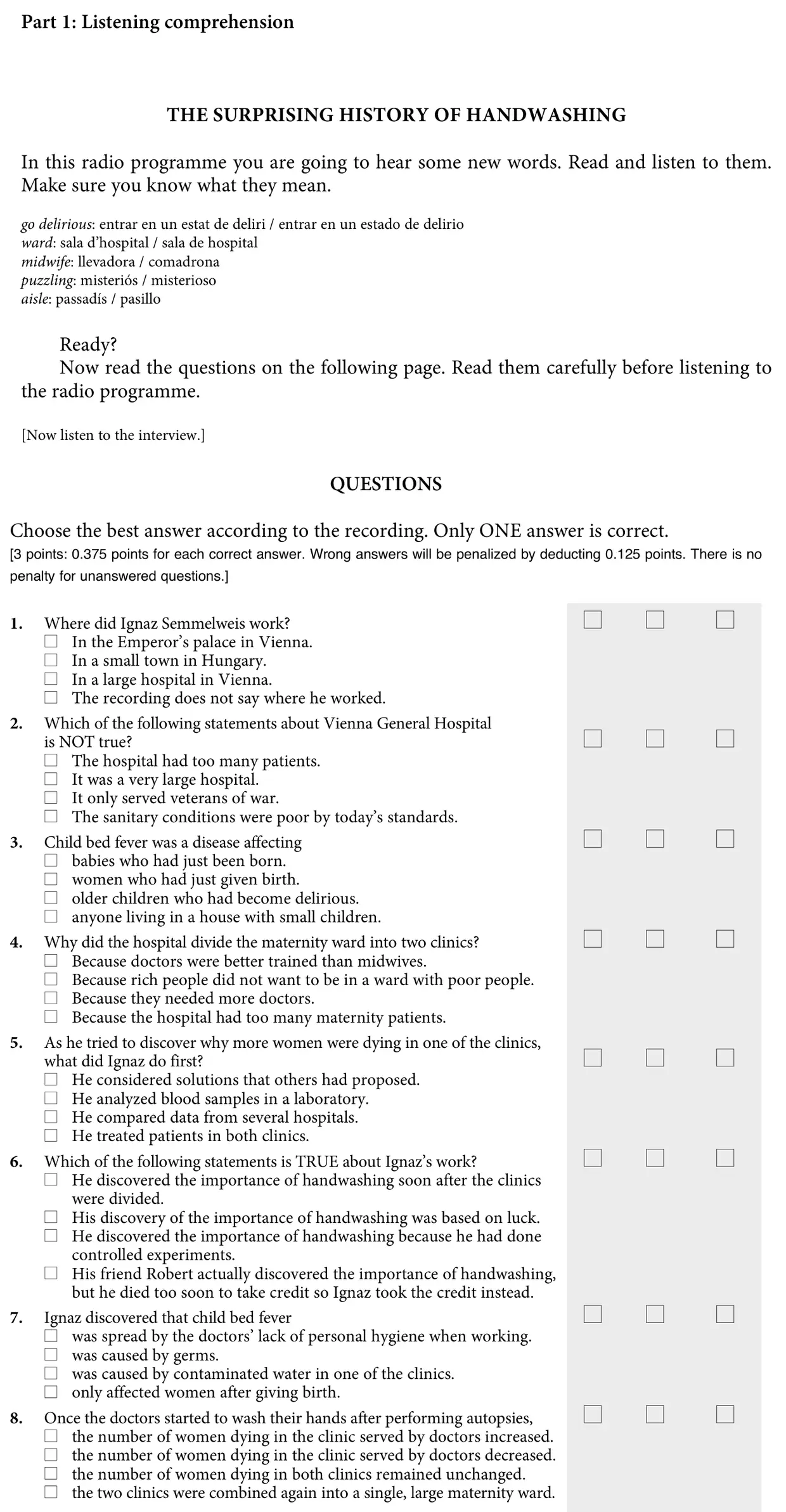
Text de l'enunciat (transcripció automàtica)
Part 1: Listening comprehension
THE SURPRISING HISTORY OF HANDWASHING
In this radio programme you are going to hear some new words. Read and listen to them.
Make sure you know what they mean.
go delirious: entrar en un estat de deliri / entrar en un estado de delirio
ward: sala d’hospital / sala de hospital
midwife: llevadora / comadrona
puzzling: misteriós / misterioso
aisle: passadís / pasillo
Ready?
Now read the questions on the following page. Read them carefully before listening to
the radio programme.
[Now listen to the interview.]
QUESTIONS
Choose the best answer according to the recording. Only ONE answer is correct.
[3 points: 0.375 points for each correct answer. Wrong answers will be penalized by deducting 0.125 points. There is no
penalty for unanswered questions.]
1. Where did Ignaz Semmelweis work?
In the Emperor’s palace in Vienna.
In a small town in Hungary.
In a large hospital in Vienna.
The recording does not say where he worked.
2. Which of the following statements about Vienna General Hospital
is NOT true?
The hospital had too many patients.
It was a very large hospital.
It only served veterans of war.
The sanitary conditions were poor by today’s standards.
3. Child bed fever was a disease affecting
babies who had just been born.
women who had just given birth.
older children who had become delirious.
anyone living in a house with small children.
4. Why did the hospital divide the maternity ward into two clinics?
Because doctors were better trained than midwives.
Because rich people did not want to be in a ward with poor people.
Because they needed more doctors.
Because the hospital had too many maternity patients.
5. As he tried to discover why more women were dying in one of the clinics,
what did Ignaz do first?
He considered solutions that others had proposed.
He analyzed blood samples in a laboratory.
He compared data from several hospitals.
He treated patients in both clinics.
6. Which of the following statements is TRUE about Ignaz’s work?
He discovered the importance of handwashing soon after the clinics
were divided.
His discovery of the importance of handwashing was based on luck.
He discovered the importance of handwashing because he had done
controlled experiments.
His friend Robert actually discovered the importance of handwashing,
but he died too soon to take credit so Ignaz took the credit instead.
7. Ignaz discovered that child bed fever
was spread by the doctors’ lack of personal hygiene when working.
was caused by germs.
was caused by contaminated water in one of the clinics.
only affected women after giving birth.
8. Once the doctors started to wash their hands after performing autopsies,
the number of women dying in the clinic served by doctors increased.
the number of women dying in the clinic served by doctors decreased.
the number of women dying in both clinics remained unchanged.
the two clinics were combined again into a single, large maternity ward.
Criteris oficials de correcció

Text dels criteris (transcripció automàtica)
listening to the radio programme. [Now listen to the interview.]
Interviewer: We take it for granted now that washing our hands is a tool to fight
disease. But somebody had to discover that, and most of the credit goes to a
Hungarian doctor named Ignaz Semmelweis. How did he come to realize that
handwashing was so important for our health? To answer that, we’ve invited Dr. Diana
Tulane, a professor of the history of medicine at Purdue University in Indiana who has
studied Ignaz Semmelweis, to our program.
Welcome and good morning, Prof. Tulane.
Prof. Tulane: Good morning, and thank you for inviting me.
Interviewer: My pleasure. How did you become interested in Ignaz? Is he famous?
Prof. Tulane: Actually, I was interested in medicine as practiced in the 19th century,
and Ignaz Semmelweis became an important name in medicine from that period.
Interviewer: I’m assuming he had something to do with handwashing.
Prof. Tulane: Yes, that’s right. The history of handwashing is actually complica […]
Resolució pas a pas
Aquest exercici no té una resolució escrita pas a pas (requereix l'àudio de la prova). Fes servir els criteris oficials de correcció.
Font: enunciat i criteris de correcció oficials de les PAU 2022 de Catalunya, publicats per la Generalitat de Catalunya (universitats.gencat.cat) i les universitats catalanes. La resolució pas a pas és pròpia de L'Acadèmia de Vic.
Altres exercicis d'aquest examen
- Part 2 · Reading comprehension Reading comprehension
- Part 3 · Writing Writing
Tots els exercicis de Listening comprehension · PAU de Anglès