
PAU Anglès 2021 · Juny · Sèrie 2 · Part 1 · Listening comprehension
Enunciat
Text de l'enunciat (transcripció automàtica)
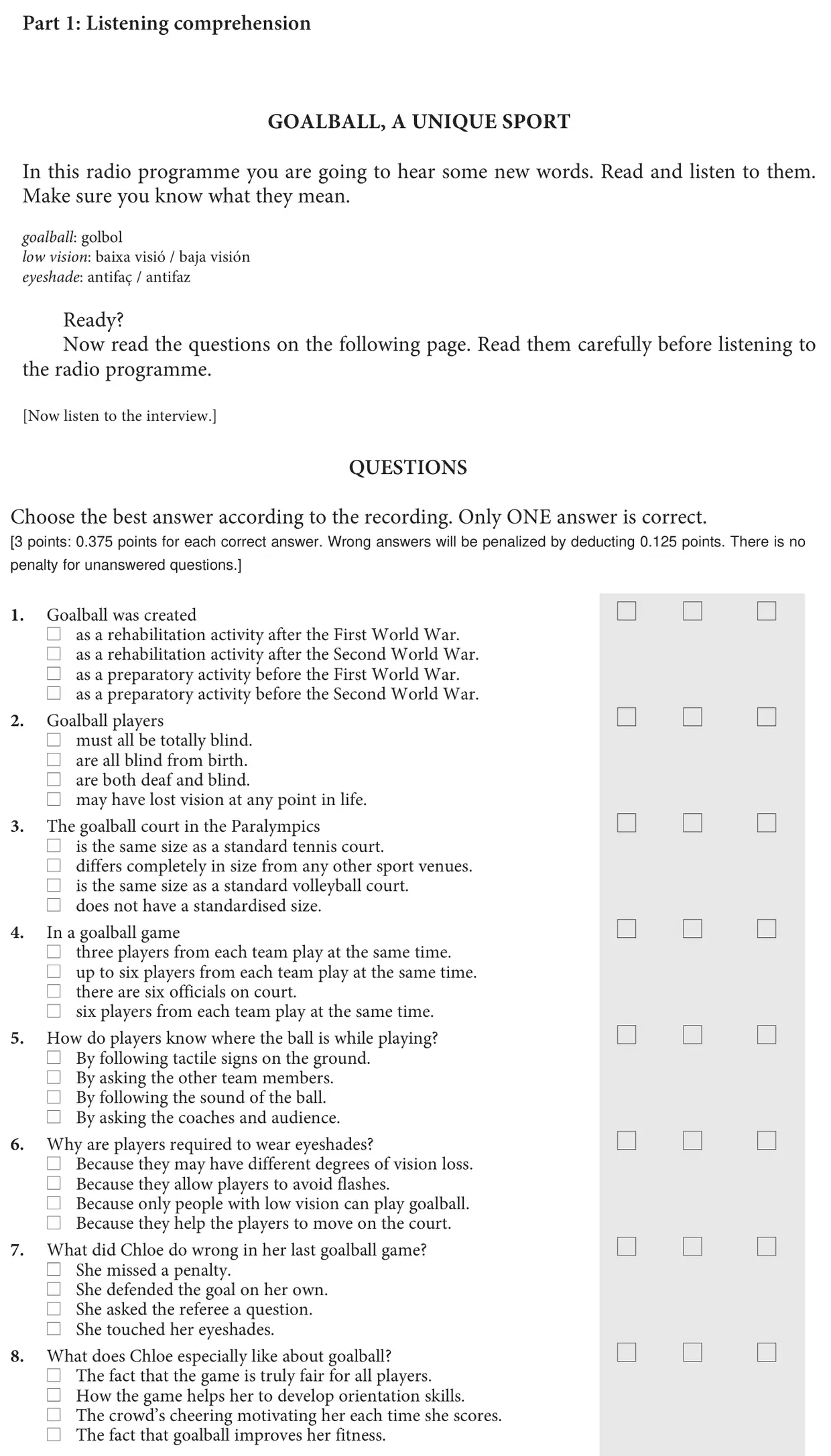
Part 1: Listening comprehension
GOALBALL, A UNIQUE SPORT
In this radio programme you are going to hear some new words. Read and listen to them.
Make sure you know what they mean.
goalball: golbol
low vision: baixa visió / baja visión
eyeshade: antifaç / antifaz
Ready?
Now read the questions on the following page. Read them carefully before listening to
the radio programme.
[Now listen to the interview.]
QUESTIONS
Choose the best answer according to the recording. Only ONE answer is correct.
[3 points: 0.375 points for each correct answer. Wrong answers will be penalized by deducting 0.125 points. There is no
penalty for unanswered questions.]
1. Goalball was created
as a rehabilitation activity after the First World War.
as a rehabilitation activity after the Second World War.
as a preparatory activity before the First World War.
as a preparatory activity before the Second World War.
2. Goalball players
must all be totally blind.
are all blind from birth.
are both deaf and blind.
may have lost vision at any point in life.
3. The goalball court in the Paralympics
is the same size as a standard tennis court.
differs completely in size from any other sport venues.
is the same size as a standard volleyball court.
does not have a standardised size.
4. In a goalball game
three players from each team play at the same time.
up to six players from each team play at the same time.
there are six officials on court.
six players from each team play at the same time.
5. How do players know where the ball is while playing?
By following tactile signs on the ground.
By asking the other team members.
By following the sound of the ball.
By asking the coaches and audience.
6. Why are players required to wear eyeshades?
Because they may have different degrees of vision loss.
Because they allow players to avoid flashes.
Because only people with low vision can play goalball.
Because they help the players to move on the court.
7. What did Chloe do wrong in her last goalball game?
She missed a penalty.
She defended the goal on her own.
She asked the referee a question.
She touched her eyeshades.
8. What does Chloe especially like about goalball?
The fact that the game is truly fair for all players.
How the game helps her to develop orientation skills.
The crowd’s cheering motivating her each time she scores.
The fact that goalball improves her fitness.
Criteris oficials de correcció
Text dels criteris (transcripció automàtica)
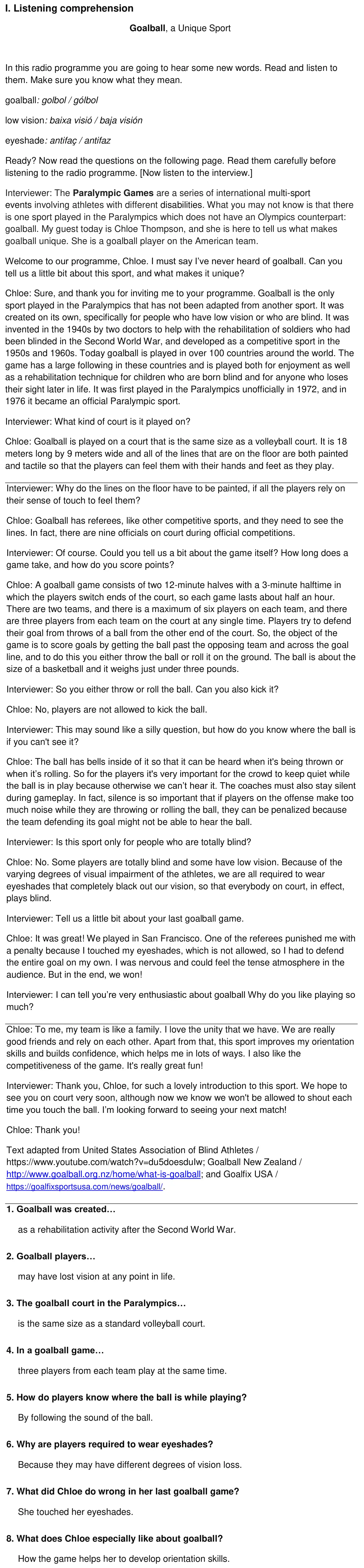
I. Listening comprehension
Goalball, a Unique Sport
In this radio programme you are going to hear some new words. Read and listen to
them. Make sure you know what they mean.
goalball: golbol / gólbol
low vision: baixa visió / baja visión
eyeshade: antifaç / antifaz
Ready? Now read the questions on the following page. Read them carefully before
listening to the radio programme. [Now listen to the interview.]
Interviewer: The Paralympic Games are a series of international multi-sport
events involving athletes with different disabilities. What you may not know is that there
is one sport played in the Paralympics which does not have an Olympics counterpart:
goalball. My guest today is Chloe Thompson, and she is here to tell us what makes
goalball unique. She is a goalball player on the American team.
Welcome to our programme, Chloe. I must say I’ve never heard of goalball. Can you
tell us a little bit about this sport, and what makes it unique?
Chloe: Sure, and thank you for inviting me to […]
Resolució pas a pas
Aquest exercici no té una resolució escrita pas a pas (requereix l'àudio de la prova). Fes servir els criteris oficials de correcció.
Font: enunciat i criteris de correcció oficials de les PAU 2021 de Catalunya, publicats per la Generalitat de Catalunya (universitats.gencat.cat) i les universitats catalanes. La resolució pas a pas és pròpia de L'Acadèmia de Vic.
Altres exercicis d'aquest examen
- Part 2 · Reading comprehension Reading comprehension
- Part 3 · Writing Writing
Tots els exercicis de Listening comprehension · PAU de Anglès