
PAU Anglès 2017 · Juny · Sèrie 5 · Part 3 · Listening comprehension
Enunciat
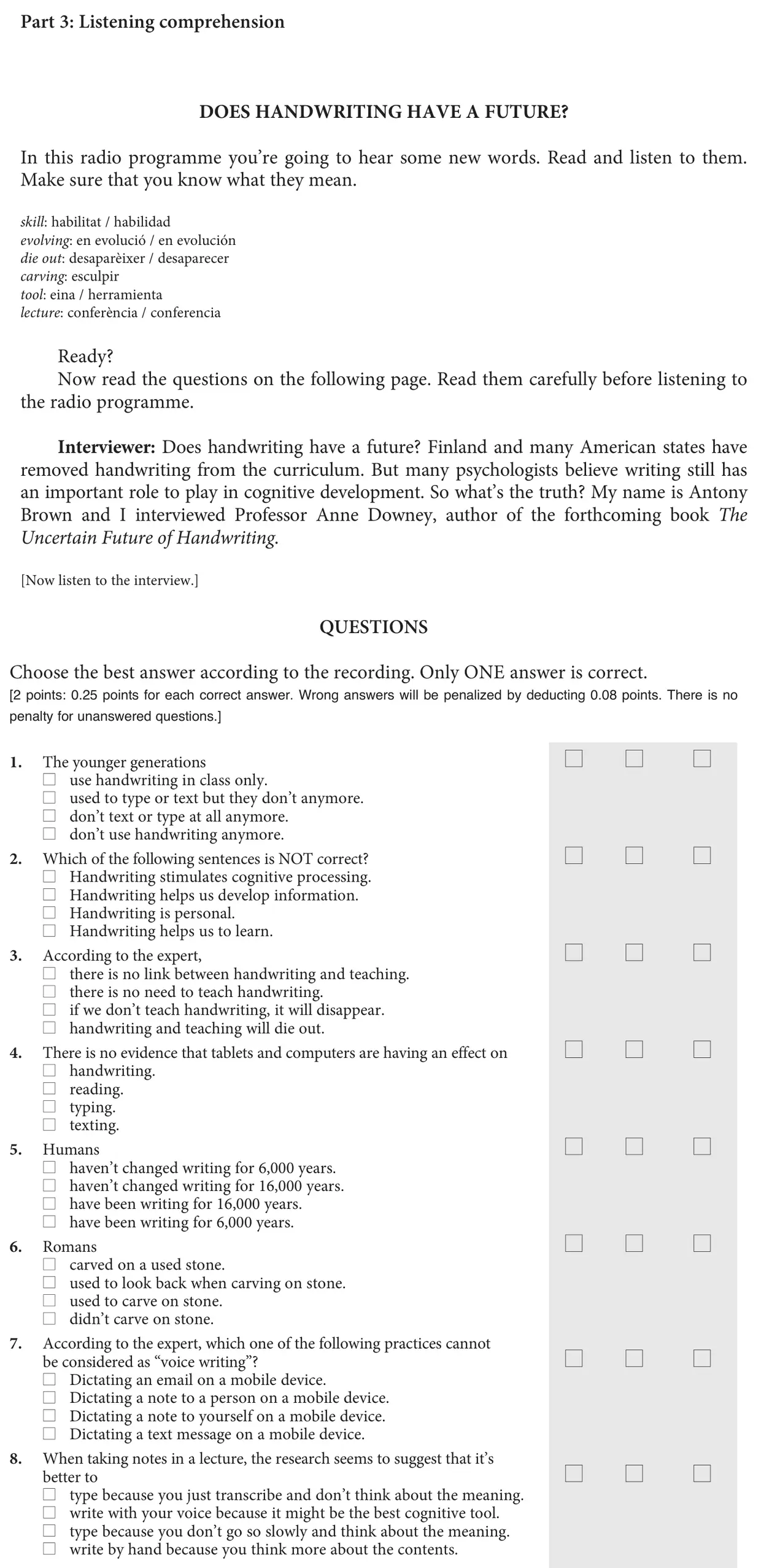
Text de l'enunciat (transcripció automàtica)
Part 3: Listening comprehension
DOES HANDWRITING HAVE A FUTURE?
In this radio programme you’re going to hear some new words. Read and listen to them.
Make sure that you know what they mean.
skill: habilitat / habilidad
evolving: en evolució / en evolución
die out: desaparèixer / desaparecer
carving: esculpir
tool: eina / herramienta
lecture: conferència / conferencia
Ready?
Now read the questions on the following page. Read them carefully before listening to
the radio programme.
Interviewer: Does handwriting have a future? Finland and many American states have
removed handwriting from the curriculum. But many psychologists believe writing still has
an important role to play in cognitive development. So what’s the truth? My name is Antony
Brown and I interviewed Professor Anne Downey, author of the forthcoming book The
Uncertain Future of Handwriting.
[Now listen to the interview.]
QUESTIONS
Choose the best answer according to the recording. Only ONE answer is correct.
[2 points: 0.25 points for each correct answer. Wrong answers will be penalized by deducting 0.08 points. There is no
penalty for unanswered questions.]
1. The younger generations
use handwriting in class only.
used to type or text but they don’t anymore.
don’t text or type at all anymore.
don’t use handwriting anymore.
2. Which of the following sentences is NOT correct?
Handwriting stimulates cognitive processing.
Handwriting helps us develop information.
Handwriting is personal.
Handwriting helps us to learn.
3. According to the expert,
there is no link between handwriting and teaching.
there is no need to teach handwriting.
if we don’t teach handwriting, it will disappear.
handwriting and teaching will die out.
4. There is no evidence that tablets and computers are having an effect on
handwriting.
reading.
typing.
texting.
5. Humans
haven’t changed writing for 6,000 years.
haven’t changed writing for 16,000 years.
have been writing for 16,000 years.
have been writing for 6,000 years.
6. Romans
carved on a used stone.
used to look back when carving on stone.
used to carve on stone.
didn’t carve on stone.
7. According to the expert, which one of the following practices cannot
be considered as “voice writing”?
Dictating an email on a mobile device.
Dictating a note to a person on a mobile device.
Dictating a note to yourself on a mobile device.
Dictating a text message on a mobile device.
8. When taking notes in a lecture, the research seems to suggest that it’s
better to
type because you just transcribe and don’t think about the meaning.
write with your voice because it might be the best cognitive tool.
type because you don’t go so slowly and think about the meaning.
write by hand because you think more about the contents.
Criteris oficials de correcció

Resolució pas a pas
Aquest exercici no té una resolució escrita pas a pas (requereix l'àudio de la prova). Fes servir els criteris oficials de correcció.
Font: enunciat i criteris de correcció oficials de les PAU 2017 de Catalunya, publicats per la Generalitat de Catalunya (universitats.gencat.cat) i les universitats catalanes. La resolució pas a pas és pròpia de L'Acadèmia de Vic.
Altres exercicis d'aquest examen
- Part 1 · Reading comprehension Reading comprehension
- Part 2 · Writing Writing
Tots els exercicis de Listening comprehension · PAU de Anglès