
PAU Anglès 2010 · Juny · Sèrie 4 · Part 3 · Listening comprehension
Enunciat
Text de l'enunciat (transcripció automàtica)
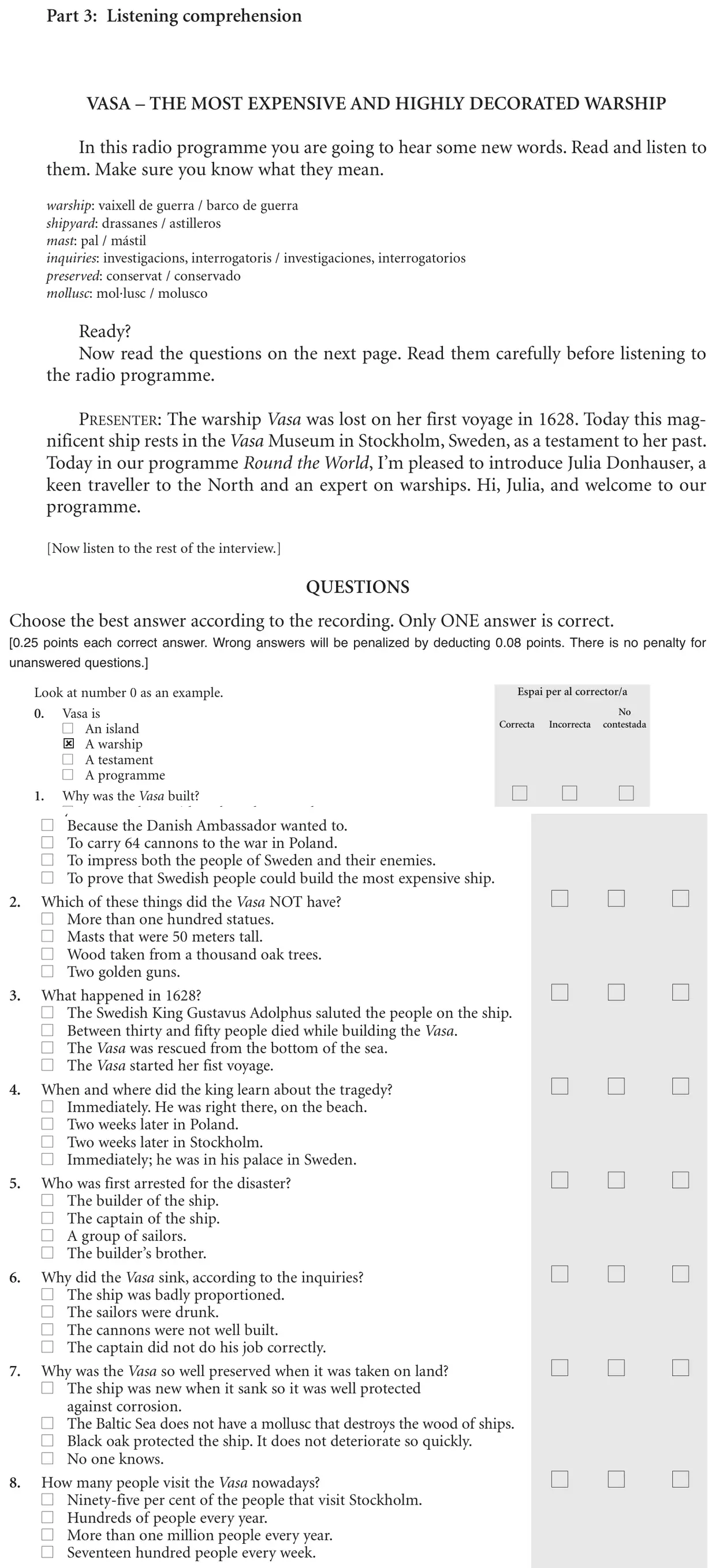
Part 3: Listening comprehension
VASA – THE MOST EXPENSIVE AND HIGHLY DECORATED WARSHIP
In this radio programme you are going to hear some new words. Read and listen to
them. Make sure you know what they mean.
warship: vaixell de guerra / barco de guerra
shipyard: drassanes / astilleros
mast: pal / mástil
inquiries: investigacions, interrogatoris / investigaciones, interrogatorios
preserved: conservat / conservado
mollusc: mol·lusc / molusco
Ready?
Now read the questions on the next page. Read them carefully before listening to
the radio programme.
PRESENTER: The warship Vasa was lost on her first voyage in 1628. Today this mag-
nificent ship rests in the Vasa Museum in Stockholm, Sweden, as a testament to her past.
Today in our programme Round the World, I’m pleased to introduce Julia Donhauser, a
keen traveller to the North and an expert on warships. Hi, Julia, and welcome to our
programme.
[Now listen to the rest of the interview.]
QUESTIONS
Choose the best answer according to the recording. Only ONE answer is correct.
[0.25 points each correct answer. Wrong answers will be penalized by deducting 0.08 points. There is no penalty for
unanswered questions.]
I Because the Danish Ambassador wanted to.
I Because the Danish Ambassador wanted to.
I To carry 64 cannons to the war in Poland.
I To impress both the people of Sweden and their enemies.
I To prove that Swedish people could build the most expensive ship.
2. Which of these things did the Vasa NOT have?
I More than one hundred statues.
I Masts that were 50 meters tall.
I Wood taken from a thousand oak trees.
I Two golden guns.
3. What happened in 1628?
I The Swedish King Gustavus Adolphus saluted the people on the ship.
I Between thirty and fifty people died while building the Vasa.
I The Vasa was rescued from the bottom of the sea.
I The Vasa started her fist voyage.
4. When and where did the king learn about the tragedy?
I Immediately. He was right there, on the beach.
I Two weeks later in Poland.
I Two weeks later in Stockholm.
I Immediately; he was in his palace in Sweden.
5. Who was first arrested for the disaster?
I The builder of the ship.
I The captain of the ship.
I A group of sailors.
I The builder’s brother.
6. Why did the Vasa sink, according to the inquiries?
I The ship was badly proportioned.
I The sailors were drunk.
I The cannons were not well built.
I The captain did not do his job correctly.
7. Why was the Vasa so well preserved when it was taken on land?
I The ship was new when it sank so it was well protected
against corrosion.
I The Baltic Sea does not have a mollusc that destroys the wood of ships.
I Black oak protected the ship. It does not deteriorate so quickly.
I No one knows.
8. How many people visit the Vasa nowadays?
I Ninety-five per cent of the people that visit Stockholm.
I Hundreds of people every year.
I More than one million people every year.
I Seventeen hundred people every week.
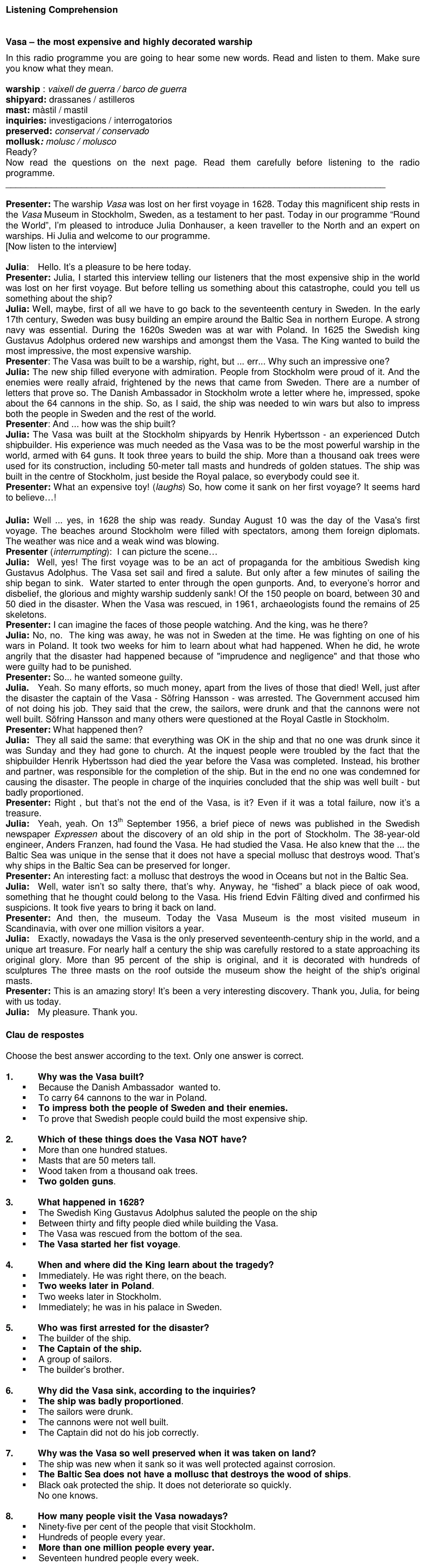
Criteris oficials de correcció
Resolució pas a pas
Aquest exercici no té una resolució escrita pas a pas (requereix l'àudio de la prova). Fes servir els criteris oficials de correcció.
Font: enunciat i criteris de correcció oficials de les PAU 2010 de Catalunya, publicats per la Generalitat de Catalunya (universitats.gencat.cat) i les universitats catalanes. La resolució pas a pas és pròpia de L'Acadèmia de Vic.
Altres exercicis d'aquest examen
- Part 1 · Reading comprehension Reading comprehension
- Part 2 · Writing Writing
Tots els exercicis de Listening comprehension · PAU de Anglès